Home » Blog » Can AI be 100% trusted in today’s date?
AI Knowledge
Can AI be 100% trusted in today’s date?
Max Schwertl
No, AI cannot be 100% trusted in today’s date.
While AI systems excel at specific tasks like data processing and pattern recognition, they remain limited by training data biases, occasional hallucinations, and inability to understand context like humans.
Complete trust in AI would be dangerous for critical decisions requiring ethical judgment, creative problem solving, or nuanced understanding of complex situations.
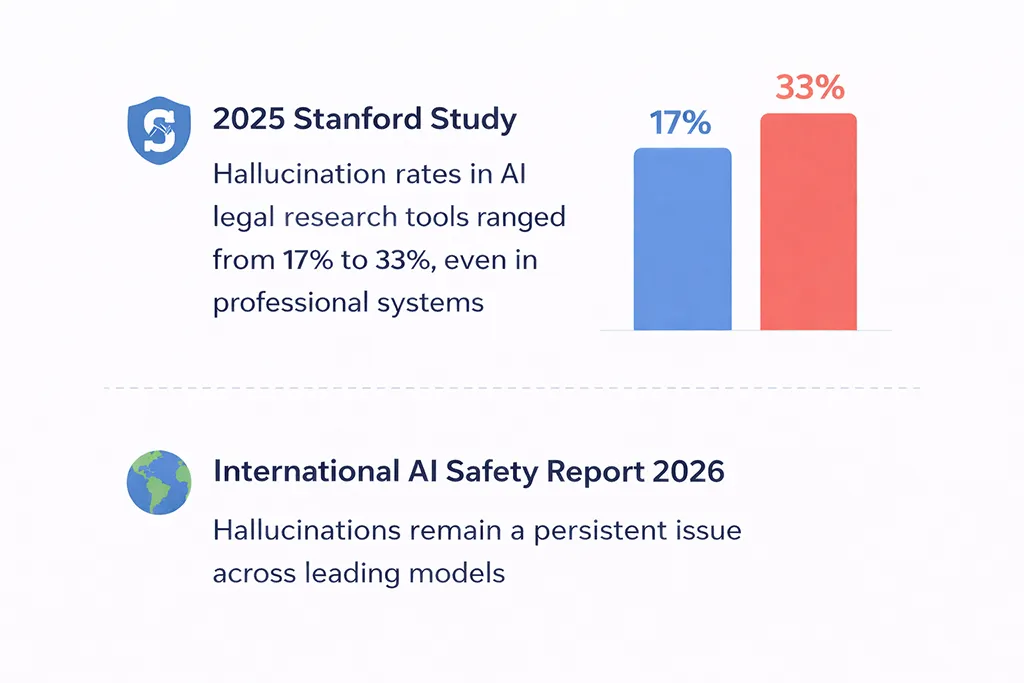
The International AI Safety Report 2026, a global synthesis written by over 100 experts, concludes that modern general-purpose AI systems remain “jagged” in performance, continue to generate false information (“hallucinations”), and require human verification in high-stakes contexts such as finance and healthcare. This reinforces that full, unconditional trust is not supported by current scientific evidence.
What does it mean for AI to be trustworthy in today’s context?
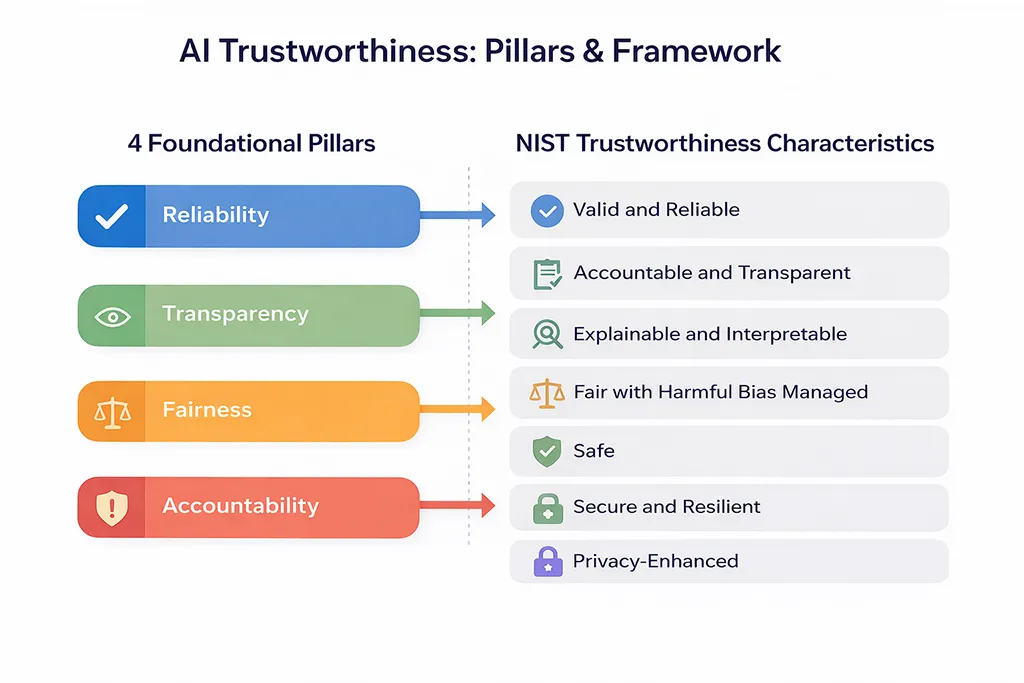
AI trustworthiness encompasses four key pillars:
Reliability: The AI performs consistently across different scenarios
Transparency: Users understand how the system reaches its conclusions
Fairness: The AI doesn’t discriminate against specific groups or individuals
Accountability: Clear responsibility chains exist when errors occur
Trust in AI differs fundamentally from trust in traditional technology.
When your calculator gives you the same result for 2+2 every time, that’s predictable reliability.
AI systems, however, work with probabilities and learned patterns, making their outputs less predictable and sometimes surprising even to their creators.
The challenge lies in balancing these factors. An AI system might be highly reliable for certain tasks but completely opaque in its decision making process. This creates a trust paradox where the system works well but you can’t understand why, making it difficult to predict when it might fail.
The U.S. National Institute of Standards and Technology (NIST) defines trustworthy AI as multi-dimensional, including “valid and reliable,” “accountable and transparent,” “explainable,” “fair with harmful bias managed,” “safe,” “secure,” and “privacy-enhanced.”
This confirms that trust is not a single metric but a contextual balance of characteristics depending on risk level and use case.
What are the main limitations that prevent AI from being 100% reliable?
AI systems face fundamental limitations that are built into how AI works, making perfect reliability technically impossible with current technology:
Training data biases
Hallucinations
Context gaps
Inability to reason beyond training parameters
Training Data Bias
Training data bias represents perhaps the most significant limitation. AI systems learn from historical data, which often contains human prejudices and societal inequalities. If the training data shows that certain groups were historically excluded from opportunities, the AI might perpetuate these patterns.
Hallucinations and False Information
Hallucinations occur when AI generates confident sounding but completely false information. This happens because AI systems predict what comes next based on patterns, not actual knowledge. They might create realistic sounding facts, citations, or explanations that have no basis in reality.
Context understanding remains limited. While AI can process vast amounts of information, it struggles with nuanced situations requiring cultural understanding, emotional intelligence, or real world experience. An AI might technically understand the words in a conversation about family relationships but miss the emotional subtext completely.
AI systems also cannot reason beyond their training cutoff dates or adapt to entirely new situations without additional training. They work within fixed parameters and cannot truly innovate or think creatively like humans do.
How do AI biases and errors impact real world decision making?
AI biases create measurable harm in hiring, lending, healthcare, and criminal justice systems. These errors don’t just affect individual decisions but can systematically disadvantage entire groups of people, amplifying existing societal inequalities at unprecedented scale.
Impact Across Key Sectors
In hiring, AI screening tools have been found to favour male candidates for technical roles because they learned from historical hiring data where men were predominantly selected. This perpetuates gender inequality even when companies intend to be fair.
Healthcare AI systems sometimes provide different quality recommendations based on race or socioeconomic factors reflected in their training data. This can lead to unequal treatment recommendations, with some patients receiving less thorough care suggestions than others.
Criminal justice algorithms used for sentencing or parole decisions have shown bias against certain ethnic groups. These systems influence real prison sentences and parole decisions, affecting people’s lives for years based on flawed algorithmic assessments.
Financial lending algorithms can perpetuate historical discrimination in loan approvals. Even when race isn’t directly considered, AI systems can use proxy variables like postcode or shopping patterns that correlate with protected characteristics, leading to discriminatory outcomes.
Scale of the Problem
The scale amplifies the problem. Where human bias might affect dozens of decisions, AI bias can affect thousands or millions of decisions automatically, spreading unfairness faster and wider than ever before.
What types of tasks can AI handle reliably versus those that require human oversight?
AI excels at data processing, pattern recognition, and repetitive tasks with clear parameters. It struggles with ethical decisions, creative problem solving, and contextual understanding. The key is matching AI capabilities to appropriate task types while maintaining human oversight for complex judgements.
Tasks AI Handles Well
AI performs reliably on tasks with clear inputs, defined processes, and measurable outputs:
Mathematical calculations
Data analysis
Image recognition
Language translation
Scheduling
Routine customer service queries
For content creators, AI content creation tools can help with initial drafts, keyword research, and SEO optimisation. AI can analyse search patterns, suggest topic ideas, and even generate basic content structures. However, the creative strategy, brand voice, and editorial decisions still require human judgement.
Tasks Requiring Human Oversight
These areas require empathy, cultural understanding, and moral reasoning:
Strategic planning
Ethical dilemmas
Creative storytelling
Relationship management
Any decision affecting people’s lives or livelihoods
The Hybrid Approach
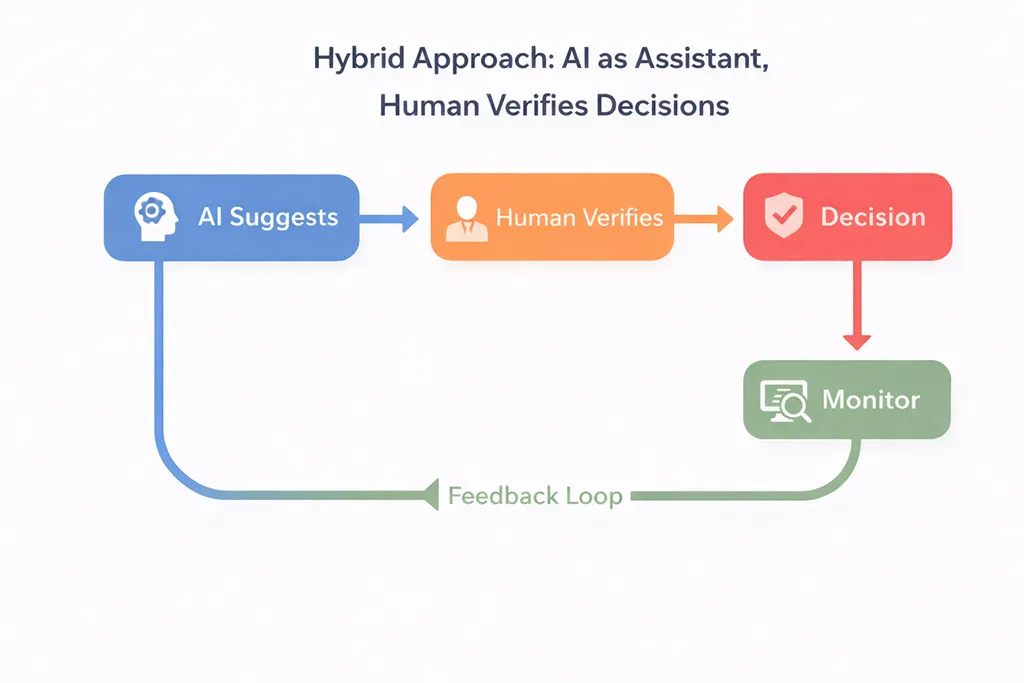
The most effective approach combines AI efficiency with human wisdom. AI can process information and suggest options, while humans make the final decisions and take responsibility for outcomes. This hybrid model leverages AI’s speed and accuracy while preserving human judgement for complex situations.
Consider AI as a powerful assistant rather than a replacement. It can handle the heavy lifting of data processing and routine tasks, freeing humans to focus on strategy, creativity, and relationship building where human skills remain irreplaceable.
The UK AI Security Institute’s Frontier AI Trends Report (Dec 2025) found that while safeguards are improving, vulnerabilities were identified in every system tested. This underscores the importance of fallback mechanisms and human oversight in real-world deployment.
How can businesses and individuals use AI safely without blind trust?
Safe AI implementation requires human in the loop processes, validation procedures, risk assessment protocols, and transparency requirements. The goal is leveraging AI benefits while maintaining control and accountability through systematic safeguards and oversight mechanisms.
Human in the Loop Processes
Human in the loop processes ensure that humans review and approve AI decisions, especially for important outcomes. This might mean having a person verify AI generated content before publication or requiring human approval for AI recommended business decisions.
Validation and Testing
Establish clear validation procedures:
Test AI outputs against known correct answers
Compare results with human experts
Regularly audit for bias or errors
For AI content creation, fact check and review for brand consistency
Ensure quality standards are maintained
Risk Assessment and Categorization
Implement risk assessment protocols that categorise decisions by potential impact. Low risk tasks like scheduling might run automatically, while high risk decisions like hiring or financial planning require multiple approval layers.
Transparency and Documentation
Maintain transparency by documenting how AI systems work, what data they use, and how decisions are made. Users should understand when they’re interacting with AI and have options to request human review.
Fallback Mechanisms
Create fallback mechanisms for when AI systems fail or produce unexpected results. This includes having human experts available to step in and alternative processes that don’t rely on AI.
Ongoing Monitoring
Regular monitoring and updates are essential. AI systems need ongoing oversight to catch drift in performance, identify new biases, and adapt to changing conditions.
What questions should you ask before trusting an AI system with important decisions?
Critical evaluation requires examining data sources, testing procedures, bias auditing, error rates, transparency levels, and fallback mechanisms. This framework helps assess whether an AI system is appropriate for your specific use case and risk tolerance.
Data and Training Questions
What data was used to train this system?
How recent is the training data?
Does the training data represent the population or situation where you’ll use the AI?
Are there known gaps or biases in the source data?
Testing and Validation
How was the system tested?
What’s the documented error rate?
Has it been tested on scenarios similar to yours?
Are there independent audits or validations available?
Bias and Fairness
Has the system been audited for bias?
How does it perform across different demographic groups?
Are there documented disparities in outcomes?
What steps have been taken to address identified biases?
Transparency and Explainability
Can the system explain its decisions?
Do you understand how it reaches conclusions?
Can you trace the reasoning process?
Is the logic accessible to non technical users?
Accountability and Control
Who’s responsible when the system makes errors?
Can decisions be appealed or overridden?
Are there human review processes?
What happens when the system fails or produces unexpected results?
Ongoing Monitoring
How is system performance monitored over time?
Are there alerts for unusual behaviour?
How often is the system updated or retrained?
What’s the process for addressing newly discovered problems?
The answers to these questions should inform your decision about whether and how to implement AI in your specific context. Remember that the right level of trust depends on the stakes involved and your ability to manage the risks.
Disclaimer: This blog contains content generated with the assistance of artificial intelligence (AI) and reviewed or edited by human experts. We always strive for accuracy, clarity, and compliance with local laws. If you have concerns about any content, please contact us.
You are currently viewing a placeholder content from YouTube. To access the actual content, click the button below. Please note that doing so will share data with third-party providers.