
Keyword Research
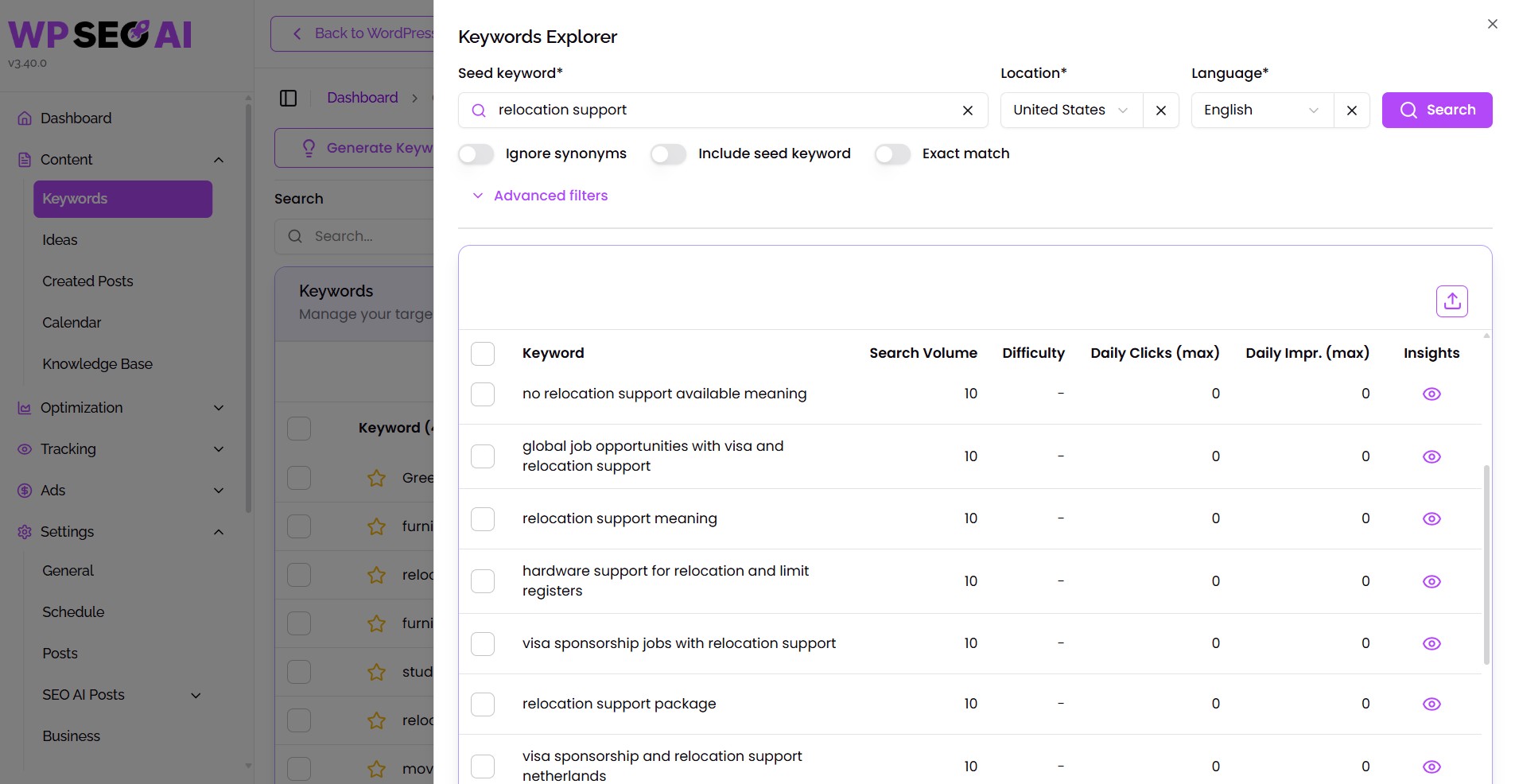
Discover keyword ideas
Find relevant keywords, long-tail terms, and new search opportunities.
Analyze keyword data
Review search volume, difficulty, CPC, intent, country, and language.
Explore SERPs
See which competitors rank and what content formats perform best.
Find user questions
Uncover real questions people ask around your target topic.
Build keyword clusters
Group related keywords into structured topic clusters for better planning.
Track rankings
Monitor keyword positions, ranking changes, and new keyword wins over time.
The reason
Why Keyword Research matters
Why it matters
Stop guessing what your audience searches for
What you get
A complete keyword workflow
Uses cases
How to use Keyword Research
Start with a seed keyword
Analyze keyword metrics
Review SERP competitors
Explore user questions
Build keyword clusters
Track keyword performance
You are currently viewing a placeholder content from YouTube. To access the actual content, click the button below. Please note that doing so will share data with third-party providers.
More InformationIn Detail
What exactly is Keyword Research?
Keyword Research is a discovery and planning feature inside WP SEO AI. It helps you find, analyze, organize, and track the keywords that matter most to your business. You can explore keyword metrics, SERP competitors, user questions, AI-generated ideas, keyword clusters, and ranking changes in one workflow. This gives you a clearer path from keyword discovery to content planning and performance tracking.
Benefits - your unfair advantages using this feature:
Find better opportunities
Understand search intent
Reduce content guesswork
Build topical authority
Learn from competitors
Verdict
Final thoughts
WP SEO AI’s Keyword Research is built for teams who want to find the right keywords and turn them into a scalable SEO strategy.
Instead of collecting random keyword lists, you can discover opportunities, analyze intent, review competitors, group keywords into clusters, and track performance over time. This makes keyword research more practical, organized, and connected to your content workflow.
With the right keywords, your content plan becomes clearer, more focused, and easier to grow.
FAQ
Everything you need to know about Keyword Research
Can I find long-tail keywords?
What keyword metrics can I analyze?
Can I see who ranks for a keyword?
Can I find user questions?
Can I organize keywords into clusters?
Can I track keyword rankings?
Who benefits most from this feature?
Book a demo
See the platform in action
Our experts are happy to give you a full tour through our platform. Book your spot now!
All features
Explore every feature in one place. Browse by use case, from AI content creation to tracking, optimization, search ads, and settings, and find all the features we use to make you successful in Search.
AI Writer
Create helpful content for your readers and future customers.
AI Blog Editor
Use our AI to edit content live with prompts inside the Gutenberg and Classic Editor.
AI Image Generation
Helping you to instantly craft beautiful, custom tailored visuals.
Content Calendar
Drag your blog drafts into the calendar to auto-schedule or publish them immediately.
Idea Generation
Generate the content ideas necessary to reach topical authority in your industry.
Internal Linking
Pave the way and establish a smart internal navigation for users and search engines.
Keyword Research
Discover long-tail keywords with low competition and high probabilty to rank #1.
Topical Map Generator
Organize, expand, and monitor your content clusters with AI-powered precision.
Translate Content
Use traditional WordPress translation plugins together with WP SEO AI to translate our blogs.
AI Visibility Tracking
Track your brand's visibility across leading LLMs like ChatGPT, Gemini, and Google’s AI Overviews.
AI Bot Tracking
See which AI bots crawl your website and identify pages to optimize for AI visibility.
Competitor Tracking
Spy on your competitors' SEO strategy and identify quick wins in order to outrank them.
Conversion Tracking
Connect your Google Analytics account with WP SEO AI and track conversions.
Keyword Analysis
Find all the keywords you are ranking with in Google and how they perform over time.
Search Visibility Dashboard
Tracks and shows you all search metrics you need to measure success.
Technical SEO Audit
Analyse your page speed or other issues and get actionable insights to improve your technicals.
Content Improvement
Analyse your indexed content, get improvement ideas and execute them with one click.
Content Pruning
Detect and clean low performing content from your website to improve overal site quality.
Keyword Cannibalization
Strengthen the authority of your most important pages by detecting and solving keyword overlap.
Lead Form
Capture more leads with personalized, high-converting forms built directly into your blog content.
LLM Optimization
Discover the fan-out-queries behind every search in AI and optimize for them.
Mass Content Edit
Mass-Edit your content, add internal links or make your content more in-depth with one click.
Universal Page Optimization
Optimize all your pages based on data from Search Console, Google Ads & Google Analytics.
Search Ads
Create unique long-tail ads and optimize your own ads with smart filters.
Configuration
Transform our platform into a content teammate who truly understands your business.
Knowledge Bases
Build a pool of expert knowledge for your AI to reduce hallucinaiton and improve accuray in writing.
Prompt Library
Save, organise, and reuse your best-performing prompts across all major functions in the platform.