

Partially ranking on Google can still get you cited in an AI answer, but less than you’d think. When you put a site’s organic performance data next to its new generative AI performance report from Search Console, the two surfaces overlap by roughly half.
That’s exactly what we did after we gained access today:
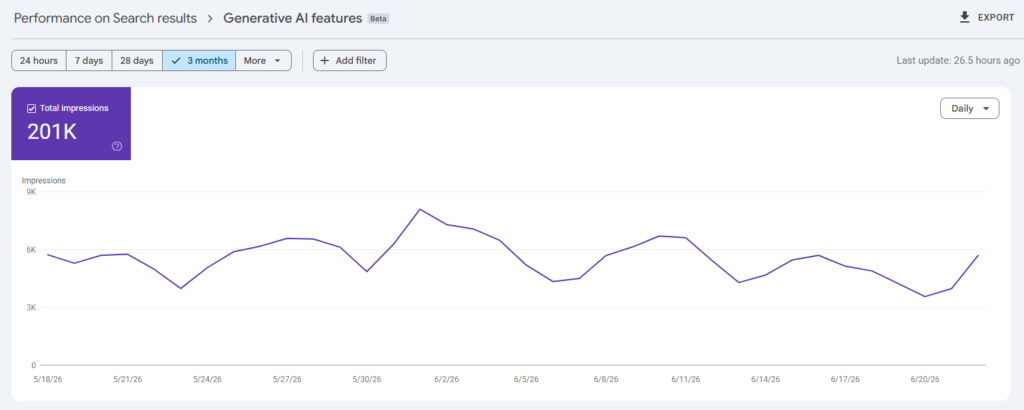
The analysis behind this post compared two Search Console exports from the same site, covering the same three-month window: the standard pages performance report (organic clicks, impressions, CTR, and position for the top 1,000 URLs) and the new generative AI pages report (impressions per URL across AI Overviews and AI Mode). The site is a mid-size B2B publisher operating across English, German, Dutch, Finnish, and Swedish, with around 1,000 indexed pages drawing roughly 25,000 organic clicks and 200,000 AI impressions in the period analyzed. We merged the two datasets at the URL level, ran rank correlations across the 810 pages that appeared in both reports, and looked at where they diverged. The findings below are drawn from that comparison.
Verdict: The pages that win in classic Google search and the pages that get cited in AI Overviews are correlated, but they aren’t the same set. Ranking is the price of entry into AI citation, not a guarantee of it. The pages that actually get pulled into AI answers are a specific subset of the pages that rank, and the gap between the two is where most of the strategic insight sits.
How strong is the link between ranking and AI citation?
Across one mid-size content site we analyzed, 810 URLs appeared in both the organic pages report and the generative AI pages report for the same three-month window. The Spearman rank correlation between organic clicks and AI impressions across those pages was 0.61. That is a real and statistically robust relationship, but it is a long way from the near-perfect alignment you would see if the two surfaces were measuring the same thing.
The top-N overlap tells the same story in plainer terms.
| Top pages by metric | Overlap |
|---|---|
| Top 10 organic vs top 10 AI | 6 of 10 (60%) |
| Top 25 organic vs top 25 AI | 13 of 25 (52%) |
| Top 50 organic vs top 50 AI | 25 of 50 (50%) |
| Top 100 organic vs top 100 AI | 54 of 100 (54%) |
What this means: Roughly half of the top performers are shared at every cutoff. The other half are different pages doing different work. Any strategy that treats AI visibility as a byproduct of organic ranking is missing the half that diverges.
Why does AI correlate better with impressions than with clicks?
When we ran the same correlation against organic impressions instead of organic clicks, the rank correlation jumped from 0.61 to 0.76. This is probably the cleanest finding in the analysis and the most useful one strategically.
AI Overviews appear to draw from the same pool of pages Google considers relevant for a given query. That pool is reflected in impression data: which pages Google chooses to show. Whether those pages then win the click is a separate question, governed by snippet quality, title tags, position on the SERP, and intent match. AI citation cares about the first question and not the second.
Practically, this means impression growth is a better leading indicator for AI visibility than click growth. A page can be gaining AI citations while losing classic clicks, and vice versa. The two metrics are pulling apart on the same content.
Does AI mention websites the same way in every language?
No, and the difference is bigger than you might expect. This matters a lot if your business operates in more than one country.
We looked at a website that publishes articles in five languages: English, German, Dutch, Finnish, and Swedish. Then we compared two things:
- AI impressions: how often the site got mentioned or cited inside AI answers (like Google’s AI Overviews or ChatGPT responses)
- Organic clicks: how many people found the site through a regular Google search
| Language section | Share of organic clicks | Share of AI impressions |
|---|---|---|
| English blog | 41% | 86% |
| German | 11% | 10% |
| Dutch | 8% | 3% |
| Finnish | 4% | <1% |
What this actually means, in plain terms:
- English content got way more love from AI than from Google. It pulled 41% of regular clicks but made up 86% of AI mentions. AI tools are leaning heavily on English sources.
- German was balanced. Roughly the same share in both places. Fair treatment.
- Dutch got shortchanged. Decent traffic from Google, but AI barely mentioned it.
- Finnish basically disappeared in AI answers, even though real people were still finding the site through Google searches in Finnish.
The takeaway:
AI tools don’t treat every language equally yet. If your content does well in English AI answers, don’t assume the same approach will work in smaller language markets. The technology behind AI search just isn’t as developed in those languages right now. A strategy that wins in English may produce almost nothing in Finnish or Dutch, so plan your content investment accordingly.
What should this change about content strategy?
Three things follow from the data.
- Ranking still matters, because being in Google’s relevance pool is what makes a page eligible for AI citation in the first place. Anyone telling you that AI visibility has decoupled from search is overstating it. The correlation is 0.61, not 0.
- Ranking is not enough. Half of the top organic performers on a site will not be top AI-cited performers, and the half that gets cited tends to share a specific format. If a content plan does not actively produce structured, question-shaped, list-based informational posts, it will under-perform in AI surfaces regardless of how well the rest of the site ranks.
- The two reports should be read together, not separately. The organic pages report on its own will tell you what is winning clicks. The AI pages report on its own will tell you what is being summarized. Only the overlap analysis reveals which pages are doing both jobs, which are only doing one, and where the gaps in a content portfolio actually sit.
The new generative AI report in Search Console is the first time site owners have had visibility into this gap with real data. Most sites that pull both exports and compare them will find roughly the same pattern: a moderate correlation, a meaningful divergence, and a clear template emerging for the kind of content that gets cited. The work now is acting on what the comparison shows.
What it means to rank on Google vs. get cited by AI
Google ranking and AI citation are two distinct forms of search visibility, and confusing them is the root of most modern SEO blind spots.
A Google ranking means your page appears in a list of results when someone searches a query. Google’s algorithm evaluates over 200 signals, including content quality, backlinks, Core Web Vitals, and how well the page matches search intent. The user sees your result as a link and decides whether to click. Traffic only arrives if they do.
An AI citation means a generative engine, such as Google AI Overviews, ChatGPT, or Perplexity, extracts content from your page and surfaces it inside a synthesized answer. The user reads your information without necessarily visiting your site. Your brand gets exposure regardless of whether a click happens.
The practical difference matters because user behavior has shifted. Zero-click searches now account for roughly 68% of U.S. queries, and AI Overviews are a primary driver of that pattern. A top-ranking page that earns no AI citation is increasingly a page that earns fewer clicks than it did two years ago.
How Google’s ranking signals differ from AI citation signals
Google and generative engines evaluate content through fundamentally different lenses. Understanding those differences is the first step toward optimizing for both.
Google’s algorithm in 2026 weights content quality most heavily, followed by keyword placement, backlinks, topical expertise, and user engagement. E-E-A-T (Experience, Expertise, Authoritativeness, Trustworthiness) is not a direct algorithmic score. It is a framework from Google’s Quality Rater Guidelines that shapes how human evaluators assess page quality, which in turn informs how the algorithm is trained. Google rewards persuasive, brand-differentiated content that satisfies a specific query.
AI citation signals work differently. Generative engines use a process called Retrieval-Augmented Generation (RAG), which retrieves external web content in real time before generating a response. That retrieval step evaluates content on criteria that Google’s ranking algorithm does not prioritize:
- Semantic completeness: Can the page answer a question without requiring the AI to pull context from elsewhere?
- Entity density: Does the page reference enough named entities (people, tools, organizations, standards) to be verifiable?
- Structured data: Is the content marked up in a way that machines can parse quickly?
- Vector embedding alignment: Does the semantic meaning of the page closely match the query, even without exact keyword overlap?
- Factual freshness: Is the content current enough to pass real-time verification?
Google’s algorithm rewards a confident brand voice. AI retrieval systems prefer neutral, factual prose that answers directly. A page optimized to convert a human reader may be structured in exactly the wrong way for a generative engine to extract and cite it.
Brand authority also plays a role that traditional SEO underweights. Research from The Digital Bloom found that brand search volume is the strongest predictor of LLM citations, outperforming backlink profiles. Brands with a presence across multiple platforms are significantly more likely to appear in ChatGPT responses than single-platform brands.
Why a top-ranking page can still be invisible to AI
The assumption that ranking in Google’s top 10 guarantees AI citation is now demonstrably false, and the gap is widening.
An Ahrefs study of 863,000 keywords found that only 38% of pages cited in Google AI Overviews also rank in Google’s top 10 for the same query. For third-party AI platforms like ChatGPT and Perplexity, the overlap is even smaller: roughly 12% of cited URLs rank in Google’s top 10 for the same prompt. Around 28% of ChatGPT’s most-cited pages have zero organic visibility on Google at all.
Several structural reasons explain this decoupling.
Query fan-out bypasses exact-match pages
When an AI Overview is triggered, Google decomposes the original query into multiple related sub-queries. It then cites pages that perform well across that wider cluster, not just the page that ranks for the original exact query. A page optimized for one specific keyword phrase may be passed over in favor of pages that cover the broader topic from multiple angles.
JavaScript rendering blocks AI crawlers
Most AI crawlers, including GPTBot, ClaudeBot, and PerplexityBot, do not render JavaScript. A page can rank well in Google and appear in AI Overviews yet still appear blank to ChatGPT, Claude, and Perplexity if its content loads via client-side scripts. The page exists in Google’s index; it is simply unreadable to the AI retrieval layer.
AI platforms favor different source types
YouTube has become the most-cited domain in Google AI Overviews. Reddit accounts for a substantial share of citations across multiple AI platforms. These sources are not ranking for the queries they appear in. They are being selected because their content structure, entity density, and community-validated factual signals match what AI retrieval systems prioritize.
The practical implication: a page can do everything right for Google and still fail to meet the criteria that generative engines use to select sources. Google ranking is a necessary but no longer sufficient condition for AI citation.
What makes content citation-worthy for generative engines
Citation-worthy content for generative engines shares a specific set of characteristics. These are not vague quality signals. They are structural and measurable.
Answer placement and content structure
AI systems scan for a clear answer at the beginning of content, extract it, and move on. Research from CXL found that over half of AI Overview citations come from the top third of a page. Leading with the direct answer, not with background context or narrative setup, is the single most actionable structural change you can make.
Content should be formatted for extraction: direct answers in the opening paragraph, clear H2 and H3 headings, bulleted lists, numbered steps, and FAQ blocks. AI systems pull individual passages, not entire pages, so every section needs to stand alone as a complete answer.
Factual density and original data
Cited articles consistently cover more facts than non-cited ones. Adding statistics to content improves AI visibility, and original research or proprietary data are among the strongest differentiators. Named authors with verifiable external credentials also matter: anonymous bylines or “content team” attributions function as a disadvantage in AI retrieval because generative engines increasingly weight author authority as a trust signal.
Structured data and entity richness
Pages with proper schema markup show meaningfully higher selection rates in AI-generated answers. FAQPage schema remains valid and is processed by Bing, Perplexity, and other AI crawlers even after Google deprecated FAQ rich results in May 2026. Schema helps machines parse your content quickly and confidently.
Entity density matters equally. Pages that reference a high number of recognized entities, including tools, organizations, people, and standards, show significantly higher AI citation probability than pages with sparse entity coverage. Specific, named language is not just clearer for human readers; it is more useful to AI retrieval systems.
Content freshness
AI citation decay begins around the 13-week mark for most content. New content can enter AI citation pools within three to five days, compared to three to six months for Google ranking. This makes freshness a more urgent variable for GEO than for traditional SEO.
How to optimize for both Google and AI visibility
Building on the signal differences covered in the earlier sections, the practical path forward is to treat SEO as the foundation and GEO as the layer on top. The two are not in conflict. Strong traditional SEO still correlates with AI citation, particularly for Google AI Overviews. The goal is to extend your existing SEO work with the additional signals that generative engines require.
Structure content for extraction from the start
Every piece of content should open with the direct answer to the question it addresses. Use hierarchical headings that mirror the literal questions a user would ask. Write each section so it can be understood without the surrounding context. This structure serves both human readers and AI retrieval systems simultaneously.
Build topic clusters, not isolated pages
AI Overviews favor sources that demonstrate breadth across a topic, not just depth on a single page. Topic cluster architecture improves performance in both Google’s traditional rankings and AI fan-out sub-query retrieval. A cluster of interconnected pages covering a topic from multiple angles gives AI systems more surface area to cite.
Implement schema markup consistently
Schema markup improves AI Overview selection rates and increases the probability of appearing in AI-generated answers. Apply it consistently across your content, prioritizing Article, FAQPage, HowTo, and Organization schemas. Google’s own AI optimization guide confirms schema remains important for AI visibility.
Expand your off-site presence
Publishing original research, contributing to industry forums like Reddit and LinkedIn, and earning press coverage all increase your AI citation surface area. AI engines frequently cite Reddit, Wikipedia, and major news publications. Being present and credible in those ecosystems raises your chances of being selected when a generative engine retrieves sources for a relevant query.
Track AI visibility separately from organic rankings
Google Search Console does not show AI citation data. Dedicated tools like Profound, Otterly AI, and Peec AI track citation frequency across AI platforms independently of traditional rank tracking. Citation patterns across major AI platforms can shift by 40 to 60% month over month, which makes continuous monitoring necessary rather than optional.
The majority of brands are not yet tracking AI search performance at all, which means the gap between those who do and those who do not is growing.
The practical reality in 2026 is that Google ranking and AI citation are related but separate outcomes. A well-executed SEO strategy gets you closer to both, but only a strategy that explicitly addresses GEO signals will close the gap. The tools, frameworks, and content structures that earn AI citations are learnable, measurable, and increasingly worth the investment.
Frequently Asked Questions
How do I know if my content is actually being cited by AI platforms like ChatGPT or Perplexity?
The most reliable approach is to use dedicated GEO monitoring tools such as Profound, Otterly AI, or Peec AI, which track how often and in what context your content appears in AI-generated responses across major platforms. You can also manually test by submitting relevant queries to ChatGPT, Perplexity, and Google AI Overviews and checking whether your domain or content is referenced. Google Search Console does not surface this data, so manual or third-party tracking is currently the only viable path.
If my site relies heavily on JavaScript frameworks like React or Next.js, how big of a problem is that for AI citation?
It depends on how your content is delivered. If key page content is rendered client-side via JavaScript, most AI crawlers — including GPTBot, ClaudeBot, and PerplexityBot — will see a blank or near-empty page, even if Google indexes it perfectly through its own rendering pipeline. The fix is to ensure critical content is available in the initial HTML response through server-side rendering (SSR) or static site generation (SSG). Run your URLs through a tool like Google’s Rich Results Test or a raw HTTP fetch to see exactly what a non-rendering crawler would see.
What's the most common mistake content teams make when trying to optimize for AI citation?
The most common mistake is burying the direct answer deep in the content — after lengthy introductions, background sections, or storytelling setups. Since AI systems prioritize the top third of a page and pull individual passages rather than full articles, content that doesn’t lead with a clear, self-contained answer is frequently skipped over entirely. A quick audit of your existing top pages to move the core answer to the opening paragraph is one of the highest-impact, lowest-effort changes you can make.
Does earning more backlinks still help with AI citation, or is it irrelevant for GEO?
Backlinks remain relevant but are no longer the dominant signal for AI citation that they are for traditional Google ranking. Research suggests that brand search volume and multi-platform presence are stronger predictors of LLM citations than backlink profiles alone. That said, high-authority backlinks still contribute indirectly — they drive brand awareness, increase the likelihood of press coverage, and signal credibility to the broader web ecosystem that AI systems draw from. Think of backlinks as a supporting signal rather than the primary lever for GEO.
How often should I refresh existing content to maintain AI citation visibility?
Given that AI citation decay begins around the 13-week mark for most content, a quarterly refresh cycle is a reasonable minimum for your highest-priority pages. For fast-moving topics, a monthly update cadence is more appropriate. Refreshes don’t need to be full rewrites — updating statistics, adding newly relevant entities, replacing outdated examples, and verifying factual accuracy are typically enough to reset the freshness signal and re-enter active citation pools.
Is there a content length or format that generative engines prefer when selecting sources to cite?
Generative engines don’t consistently favor longer content the way traditional SEO has historically suggested. What matters more is structural clarity and self-contained sections: each H2 or H3 section should answer its implied question completely without relying on surrounding context. Practically, this means using direct opening sentences, bullet points, numbered lists, and FAQ blocks throughout your content rather than dense narrative paragraphs. Shorter, well-structured pages with high factual density often outperform longer, loosely organized ones in AI citation.
Should small or newer websites bother with GEO, or is AI citation only realistic for established brands?
GEO is actually an area where smaller or newer sites can compete more effectively than in traditional SEO, because AI citation is less dependent on domain authority and backlink volume. A newer site publishing original research, specific data, or highly structured answers on a niche topic can earn AI citations relatively quickly — sometimes within days of publication — while it might take months to climb Google’s organic rankings for the same query. The key advantages to focus on early are content structure, factual specificity, schema markup, and building a presence on platforms like Reddit or LinkedIn that AI systems frequently cite.
This content was generated with the help of AI and it may contain mistakes