

Google’s latest AI Mode Insights report may focus on U.S. users, but for anyone working in SEO, content marketing, or digital visibility in Europe, the document offers something far more important than regional statistics: a glimpse into where search behavior itself is heading.
TL;DR: Google’s new AI Mode Insights report confirms what many in SEO are already noticing: search behavior is fundamentally changing. Users are asking longer, more conversational questions, refining searches through follow-up interactions, and increasingly relying on AI systems to help them complete tasks instead of simply finding links. While the report focuses on U.S. users, the underlying behavioral trends are highly likely to emerge across Europe as well.
For businesses, this means traditional keyword-focused SEO alone is no longer enough. AI-driven search rewards topical authority, structured and extractable content, strong entity trust, and websites that can clearly help users solve problems.
Here are some of the key insights about AI Mode in the U.S. one year after launch and why they strongly support the direction we are taking at WP SEO AI:
#1 Asking longer questions: The average AI Mode search query is already three times longer than a traditional Google search query.
➣ At WP SEO AI, this is exactly the type of search behavior we optimize for. Our content is designed to satisfy longer, more specialized, and more contextual questions with clear expert-driven answers instead of only targeting isolated keywords.
#2 Getting things done: AI Mode queries related to planning, schedules, routines, and task completion have grown 80% faster than AI Mode queries overall in the past six months.
➣ We tackle this by working with real companies that help people solve real problems and complete real tasks. Inside our content, we inform, answer questions, and inspire users, while also strategically connecting them to important conversion-oriented pillar pages. This helps users move naturally from information seeking to actually fulfilling a need directly on the customer’s website.
#3 Making decisions: Brainstorming-related searches are growing rapidly, with strong increases in searches starting with “where to,” “where should I,” and “ideas for.”
➣ Our goal is always to position customers as the authority within the topical areas connected to their products and services. What we consistently see is that the stronger the authority of a brand becomes, the more often it gets recommended as a go-to destination when users ask questions like “Where can I repair my refrigerator?” or “Where can I eat vegan poke bowls in Amsterdam?” This perfectly aligns with our long-term vision: before AI systems recommend you as the preferred destination, you first need to build deep authority around the core topics connected to your business.
Many of the patterns Google highlights are already visible across Europe as well. We can confirm this with our own experience and data.
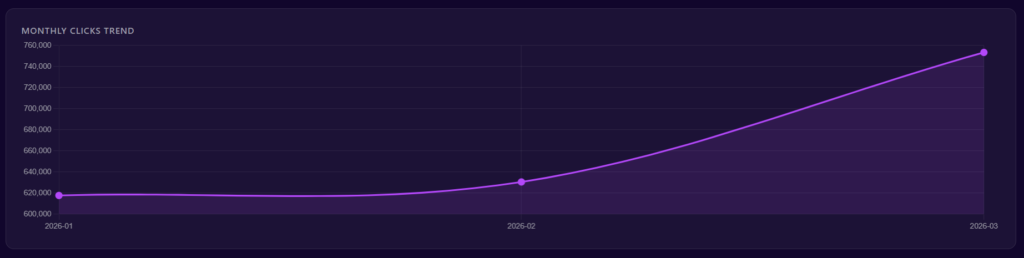
WP SEO AI internal data from Q1 2026
Just to show how closely our systems and processes align with real user behavior: while much of the industry is facing declining organic traffic, WP SEO AI increased monthly clicks at portfolio level from 617,000 to 753,000.
How you might ask? Simple. By creating genuinely helpful content that does not just encourage users to click, but helps them continue their journey deeper into our customers’ websites to fulfill the actual needs and intentions they came with in the first place.
Yes, rollout speed may differ. Regulation may differ. Language diversity may influence adoption. But the underlying behavioral shift is universal: people are moving away from traditional keyword-based searching and toward conversational, AI-assisted discovery.
The way people interact with information online is fundamentally changing.
For us at WP SEO AI, this report is especially interesting because it validates many of the strategic directions we’ve already been building toward for years.
Search Is Becoming Conversational
One of the clearest findings from Google’s report is that AI Mode is changing how people formulate searches. Users are no longer trying to “optimize” their queries into short keywords. They simply ask naturally.
Google states that the average AI Mode query is now three times longer than a traditional search query. Follow-up conversations are increasing rapidly, and people are refining their searches through natural back-and-forth interactions.
This is a massive shift.
For years, SEO largely revolved around matching pages to isolated search terms. But conversational AI changes the dynamic completely. Users are no longer just looking for “best running shoes.” They ask:
“Which running shoes are best for knee pain during marathon training at different price points?”
That changes what successful content looks like.
Search is moving from keyword retrieval toward contextual problem solving.
And this is not limited to the U.S. Whether someone uses Google AI Mode, ChatGPT, Gemini, Perplexity, or Claude in Europe, the interaction model is becoming increasingly similar: longer prompts, follow-up questions, comparisons, refinement, and contextual exploration.
People Are Searching for Outcomes, Not Just Information
Another important insight from the report is that AI search is expanding what people consider “searchable.”
People are no longer only searching for information. They are searching for assistance.
Google’s examples include:
- planning vacations,
- building workout routines,
- creating study guides,
- comparing products,
- finding restaurants with specific vibes,
- learning new skills,
- organizing schedules,
- and making financial plans.
The pattern here matters more than the examples themselves.
Users increasingly expect search engines and AI systems to help them complete tasks, not just present links.
This has enormous implications for SEO and content strategy.
The brands that win in AI-driven search environments will not simply be the ones with the highest rankings. They will be the ones that help users achieve outcomes.
That means:
- clearer expertise,
- deeper topical coverage,
- structured information,
- actionable guidance,
- and trustworthy content ecosystems.
AI Search Rewards Topical Authority
One of the strongest signals throughout the report is how conversational search naturally leads users deeper into topics.
Google reports significant growth in follow-up queries and multi-step conversations.
That supports something we have believed for a long time at WP SEO AI:
One isolated page is no longer enough.
AI systems do not evaluate content the same way traditional ranking systems did. Instead of matching a single keyword to a single page, they increasingly evaluate broader topical understanding, entity relationships, contextual trust, and supporting information across an entire website.
In other words:
the future belongs to websites that demonstrate comprehensive topical authority.
This is exactly why we emphasize:
- topic clusters,
- internal linking,
- entity-first SEO,
- semantic relevance,
- and structured content ecosystems.
The future winner is not the page with the best keyword density.
It’s the website with the clearest and most trustworthy understanding of a topic.
Multimodal Search Is Becoming the Default
Another trend that will almost certainly become universal across Europe is multimodal search behavior.
According to Google, more than one in six AI Mode searches are already non-text queries, and image-based searches are among the fastest-growing query types.
Users are increasingly:
- uploading screenshots,
- using voice,
- sharing images,
- interacting through video,
- and combining multiple input types in one search experience.
This changes SEO dramatically.
Search optimization can no longer focus only on text.
Brands now need:
- clean technical structures,
- machine-readable content,
- semantic clarity,
- optimized media,
- proper schema,
- fast rendering,
- and strong contextual signals across all content formats.
The websites that AI systems can easily understand will have a major advantage.
AI Visibility Is Becoming the New Battleground
Perhaps the most important takeaway from Google’s report is this:
Visibility is no longer only about rankings.
AI systems increasingly synthesize answers directly inside the search experience. Users often interact with the response itself before ever clicking through to a website.
That changes the strategic question from:
“How do we rank?”
to:
“How do we become part of the answer?”
This is exactly why we believe SEO, GEO, and AI visibility can no longer be treated separately.
At WP SEO AI, we’ve been moving toward a broader Search Visibility approach because modern search results now combine:
- organic results,
- AI-generated answers,
- paid placements,
- entity references,
- and conversational recommendations
inside a single experience.
Traditional ranking reports alone no longer reflect actual visibility.
The brands that succeed will be the ones AI systems consistently:
- understand,
- trust,
- retrieve,
- and cite.
Why This Report Validates the Direction We’ve Taken
What makes Google’s AI Mode report especially interesting to us is how strongly it validates many of the principles we already built WP SEO AI around.
Long before AI Mode became mainstream, we already believed:
- search would become conversational,
- topical authority would matter more than isolated keywords,
- structured and extractable content would become critical,
- AI systems would reward clarity and expertise,
- and visibility would extend beyond traditional rankings.
That is why our approach combines:
- SEO,
- AI visibility,
- topical authority,
- technical optimization,
- and content workflows
into a single execution layer inside WordPress.
Because ultimately, AI search is not replacing SEO.
It is changing what good SEO looks like.
The Future of Search Is Already Starting
Europe may not evolve exactly like the U.S.
But the direction is becoming increasingly clear everywhere.
Search is becoming:
- conversational,
- multimodal,
- iterative,
- contextual,
- and outcome-driven.
And as AI systems become more integrated into discovery, recommendation, and decision-making, businesses that optimize only for rankings risk becoming invisible inside the new search experience.
The future of search visibility belongs to brands that can be understood, trusted, and cited by both humans and AI systems.