Large language models like ChatGPT, Claude, Gemini, and Perplexity AI are changing how people find information online. Traditional search rankings don’t tell you whether your brand appears when someone asks these AI tools a question. You need a platform that tracks your visibility in AI-generated answers, showing which queries mention your brand and how often you appear as a source.
WP SEO AI’s Brand Visibility Tracker monitors your brand mentions across ChatGPT, Claude (Anthropic), Gemini, Perplexity, and Google AI Overviews.
The tool provides visual dashboards showing visibility trends over time, generates optimized prompts based on your keywords, and simulates LLM results to show exactly how your brand is presented. You can identify missed opportunities, export mention data for reporting, and build LLM-optimized content to increase future visibility.
Why tracking AI citations matters for SEO
Search behavior is shifting from traditional result pages to AI-generated answers. When someone asks Perplexity or ChatGPT a question, they get a comprehensive response with citations rather than ten blue links. Your brand either appears in that answer or it doesn’t. There’s no page two.
As large language models become a primary source of information for users, brand visibility inside tools like ChatGPT or Gemini is more important than ever.
Whether it’s a potential customer asking, “What’s the best SEO tool for WordPress?” or “Which companies offer LLM tracking?”, you want your brand to show up.
The visibility difference is substantial. Brands that appear in AI-generated answers reach users at the exact moment they need information. You become a trusted source rather than one option among many. This affects both direct traffic and brand perception, as users associate your brand with authoritative answers in your field.
Generative Engine Optimization differs fundamentally from traditional SEO. You’re not optimizing for positions one through ten. You’re optimizing to be selected as a citation source when AI engines synthesize answers.
This requires tracking citation frequency, answer position, and query coverage rather than standard rank positions. The Brand Visibility Tracker gives you full transparency into your LLM presence, insight into how it’s evolving, and actionable data to improve your brand exposure.
How to use the Brand Visibility Tracker
Getting started with WP SEO AI’s Brand Visibility Tracker is easy and requires no coding or technical setup. The tool provides a complete system for monitoring your brand’s visibility across all major LLMs in one centralized dashboard.
Start by identifying your target keywords. List the queries where you want AI engines to cite your brand. Focus on informational queries where AI engines provide detailed answers. Product comparisons, how-to topics, and industry explanations work well for LLM visibility.
Review your current content inventory. Which pages have the depth and authority that AI engines prefer? Content with comprehensive coverage receives more citations than shorter pieces. Identify your strongest candidates for AI visibility before you begin tracking.
Determine your tracking frequency. The Brand Visibility Tracker stores historical data, allowing you to spot trends and measure progress over time. You can track visibility changes daily, weekly, or monthly depending on your SEO workflow and how frequently your content changes.
Essential baseline data to collect
- Current citation count across your top 20–30 target queries
- Position within AI answers when you are cited
- Competitor brands appearing in the same query results
- Query categories where you have zero visibility
- Which LLMs currently mention your brand
Step 1 – Open your dashboard
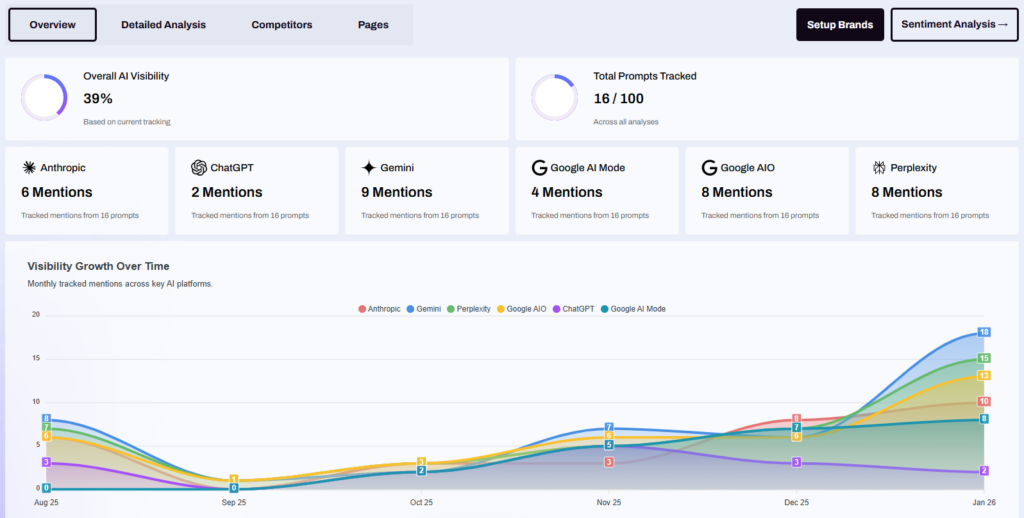
Visit the Brand Visibility Tracker inside your WP SEO AI account. You’ll land on a visual dashboard that shows your overall LLM visibility and historical performance trends across all tracked AI platforms.
The dashboard provides multi-engine support, tracking your brand mentions across ChatGPT, Claude, Gemini, Perplexity, and Google AI Overviews simultaneously. This gives you comprehensive visibility data across the AI ecosystem rather than isolated metrics from individual platforms.
Citation tracking is the core feature. The tool identifies when your brand appears in AI-generated answers, records the exact queries that trigger citations, and tracks changes over time. The dashboard also captures the surrounding context, showing how AI engines reference your brand.
Answer position monitoring shows where your brand appears within AI responses. Being cited as the primary source differs from appearing as a supporting reference. The Brand Visibility Tracker distinguishes between these positions and shows movement over time.
Integration with WordPress provides workflow efficiency. The tool connects directly with your WordPress site, combining AI visibility data with your content management system. This helps you understand the full impact of your optimization efforts and make data-driven content decisions.
Key features of the Brand Visibility Tracker
- Automated querying of multiple LLMs at your chosen frequency
- Citation detection and brand attribution tracking
- Historical data storage showing visibility trends
- Competitor comparison for the same queries
- Visual dashboards for easy data interpretation
- Export capabilities for reporting and optimization
Step 2 – Generate prompts
Click Generate Prompts and choose from your existing keywords or add a new one. The Brand Visibility Tracker makes it easy to create optimized prompts that simulate real user searches across each supported LLM.
Select your target location to ensure tracking matches your audience’s geographic parameters. AI platforms like ChatGPT and Perplexity provide different answers based on user location, so configuring the correct region is essential for accurate tracking.
Choose the desired language for your prompts. The tool supports multiple languages, allowing you to track brand visibility across different markets and language preferences.
Click Next to auto-generate tailored prompts. The Brand Visibility Tracker creates prompts designed to simulate real user searches across ChatGPT, Claude, Gemini, Perplexity, and Google AI Overviews. These prompts are optimized based on your keywords, location, and language settings.
Organize keywords by topic or intent if you’re tracking multiple categories. This helps you analyze performance by content type later and identify which areas of your business receive the most AI visibility.
Prompt generation best practices
- Start with your most important informational queries
- Confirm geographic settings match your target audience
- Select language preferences for each market you serve
- Review auto-generated prompts for relevance
- Organize prompts by topic for easier analysis
- Test prompts manually in one LLM to validate accuracy
Step 3 – Analyze mentions
For each prompt, WP SEO AI sends requests to ChatGPT, Gemini, Claude, Perplexity, and Google AI Overviews. The simulated responses show exactly what a user would see—and whether your brand was mentioned.
Citation frequency shows how often AI platforms mention your brand across all tracked queries. This is your primary visibility metric. Track both absolute citation count and citation rate (the percentage of queries where you appear). Rising citation rates indicate improving AI visibility.
Answer position indicates where your brand citation appears within the AI response. Primary sources appear early in answers, often in the opening paragraph. Supporting citations appear later or in specific sections. Monitor position changes because moving from supporting to primary citation significantly increases visibility impact.
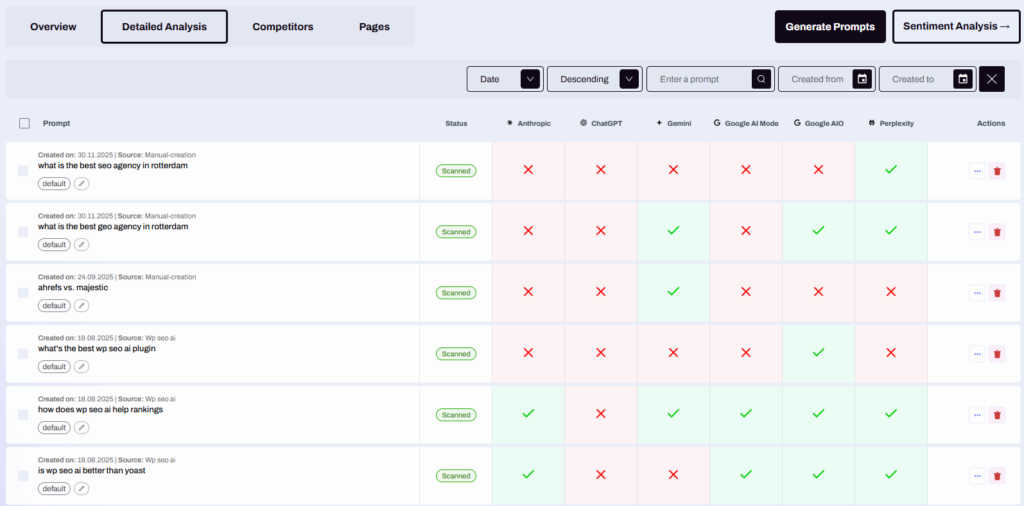
Query coverage reveals what percentage of your target keywords generate brand mentions. Low coverage indicates gaps in your content strategy or authority signals. Track coverage trends over time rather than absolute numbers, as improving coverage demonstrates optimization effectiveness.
Visibility trends over time provide the most valuable insights. Daily fluctuations are normal, but weekly and monthly trends show whether your optimization efforts are working. Look for sustained upward movement in citation frequency and query coverage across multiple LLMs.
Reading your tracking dashboard effectively
The Brand Visibility Tracker presents data through visual dashboards designed for quick interpretation. Citation graphs show clear trend lines rather than just current numbers. Query tables highlight new citations and lost visibility so you can investigate causes.
Compare your visibility against competitors tracking the same queries. This context helps you understand whether changes reflect your performance or broader shifts in how AI platforms answer certain topics. Relative performance often matters more than absolute numbers.
Step 4 – View snippets and store insights
If your brand is mentioned, the exact snippet is highlighted and stored in the Brand Visibility Tracker. This stored data helps you refine your website content to increase future visibility across all tracked LLMs.
You’ll get insights like where in the response your brand appeared, which LLM mentioned you, and how consistent the mentions are over time. This information reveals patterns in how different AI platforms perceive and present your brand.
Analyze content characteristics that correlate with citations. Examine the contexts where your brand receives mentions for common elements. Comprehensive information, clear positioning, and high factual density typically perform better across AI platforms.
Look for authority signals in your brand mentions. References that include specific credentials, unique features, or clear value propositions earn more prominent AI citations. Experience, Expertise, Authoritativeness, and Trustworthiness factors influence whether AI tools select your brand.
Conduct competitive visibility analysis. Identify which brands AI platforms cite alongside yours for target queries. Understanding competitive positioning reveals what AI engines consider authoritative for your topic area and helps you identify differentiation opportunities.
Insight analysis framework
| Element | What to Check | Why It Matters |
|---|---|---|
| Mention Context | How your brand is described | Reveals AI perception of your positioning |
| Citation Position | Primary vs. supporting reference | Indicates authority level in AI responses |
| LLM Coverage | Which platforms mention you | Shows breadth of AI visibility |
| Competitor Presence | Brands cited alongside yours | Identifies competitive landscape |
| Consistency | Mention frequency over time | Measures stability of AI visibility |
Optimize your brand visibility based on tracking data
Prioritize queries with partial visibility. Keywords already earning occasional citations have proven relevance. Improving your content and positioning for these queries often yields faster results than targeting completely new areas. Focus on your top opportunities before expanding to other keywords.
Enhance your on-page content for better AI recognition. Add clear information about your brand’s unique value, specific features, and authoritative positioning. Use structured data and clear headings that make your content easier for AI platforms to understand and quote accurately.
Add authoritative elements to boost trust signals. Include clear About pages with team credentials, case studies demonstrating results, and links to credible external sources. Strengthen site-wide authority signals that help AI platforms recognize your brand as a trusted source.
Improve factual density by adding specific data points, examples, and concrete information about your offerings. Vague statements rarely get cited. Replace general descriptions with precise details backed by evidence. This gives AI platforms quotable material for detailed answers.
Build LLM-optimized content using insights from the Brand Visibility Tracker. Study which content formats currently earn citations in your niche across different AI platforms. Create comprehensive resources that match what ChatGPT, Gemini, and other LLMs already select as authoritative sources.
Optimization priority matrix
- Queries with occasional brand mentions (quick wins with proven relevance)
- High-volume keywords with zero visibility (significant opportunity gaps)
- Competitor-dominated queries where you have comparable offerings
- Recently launched products or services that need AI visibility
- Core brand positioning that needs authority signal updates
Additional benefits and SEO best practices
Just like with search engine optimization, LLM visibility can be influenced by your content structure, authority signals, and topic relevance. With the Brand Visibility Tracker, you can identify which pages need optimization to improve LLM recognition across all major AI platforms.
Test different keyword angles or use cases for brand positioning. The tool allows you to experiment with various prompts and see how AI platforms respond. This helps you understand which aspects of your brand resonate most strongly with different LLMs.
Capture performance shifts and growth over time with historical data tracking. The Brand Visibility Tracker stores all mention data, allowing you to see long-term trends and measure the impact of your optimization efforts across ChatGPT, Gemini, Claude, Perplexity, and Google AI Overviews.
Align your content strategy with emerging AI trends by monitoring which types of queries generate the most brand mentions. Use these insights to regularly improve your presence in both search engines and AI-driven responses.
Export mention data for reporting and optimization. The Brand Visibility Tracker allows you to download citation data, making it easy to share insights with stakeholders and integrate AI visibility metrics into your broader SEO reporting framework.
Maximizing the Brand Visibility Tracker
- Review your dashboard weekly to spot trends and opportunities
- Compare performance across different LLMs to identify platform-specific patterns
- Use citation data to guide content updates and positioning refinements
- Track competitor mentions to understand the competitive landscape
- Export data regularly for comprehensive reporting
- Build new content based on high-opportunity keywords with zero visibility
WP SEO AI’s Brand Visibility Tracker is a first-of-its-kind feature built to help brands dominate the next frontier of SEO: LLM visibility. Whether you’re tracking performance or actively optimizing to be featured in AI answers, this tool gives you the power to lead—not follow.
As your brand visibility improves across ChatGPT, Gemini, Claude, Perplexity, and Google AI Overviews, you’ll see increased brand awareness and traffic from users who discover you through AI-generated answers. The Brand Visibility Tracker provides the foundation for sustained visibility as large language models become an increasingly important channel for reaching your audience.
Want to see how well your brand performs across LLMs? → Activate Brand Visibility Tracker now in your WP SEO AI dashboard.
Frequently Asked Questions
How long does it typically take to see improvements in AI citations after optimizing content?
Most brands see initial changes within 2-4 weeks after implementing optimizations with the Brand Visibility Tracker, though significant improvements typically require 6-8 weeks of consistent effort. Unlike traditional SEO where algorithm updates drive sudden changes, AI citations tend to increase gradually as LLMs recognize your enhanced authority signals and content depth. Track weekly trends rather than daily fluctuations, and expect different queries to show results at different rates depending on existing visibility levels.
Can I track brand visibility for local or region-specific queries?
Yes, the Brand Visibility Tracker allows you to set geographic parameters that match your target audience's location. AI platforms like ChatGPT and Perplexity generate different answers based on user location, so you can configure tracking for each region you serve. This is particularly important for businesses targeting multiple countries or regions, as citation patterns and competitor visibility often vary significantly by geography.
What should I do if my brand suddenly loses AI citations it previously had?
First, verify the loss is sustained over 2-3 weeks rather than normal fluctuation using the Brand Visibility Tracker's historical data. Then check if competitors strengthened their positioning, review whether your website lost authority signals, and confirm your content hasn't become outdated. If the loss is confirmed, update your content with fresh information, add more specific details about your offerings, and strengthen authority signals like credentials and case studies.
Is it better to optimize existing content or create new content for AI visibility?
Optimize existing pages that already have partial visibility first, as they've proven relevance to AI platforms and typically yield faster results. Focus on queries that earn occasional mentions before targeting completely new areas. Once you've maximized existing visibility, create new comprehensive content targeting high-opportunity keywords where you currently have zero brand mentions, ensuring strong authority signals from the start.
How many keywords should I track initially with the Brand Visibility Tracker?
Start with 20-30 of your most important queries to keep initial setup manageable and data actionable. Focus on queries where you want brand visibility and where AI-generated answers are common. As you become comfortable analyzing the data and optimizing based on insights, gradually expand to 50-100 keywords. Tracking too many queries initially often leads to analysis paralysis and dilutes your optimization efforts.
Do AI citations actually drive measurable traffic and business results?
Yes, though the impact pattern differs from traditional search. Citations increase brand awareness and establish authority, leading to direct traffic increases as users remember your brand from AI answers. You'll also see users who discover you in ChatGPT or Gemini then visit your site directly later. Track branded search volume and direct traffic alongside citation metrics using the Brand Visibility Tracker to measure the full impact of your LLM visibility.
What's the biggest mistake to avoid when optimizing for AI visibility?
The biggest mistake is creating artificial or misleading information to game AI platforms. LLMs like ChatGPT and Gemini favor brands that provide genuine value—comprehensive information, clear positioning, and authentic authority. Avoid exaggerating claims, creating unnaturally promotional content, or adding fake credentials. Instead, focus on genuine expertise, specific details about your offerings, and clear communication. Brands that provide real value will naturally perform better with AI engines.