

Finding entities for SEO optimisation means identifying the specific people, places, concepts, and topics that search engines recognise and understand and then making sure your content reflects them strategically.
Entity based SEO is how you help Google better comprehend your content’s context and relevance. Get this right, and you’ll see the difference in how your pages perform.
To discover the right entities, you’ll want to work through competitor analysis, Google’s own suggestions, semantic research tools, and a clear understanding of which topics naturally connect to your industry and content themes.
Keep reading to discover four outstanding tools you can use to find the entities worth optimising for.
What are SEO entities and why do they matter for search rankings?
Think of SEO entities as the real-world people, places, things, concepts, and ideas that search engines can identify and understand. Unlike keywords, entities carry distinct meanings and relationships that Google stores in its Knowledge Graph database. This semantic understanding is what allows search engines to deliver genuinely relevant results, not just pattern-matched ones.
Google’s Knowledge Graph connects millions of entities and their relationships, enabling the search engine to understand context rather than simply match keywords. When you mention “Apple” in your content, Google determines whether you’re discussing the technology company, the fruit, or Apple Records based on surrounding entities and contextual signals. That’s the power you’re working with when you optimise for entities.
Entity based SEO matters because it improves your content’s semantic relevance. Search engines reward content that demonstrates comprehensive understanding of topics through proper entity usage. Done well, this approach helps your pages rank for related searches well beyond your primary keywords, expanding your overall visibility and traffic potential.
The impact on search visibility becomes clear when you consider how Google processes queries. Modern search algorithms look for topical authority and content depth and entities are how you establish both. Pages that properly incorporate relevant entities consistently outperform those that don’t, because they signal greater authority and comprehensiveness to search engines.
How to Use Entity Explorer Tools for SEO
Dedicated entity explorer tools take entity research beyond manual discovery, giving you structured, data-driven insights into how search engines map relationships between concepts, people, organisations, and topics. Here are four resources I recommend for intermediate-to-advanced practitioners:
#1 The Knowledge Graph Generator by Metehan Yeşilyurt
Metehan Yeşilyurt has arguably been one of the most valuable contributors to the SEO community in recent years. The resources and tools he continues to develop are of exceptional quality, and his newest creation, the Knowledge Graph Generator, is a remarkable tool that fits seamlessly into any SEO strategy centred around entities.
GitHub: https://github.com/metehan777/entity-topic-cluster
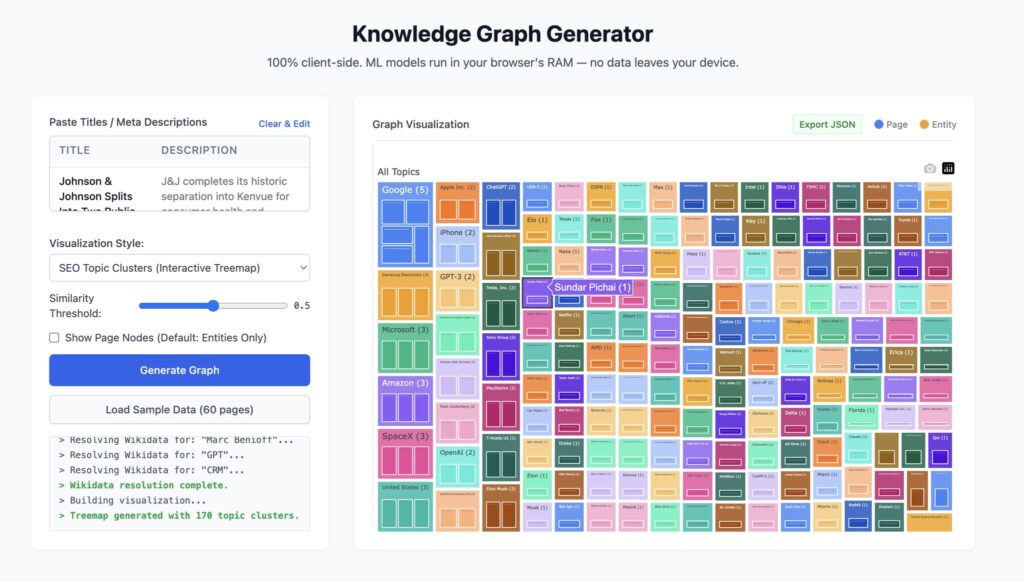
The premise is simple but powerful: extract your site’s title tags and meta descriptions, then upload them to the tool. It runs 100% locally and generates a rich, interactive visualisation of the topical entities represented across your key pages.
What you get is an immediately clear picture of what your site is actually about from a semantic standpoint, not what you think it’s about, but what search engines are likely to infer. That distinction matters more than most people realise.
To get the most out of the Knowledge Graph Generator, I recommend these approaches:
- Segment your pages before uploading: Rather than uploading your entire site at once, separate your titles and meta descriptions by page type (demand-generation pages, blog posts, product pages, and so on). This lets you see the entity landscape specific to each section of your site, rather than a blended view that can obscure gaps or imbalances.
- Identify entity gaps in your content strategy: Once you can see which entities dominate each segment, it becomes much easier to spot topics that are underrepresented or missing entirely. These gaps are direct opportunities to expand your topical authority.
- Run the same analysis on competitors: Extract the title tags and meta descriptions from a competitor’s site and run them through the tool. Comparing your entity visualisation against theirs reveals where your topical coverage diverges and where they may be building authority that you’re not yet competing for.
- Use the output to inform content planning: The visualisation isn’t just diagnostic, it’s a strategic planning asset. Use it to prioritise new content that fills entity gaps, strengthen clusters where your coverage is thin, and ensure your site’s semantic footprint aligns with the topics you want to own.
Because the tool runs locally, you have no data privacy concerns about uploading sensitive site information to a third-party server. For agencies and in-house teams working with proprietary content strategies, that’s a meaningful advantage worth factoring in.
#2 SEOPowerSuite Entity Explorer
SEOPowerSuite’s Entity Explorer is a dedicated feature within the WebSite Auditor module built specifically for entity discovery and topical mapping. Here’s how to use it effectively:
- Enter your seed topic or URL: Input your primary keyword or paste a competitor URL into the Entity Explorer interface. The tool will crawl the content and extract recognised entities automatically.
- Review the entity output: The tool returns a structured list of entities categorised by type (people, organisations, locations, concepts, and events) along with relevance scores that indicate how prominently each entity features in the analysed content.
- Identify entity gaps: Compare the entities extracted from top-ranking competitor pages against your own content. Any high-relevance entities appearing consistently across competitors but absent from your page represent clear optimisation opportunities you should act on.
- Build your entity map: Use the output to construct a topical entity map, grouping related entities into clusters that can inform your content structure, internal linking, and schema markup strategy.
The key advantage of SEOPowerSuite’s Entity Explorer is its ability to process multiple URLs in sequence, making competitive entity benchmarking faster and more systematic than manual extraction methods.
#3 SEMrush Entity Analysis
SEMrush incorporates entity recognition across several of its tools, most notably within the SEO Content Template and the On-Page SEO Checker. I’d encourage you to use both in tandem for the best results.
When you generate a content template for a target keyword, SEMrush analyses the top-ranking pages and surfaces semantically related entities and terms that Google associates with comprehensive coverage of your topic. Use this as your baseline before you write a single word.
The On-Page SEO Checker then flags missing entities by comparing your published content against top-ranking competitors, providing prioritised recommendations for entities to add. Together, these features allow you to align your content’s entity profile with what search engines already reward for your target queries.
#4 Koray Tuğberk GÜBÜR’s Entity-Based SEO Framework
Koray Tuğberk GÜBÜR is a prominent figure in the semantic SEO space whose entity-based methodology has gained significant attention among advanced practitioners. His framework centres on the concept of topical authority: the principle that search engines evaluate not just individual pages but the breadth and depth of entity coverage across an entire website. It’s a shift in thinking that I’d strongly recommend you internalise.
Key principles from his approach that you should apply include:
- Building tightly structured entity clusters where every piece of content reinforces the site’s authority on a core set of entities.
- Using entity co-occurrence patterns to signal semantic relationships to search engines.
- Prioritising content that satisfies the full knowledge graph context of a query rather than targeting isolated keywords.
If you’re researching “entity explorer SEO Koray” to apply his topical authority principles using structured tools, I’d recommend combining his framework with SEOPowerSuite’s Entity Explorer or SEMrush’s analysis features. Together, they give you a powerful, systematic approach to entity-led content strategy.
What Are Entity Clusters and How Do You Build Them for SEO?
Entity clusters are groups of semantically related entities that, when covered together, signal comprehensive topical authority to search engines. Rather than treating each entity in isolation, you want to connect a core entity with its most relevant sub-entities, creating a web of related content that demonstrates deep subject expertise. Search engines reward this interconnected approach because it mirrors how real-world knowledge is actually structured.
Here’s a clear, repeatable process for building an effective entity cluster:
- Identify your core entity. Start with the central concept your content focuses on. This is the primary entity around which all related sub-entities will orbit. For example, if your content targets email marketing, that becomes your core entity.
- Map related sub-entities using research tools. Use tools like Google’s Natural Language API or SEOPowerSuite to uncover semantically connected entities. Look for the people, platforms, concepts, and processes that consistently appear alongside your core entity in authoritative sources. For an email marketing cluster, relevant sub-entities might include Mailchimp, ConvertKit, list segmentation, marketing automation, A/B testing, and deliverability.
- Create or update content to cover each cluster entity. Make sure your website has dedicated, in-depth content addressing each significant sub-entity within the cluster. This might mean creating new pages, expanding existing ones, or adding targeted sections that thoroughly cover each entity’s role, meaning, and relevance to the core topic.
- Use internal linking to connect cluster pages. Link between your core entity page and all related sub-entity pages in a deliberate, logical way. These internal links signal to search engines that your site treats these entities as interconnected, reinforcing topical authority across the entire cluster rather than on individual pages alone.
To make this concrete, consider building an entity cluster around email marketing. Your core page covers the topic broadly, while supporting pages or sections address sub-entities such as:
- Mailchimp (platform)
- Segmentation (strategy)
- Automation (technology)
- A/B testing (optimisation method)
- Open rate (performance metric)
Each page should reference and link to the others, creating a tightly connected cluster that collectively signals to search engines that your site is a comprehensive, authoritative source on email marketing.
Entity clusters are particularly valuable because they expand your content’s reach beyond a single keyword or page. When search engines recognise a well-structured cluster, they are more likely to surface multiple pages from your site across a range of related queries, compounding your visibility and reinforcing your site’s authority on the topic as a whole.
How do you identify relevant entities for your content topics?
Start by analysing your main topic and listing all related concepts, people, organisations, and locations that naturally connect to your subject. Ask yourself what experts in your field would discuss when covering the same topic comprehensively. This brainstorming step reveals the obvious entities you should include — and it costs nothing.
Google’s search suggestions are an excellent and often underused entity discovery resource. Type your main topic into Google and pay close attention to the following features, each of which reveals entities that users commonly associate with your topic:
- Autocomplete suggestions
- “People also ask” sections
- Related searches at the bottom of results pages
Wikipedia is an outstanding entity research tool that I’d encourage you to use regularly, because it’s heavily structured with linked concepts. Search for your topic on Wikipedia and examine the linked terms, categories, and related pages. The interconnected nature of Wikipedia articles mirrors how search engines understand entity relationships — making it a surprisingly reliable proxy for Knowledge Graph thinking.
Industry publications and authoritative websites in your field naturally incorporate relevant entities when discussing topics. Review how established sources cover your subject matter and note which people, companies, concepts, and locations they consistently mention. This research reveals entities that add credibility and depth to your content.
Always consider the broader context surrounding your topic. If you’re writing about email marketing, relevant entities you should be covering might include:
- Specific platforms such as Mailchimp and ConvertKit
- Industry experts
- Marketing concepts such as segmentation and automation
- Related technologies
What’s the difference between keywords and entities in SEO?
Keywords are search terms that people type into search engines, while entities are real-world concepts, people, places, or things that carry distinct meanings and relationships. Keywords help you target specific search queries; entities help search engines understand the context and meaning behind those queries. You need both, but they serve different purposes.
The distinction becomes clearer when you compare the two approaches side by side:
| Aspect | Keywords | Entities |
|---|---|---|
| Focus | Matching specific search phrases | Comprehensive topic coverage and semantic relationships |
| Question answered | What people search for | What this content is really about |
| Ambiguity | Can be ambiguous without context | Remove ambiguity by establishing clear relationships |
| SEO role | Target specific searches and user intent | Demonstrate topical authority and comprehensive coverage |
Keywords can be ambiguous without context. The keyword “apple” could refer to fruit, technology, or music. Entities remove this ambiguity by establishing clear relationships and context. When you mention Apple Inc. alongside entities like iPhone, Tim Cook, and Cupertino, search engines understand you’re discussing the technology company. That’s the kind of clarity you should be building into your content.
Modern SEO requires both approaches working together. Use keywords to target specific searches and user intent, and use entities to demonstrate topical authority and comprehensive coverage. The most effective content strategy incorporates target keywords naturally while building rich entity relationships throughout.
Search engines increasingly reward content that balances keyword targeting with entity richness. If you focus solely on keyword density without proper entity context, you’ll struggle to rank against content that demonstrates deeper topical understanding. Don’t let that be your pages.
How do you implement entities effectively in your content?
Incorporate entities naturally within your content flow rather than forcing them into awkward placements. Mention relevant people, companies, locations, and concepts where they genuinely add value to your discussion. Natural integration maintains readability while providing the semantic signals search engines need.
Use proper nouns and specific terminology when referencing entities. Instead of writing “a popular email marketing platform,” name it, write “Mailchimp” or “ConvertKit” when relevant. This specificity helps search engines recognise and categorise your content more accurately within their knowledge systems.
Implement structured data markup to explicitly identify entities for search engines. Schema.org provides markup types for the following entity categories:
- Person
- Organization
- Place
This markup helps search engines understand your content’s entities even when natural language processing might miss them. Don’t skip this step, it’s one of the clearest signals you can send.
Build a deliberate internal linking strategy that connects related entities throughout your website. Link between pages that discuss related people, concepts, or topics to reinforce entity relationship signals. This internal linking is how you establish your site’s authority on specific entity clusters and topics over time.
Avoid over-optimisation by maintaining natural writing patterns. Do not stuff entities into content where they don’t belong or repeat entity names excessively. Your goal is comprehensive coverage that naturally incorporates relevant entities while genuinely serving your readers’ information needs.
Finally, monitor your entity implementation using tools that analyse semantic richness and topical coverage. Regular content audits will surface opportunities to strengthen entity usage while ensuring your content remains valuable and readable for human audiences, because ultimately, that’s who you’re writing for.
This content was generated with the help of AI and it may contain mistakes