

Every few years, someone declares SEO dead. In 2026, that claim is louder than ever, fueled by AI Overviews pushing organic results down the page, ChatGPT answering questions without sending users anywhere, and traffic reports that look alarming at first glance. But the data tells a more nuanced story.
SEO is not dead. It is evolving faster than at any point in its history, and the businesses that understand what has actually changed are the ones pulling ahead.
This article answers the questions I hear most often from marketing teams working through this shift. Is SEO still relevant in 2026? What is Generative Engine Optimization, and do you need it? What content actually works now? Read through each section and you will leave with a clear picture of where search is heading, and exactly what to do about it.
Key takeaways
- SEO is not dead: Google still sends 89% of web traffic to websites.
- AI Overviews now trigger on 30% to 50% of U.S. queries, reducing click-through rates by 61% on affected searches.
- Brands cited inside AI Overviews earn 35% more organic clicks than competitors not cited.
- GEO and SEO are complementary: 76% of URLs cited in AI Overviews also rank in Google’s top 10.
- Measurement must expand beyond traffic to include AI citation rates, brand mention frequency, and conversion quality.
Is SEO dead in 2026?
No. SEO is still worth investing in for most businesses in 2026. Consider the following data points:
- Google still controlled 89% of all U.S. web traffic in 2025.
- Organic search grew by more than 21% in 2024 despite the rise of AI Overviews.
- The global SEO services market continues to expand at a compound annual growth rate of around 16%.
- 91% of marketers reported that SEO had a positive impact on their goals in 2024.
What has died is a particular version of SEO: the one built on keyword stuffing, thin content, and technical tricks that gamed rankings without earning trust. That approach stopped working years ago. AI-powered search has simply finished it off. The underlying discipline of helping search engines understand, trust, and recommend your content is more valuable now than it has ever been.
Lily Ray, Senior Director of SEO at Amsive, has noted publicly that brands misreading traffic declines as SEO failure are conflating a change in click behavior with a change in search relevance. Visibility in AI-generated answers and featured positions is real reach, even when it does not produce a direct click. The discipline is evolving; the demand for trusted, authoritative content is not going away.
The more accurate framing is this: SEO in 2026 is still relevant, still growing as an industry, and still essential for visibility. What has changed is the definition of visibility itself, and that is where the real conversation begins.
How has SEO changed with the rise of AI search?
In my view, the future of SEO in 2026 is defined by one structural change above all others: Google AI Overviews.
As of early 2026, roughly 30% to 50% of U.S. search queries trigger a conversational, multi-source summary that appears above all organic results. This has fundamentally altered click behavior, content strategy, and what it means to rank well.
| Dimension | SEO before 2024 | SEO in 2026 |
|---|---|---|
| Success metric | Rankings and click-through rate | Rankings + AI citation rate + brand mention frequency |
| Primary ranking signals | Backlink counts and keyword density | Branded web mentions, E-E-A-T signals, and structured content |
| Content format | Keyword-by-keyword pages targeting individual terms | Topic clusters with Q&A-structured, self-contained sections |
| Off-site strategy | Followed backlinks for domain authority | Editorial brand mentions on authoritative domains for AI citation |
| Visibility definition | A position on a Google results page | Presence in Google results and inside AI-generated answers |
| Measurement approach | Organic traffic and ranking reports | Blended scorecard covering traffic, AI share of voice, and conversions |
The click-through rate reality
Research analyzing more than 3,100 informational queries found that organic click-through rates dropped by 61% on queries where AI Overviews appeared. That is a significant number. But there is an important counterpoint buried in the same data:
- Brands cited within AI Overview results earned 35% more organic clicks than competitors not cited.
- Those same cited brands earned 91% more paid clicks compared to non-cited competitors.
Being in the answer is now more valuable than being below it.
Zero-click behavior has also intensified. Around 60% of searches in traditional search engines now end without a click, and AI Mode searches end without a click at an even higher rate. This does not mean your content is failing. It often means your content answered the question well enough to be pulled into the AI response, which is a form of visibility that traditional analytics cannot easily measure.
The rise of AI as a discovery platform
AI search is no longer a niche behavior. When I look at the scale, the numbers are striking:
- More than 810 million people use ChatGPT daily.
- Google AI Overviews reaches 1.5 billion monthly users across more than 200 countries.
- Referral visits from AI platforms, including ChatGPT, Gemini, and Perplexity, increased by 357% year over year as of June 2025.
- Nearly 35% of Gen Z users in the U.S. now use AI chatbots as their primary tool for finding information.
Semrush projects that AI-driven search experiences could surpass traditional search usage by early 2028, potentially sooner if AI modes become the default interface. In that environment, an SEO strategy focused solely on traditional rankings leaves a growing portion of the discovery journey unaddressed. The channel is expanding, not replacing. Your strategy needs to expand with it.
What is Generative Engine Optimization (GEO), and how does it differ from SEO?
Generative Engine Optimization (GEO) is the practice of optimizing content to appear inside AI-generated answers rather than just ranking in traditional search results. Where SEO earns you a position on a results page, GEO earns you a citation or recommendation within the response that ChatGPT, Gemini, Google AI Overviews, Perplexity, or Claude generates when someone asks a relevant question.
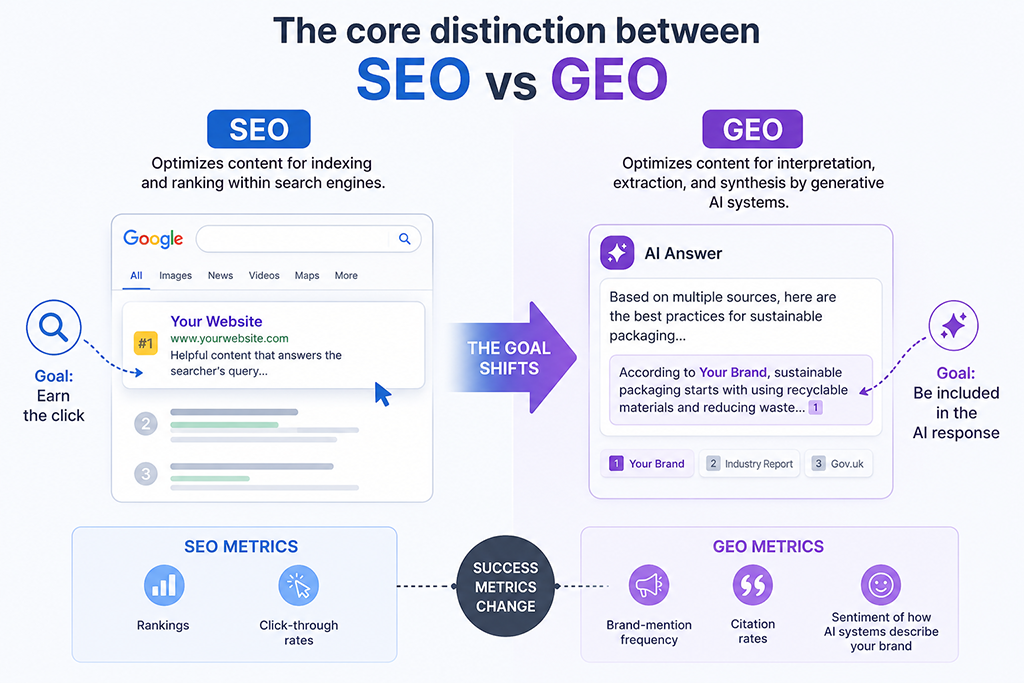
The core distinction between SEO and GEO
SEO optimizes content for indexing and ranking within search engines. GEO optimizes content for interpretation, extraction, and synthesis by generative AI systems. The goal shifts from earning a click to having your information included in the AI’s response. Success metrics change accordingly:
- SEO metrics: Rankings and click-through rates.
- GEO metrics: Brand-mention frequency, citation rates, and the sentiment of how AI systems describe your brand.
The analogy I use with clients: if SEO is about securing the best shelf space in a library, GEO is about having the librarian (who is now an AI) select your content and read it aloud to the person asking. The two are not competing disciplines. They are complementary layers of one visibility system.
Research published by Pranjal Aggarwal et al. documents that brands deploying GEO techniques achieved visibility improvements averaging 40% within generative engines. The global GEO services market reached $886 million in 2024, with projections of $7.3 billion by 2031 at a 34% compound annual growth rate.
What signals AI systems use to decide what to cite
The signals that drive AI citation differ meaningfully from traditional SEO. Key findings from my research include:
- Branded web mentions have the strongest correlation with AI Overview appearances, far outperforming backlink counts.
- Content depth, readability scores, and page speed all correlate with higher citation rates.
- A Q&A format is particularly effective for AI extraction.
- Brands are 6.5 times more likely to be cited through third-party sources than through their own domains, making off-site authority building a central GEO tactic.
Author credentials matter, too. AI systems increasingly weight named, verifiable authors over anonymous content. Every piece of content you want cited in AI responses should carry a named author with a credible external presence.
Why do some businesses think SEO no longer works?
Businesses think SEO no longer works primarily because they are seeing less traffic despite maintaining or even improving their rankings. This pattern is real, but it reflects a change in how traffic flows rather than a failure of SEO itself. The culprit is largely AI Overviews, which answer questions directly on the results page and reduce the need for users to click through to source websites.
Key data points illustrate the disruption:
- Only 40.3% of U.S. Google searchers clicked on an organic result in March 2025, down from 44.2% the previous year.
- Google’s AI-powered search features now appear in 67% of B2B-related queries.
For businesses whose content targets informational queries, this is a genuine disruption. Traffic to information-focused blog content has declined meaningfully, particularly for mid-sized sites that lack the brand authority to be cited within AI Overviews.
The broken attribution problem
There is a deeper issue that makes the situation appear worse than it is: traditional SEO reporting is not built to capture AI-influenced visibility. Your content can rank first, appear in an AI Overview, and get cited in a featured snippet, all while your direct traffic numbers fall. The user got their answer, possibly acted on it, but never clicked through to your site. Your analytics show declining organic traffic. Your stakeholders assume SEO is failing. In reality, your content is doing exactly what it should.
What the conversion data actually shows
The conversion picture also complicates the narrative. Despite traffic drops, many businesses I speak with report steady or growing conversions. According to Adobe data, by May 2025, AI-referred traffic showed:
- A 27% lower bounce rate compared to non-AI traffic.
- 38% longer time on site compared to non-AI traffic.
- 10% more page views per visit compared to non-AI traffic.
Users arriving from AI platforms come with higher intent and more context. Conversion rates from AI referrals were 91% lower than non-AI traffic in July 2024, but that gap had narrowed to 22% by May 2025, showing rapid maturation rather than structural weakness.
Which SEO practices no longer work in 2026?
Several tactics that once produced results now actively undermine your visibility in both traditional search and AI-generated answers. Knowing what to stop doing is as valuable as knowing what to start.
- Keyword stuffing. Repeating target keywords at high density no longer improves rankings. Google and AI systems evaluate semantic relevance and topic coverage across a cluster of related content, not keyword frequency on a single page. Replace this with topic cluster strategies that cover a subject area comprehensively.
- Thin content without original insight. AI-generated summaries that repackage publicly available information without adding firsthand experience or original data are penalized by E-E-A-T signals. Content needs to demonstrate that you have actually done the thing you are writing about.
- Anonymous content without named authors. AI citation systems increasingly downweight content that lacks a named, verifiable author. Every page you want cited in AI Overviews or generative answers should carry an author bio with a credible external presence.
- Chasing followed backlinks without editorial context. Raw backlink counts have weakened as an AI visibility signal. Branded mentions on authoritative domains now outperform link counts for AI citation rates. Your off-site strategy should prioritize genuine editorial coverage over link acquisition.
- Optimizing for a single keyword per page. Single-keyword targeting misses the semantic coverage that both Google and generative AI systems now evaluate. Q&A structure and topic depth matter more than exact-match optimization for any individual term.
What types of content still rank well in 2026?
Content that demonstrates genuine expertise, serves specific user intent, and is structured for both human readers and AI extraction performs well in 2026. The following query types remain largely unaffected by AI Overviews:
- Transactional queries where users intend to buy.
- Local queries requiring current information such as business hours or availability.
- Navigational queries for specific sites.
Informational content that provides original insight, firsthand experience, or proprietary data continues to earn both rankings and AI citations.
Which Content Formats Will Survive AI?
With nearly 60% of Google searches now ending without a click, generic content is exactly what AI replaces. The formats that survive share four traits: they’re proprietary, experience-based, niche-focused, and help the reader complete a task, not just learn something.
Here’s how the main content types stack up.
🟢 Strongest: build here first
| Format | Why it survives AI |
|---|---|
| Owned Audience (email/newsletter) | You don’t rely on Google at all |
| Transaction Pages (book, buy, subscribe) | AI can’t complete the action |
| Original Research | AI cites it; users want the original source |
| UGC Communities / Forums | Members seek them out for real experience |
| Creator Video & Podcast | People come for the host, not the info |
| In-Depth Reviews & Tests | Firsthand evidence AI can’t replicate |
| Brand Pages (About, Trust, Proof) | Defines your entity for search and LLMs |
🟡 Moderate: work, but need a real moat
Directories & Databases · Expert Perspective · Templates · Case Studies · Original Reporting · Support & Documentation
🔴 Weakest: highest AI-replacement risk
Guides & Explainers · FAQs & Glossaries · Lists & Roundups — these survive only if you become the canonical source, backed by original testing, proprietary data, or a hyper-niche focus.
The takeaway: stop publishing commodity content. Treat these formats as starting points for your best, most distinctive work—the only content worth making is what AI can point to but never replace.
Adapted from Zyppy’s “17 Content Types to Survive Google’s Zero-Click Era” (signal.zyppy.com).
AI Overviews appear most frequently on informational queries. Transactional searches where users intend to buy, local searches requiring current information such as business hours or availability, and navigational searches for specific sites all continue to generate clicks at strong rates. For these query types, click-through rates have not cratered. When someone searches for an emergency service at 11 PM, they are not satisfied by an AI summary.
Structured, modular content performs particularly well. AI systems favor content organized into self-contained sections of roughly 100 to 200 words that can be extracted and cited independently. The first 200 words of any article carry outsized weight with AI systems that use real-time retrieval, because relevance is assessed primarily on opening content. Q&A formats work especially well. In my testing, I have seen up to 55% increases in AI chatbot visibility when content is restructured this way.
E-E-A-T and original data
Content built around experience and proof rather than summaries is what survives. Google and AI systems look for signals that you have actually done the thing you are writing about:
- Original data and proprietary research.
- Firsthand insights and real workflows.
- Verifiable expertise tied to named authors.
Content written to satisfy crawlers rather than people does not hold up. More than 80% of AI-driven traffic goes to pages updated within the past two years, which makes content freshness a practical priority, not a nice-to-have.
Publishing original research that becomes a citation source creates compounding value. When journalists, bloggers, and AI systems cite your data, you build a citation network that benefits every piece of content on your domain.
Why does video content hold up against AI Overviews?
Video content holds up against AI Overviews because generative AI systems cannot easily compress a video into a text summary, which preserves click-through behavior for video results. Users still need to watch the video to get the value, so AI cannot intercept that intent the way it can with a written how-to article.
To maximize video SEO in 2026, follow these practices:
- Place your target keyword in the video title, description, and spoken transcript within the first 30 seconds.
- Pair educational videos with a structured written transcript on the same page to capture both video search traffic and text-based AI citation signals.
- Use original video demonstrating firsthand expertise, one of the strongest experience signals available to content creators right now, directly reinforcing the E-E-A-T signals that both Google and AI systems reward.
Should businesses invest in SEO or shift to GEO instead?
In the SEO vs. GEO debate of 2026, my answer is clear: businesses should invest in both. They are not competing priorities. Search has split into two parallel visibility layers: traditional rankings and AI-generated answers. SEO gets you into the rankings layer. GEO gets you into the answers layer. In 2026, you need presence in both because your customers are using both.
The case for maintaining SEO investment is straightforward. Consider the scale difference between platforms:
- Google processes approximately 14 billion search queries daily.
- AI platforms like ChatGPT handle around 37.5 million queries daily, a ratio of roughly 373 to 1 in Google’s favor.
- Around 76% of URLs cited in AI Overviews also rank in Google’s top 10, meaning strong SEO is the infrastructure that makes GEO possible.
Why GEO investment is urgent now
The urgency around GEO comes from first-mover dynamics. Only 39% of marketing leaders rank GEO as a top-three priority for the next 6 to 12 months, while 67% of consumers already use AI tools for product research. That 28-percentage-point gap between consumer behavior and strategic priority is an opportunity I would not leave on the table.
Organizations establishing authority within AI systems today build citation patterns that are difficult for competitors to displace later, as AI platforms develop a sustained understanding of which brands represent authoritative sources in specific categories.
The right framing is not SEO versus GEO. It is SEO as the foundation and GEO as the next layer. At WP SEO AI, our approach unites both into one workflow: the WP SEO Agent handles content creation, technical audits, and on-page optimization while also producing GEO-ready content structured for AI citation, all tracked across both Google and generative engines from within your WordPress dashboard.
What SEO and GEO strategies are actually working in 2026?
The tactics producing measurable results in 2026 combine traditional SEO foundations with GEO-specific content structures and off-site authority building. Here are seven concrete approaches you can act on now.
Restructure top content into Q&A format
Restructure your highest-traffic pages into clear Q&A sections, each running 100 to 200 words and written to stand alone without surrounding context. AI retrieval systems extract self-contained answers, so content organized this way earns citation rates up to 55% higher than unstructured prose. Start with pages that already earn impressions in Google Search Console.
Add named author bios with verifiable credentials
Add a named author bio to every key page, including a title, verifiable external presence such as a LinkedIn profile or published bylines, and relevant credentials. AI systems increasingly downweight anonymous content when deciding what to cite. This is one of the fastest E-E-A-T improvements you can make to an existing content library.
Build topic clusters around your core categories
Build interconnected content ecosystems around your core service or product categories rather than targeting keywords in isolation. A pillar page supported by five to ten related articles signals deeper topical authority to both Google and generative AI systems. Topic clusters consistently outperform standalone pages for both rankings and AI citation rates.
Publish original data or research
Publish at least one piece of original research per quarter that other publications, bloggers, and AI systems can cite. Proprietary data creates a citation network that compounds across your entire domain. When Semrush, Search Engine Land, or an industry blog cites your study, that third-party mention carries more AI visibility weight than any owned content you produce.
Earn branded mentions on high-authority domains
Pursue editorial coverage and brand mentions on authoritative domains through digital PR, contributed articles, and expert commentary. Branded web mentions have a stronger correlation with AI Overview appearances than raw backlink counts. Aim for placements in the publications and sources that AI systems are trained on, not just sites with high domain authority scores.
Expand your measurement framework to include AI citation tracking
Track how often your brand appears in AI-generated answers using tools like Semrush’s AI Toolkit, Profound, or AthenaHQ. Supplement this with branded search volume trends, direct traffic patterns, and conversion rates by channel. Raw organic traffic numbers alone no longer reflect actual search visibility in 2026, and presenting stakeholders with a blended scorecard prevents premature decisions based on incomplete data.
How can a business adapt its SEO strategy for 2026?
Adapting your SEO strategy for 2026 means expanding your definition of where your customers find information and optimizing for all of those channels. The core shift is from search engine optimization to what I and other practitioners are calling “search everywhere optimization”, covering Google, ChatGPT, Perplexity, Gemini, voice assistants, and social search platforms simultaneously.
Technical foundations for AI visibility
Technical SEO in 2026 is no longer primarily about page speed and mobile optimization, though both still matter. It is increasingly about data accessibility for AI agents. Key technical priorities include:
- Structured data using JSON-LD schema markup, which has become more important as AI systems rely on it to accurately represent businesses in generated results. Schema for your business type, services, service area, reviews, and FAQ content is no longer optional.
- Entity consistency across platforms. Ensuring your company name, founding date, leadership, headquarters, and core offerings match exactly across your website, LinkedIn, Crunchbase, press releases, and directory listings helps AI systems understand your entity clearly. In my experience, this consistency can improve AI visibility within weeks.
Content strategy for 2026
Topic clusters are replacing keyword-by-keyword content strategies. Building interconnected content ecosystems around specific topic areas signals deeper relevance to both traditional search engines and AI systems. Each piece of content should:
- Answer a specific question directly in its opening section.
- Use Q&A formatting where appropriate.
- Be updated every 6 to 12 months to maintain freshness signals.
Off-site presence has become fundamental. Publishing thought leadership on high-authority domains, earning mentions in credible publications through digital PR, and ensuring your brand appears in the sources that AI systems are trained on all contribute to AI visibility. Brands are 6.5 times more likely to be cited through third-party sources than through their own domains, which means your off-site content strategy is now directly tied to your AI search presence.
How does optimization differ across AI platforms?
Optimization tactics vary meaningfully across AI platforms, and a one-size-fits-all approach leaves visibility gaps. Here is how each platform differs:
| Platform | Key optimization priorities |
|---|---|
| Google AI Overviews | Structured data, and content that already ranks in the top 10. |
| Perplexity | Clear sourcing, named authors, and structured factual claims. Author credentials and explicit references to data sources are particularly valuable. |
| ChatGPT | Draws from training data and indexed content. Becoming an authority in traditional indexes increases chances to being recommended. |
| Voice search (Siri, Alexa) | Conversational, question-based phrasing and direct answers in the first sentence of each section, reinforcing the Q&A structure that benefits all AI platforms. |
Measuring success differently
Traditional traffic metrics are no longer sufficient on their own. In 2026, a complete measurement framework includes:
- Brand mentions in AI responses.
- Share of voice within AI-generated answers.
- Sentiment analysis of how AI describes your brand.
- Conversion metrics that account for the reality that many assisted journeys no longer produce a direct click.
Qualified leads, conversion rates, and brand demand growth tell a more accurate story than raw organic traffic numbers alone.
The businesses pulling ahead right now are not the ones doing the most SEO or the most GEO separately. They are the ones treating both as layers of one integrated system, building the technical infrastructure, content quality, and off-site authority that make them visible wherever their customers are searching, whether that is a Google results page or a ChatGPT conversation at 10 PM.
Frequently Asked Questions
How do I know if my content is being cited in AI Overviews or generative AI responses?
You can monitor AI citations using tools like Semrush’s AI Toolkit, Profound, or AthenaHQ, which track how often your brand appears in AI-generated answers across platforms like ChatGPT, Perplexity, and Google AI Overviews. Additionally, setting up Google Alerts and social listening tools for your brand name can surface indirect signals. Keep in mind that a drop in direct organic traffic alongside stable or growing conversions is often a sign your content is being synthesized into AI responses rather than clicked through directly.
What is the fastest way to get started with GEO if I have an existing content library?
Start by auditing your highest-performing existing content and restructuring it into clear Q&A formats with self-contained sections of roughly 100 to 200 words each. This is one of the highest-impact changes you can make immediately. Next, add named author bios with verifiable credentials to every key page, and implement FAQ schema markup using JSON-LD. You do not need to create new content from scratch; retrofitting your best existing assets for AI extraction is a faster and often more effective first step.
Which types of businesses or industries are least affected by AI Overview disruption?
Businesses that rely on transactional, local, or navigational search queries are the least disrupted, because AI Overviews appear far less frequently on those query types. This includes local service businesses (plumbers, dentists, restaurants), e-commerce stores targeting purchase-intent keywords, and brands with strong navigational search demand. Industries most affected are those producing general informational content, how-to guides, definition articles, and broad educational content, where AI can easily synthesize a direct answer without sending the user anywhere.
How often should I update existing content to stay competitive in 2026?
A practical benchmark is a full content review every 6 to 12 months for your most important pages, with lighter updates (refreshing statistics, adding new examples, or expanding thin sections) every quarter for high-traffic assets. The data point to keep in mind is that more than 80% of AI-driven traffic goes to pages updated within the past two years, so freshness is a concrete ranking and citation factor, not just a best practice. Prioritize pages that target informational queries and already earn impressions in Google Search Console, as these have the most to gain from a timely refresh.
Does SEO still work with AI search?
SEO still works with AI search, and the two are more connected than most businesses realize. Around 76% of URLs cited in Google AI Overviews also rank in Google’s top 10, which means strong traditional SEO is the foundation that makes AI citation possible. Google still processes approximately 14 billion queries daily compared to around 37.5 million for ChatGPT, a ratio of roughly 373 to 1. Neglecting SEO in favor of GEO alone leaves the vast majority of search demand unaddressed.
What is a common mistake businesses make when trying to optimize for AI search?
The most common mistake is treating GEO as a completely separate strategy and neglecting the SEO foundation that makes AI visibility possible in the first place. Because roughly 76% of URLs cited in AI Overviews also rank in Google’s top 10, weak traditional SEO almost always means weak AI citation rates too. A close second mistake is focusing exclusively on owned content while ignoring off-site authority, since brands are 6.5 times more likely to be cited through third-party sources than their own domains, neglecting digital PR and thought leadership placements leaves a massive visibility gap.
Do backlinks still matter for SEO and GEO in 2026?
Backlinks still matter for traditional SEO rankings, but their relative importance has shifted in the context of AI visibility. For GEO specifically, branded web mentions, including unlinked mentions on authoritative domains, have a stronger correlation with AI Overview appearances than raw backlink counts do. This means your link-building strategy should evolve toward earning genuine editorial coverage, brand mentions in credible publications, and citations in the kinds of sources that AI systems are trained on, rather than purely chasing followed links for domain authority.
How should I adjust my SEO reporting to reflect the realities of zero-click and AI-assisted search?
Expand your measurement framework beyond organic traffic and rankings to include branded search volume growth, direct traffic trends, conversion rates by channel, and, where tooling allows, share of voice within AI-generated answers. Qualified lead volume and revenue attribution are more reliable north-star metrics than session counts in an environment where many assisted journeys end without a click. Presenting stakeholders with a blended visibility scorecard that includes both traditional and AI-channel metrics helps prevent the common mistake of declaring SEO a failure based solely on a traffic dip that does not reflect actual business impact.
This content was generated with the help of AI and it may contain mistakes