Over the past year, something subtle but important has changed in search.
Many websites didn’t suddenly “lose SEO”. Rankings often stayed stable. Impressions didn’t collapse. Yet traffic became harder to predict, attribution noisier, and visibility more fragmented.
The reason is simple: discovery is moving upstream.
Google now answers a growing share of questions directly through AI Overviews and AI Mode. Tools like ChatGPT and Perplexity synthesise information before a user ever visits a website. Increasingly, users don’t browse ten results, they ask one system and continue the conversation.
That doesn’t eliminate SEO, but it breaks the old mental model of how SEO delivers value.
In 2026, visibility is no longer just about being clicked. It’s about being understood, cited, and trusted by AI systems at the moments when users form opinions and make decisions.
This checklist is built from two inputs:
- Comprehensive predictions and field insights from experienced SEO professionals
- Performance data from WP SEO AI customers across multiple markets
Where expert opinion and real-world data aligned, we reinforced it.
Where our data told a different story, particularly around content production and topical authority, we adjusted the narrative.
You’ll find practical guidance on how to:
- Stay visible in Google AI Mode and AI Overviews
- Structure content so AI systems can reliably extract and reuse it
- Scale content in a way that builds topical authority instead of diluting it
- Measure impact when clicks alone no longer tell the full story
The aim isn’t to chase “AI SEO” as a separate discipline.
It’s to adapt proven SEO fundamentals to a search environment where influence happens before traffic.
What AI visibility is and why it matters in 2026
AI visibility refers to how prominently your content appears when artificial intelligence systems generate responses to user queries. Unlike traditional search results that display links to websites, AI platforms like ChatGPT, Google’s AI Overviews, and Perplexity synthesise information from multiple sources to create comprehensive answers.
When someone asks ChatGPT about your industry, does it mention your business? When Google displays an AI Overview for your target keywords, does your content get cited? This represents a fundamental shift from ranking websites to becoming a trusted source that AI systems quote and reference.
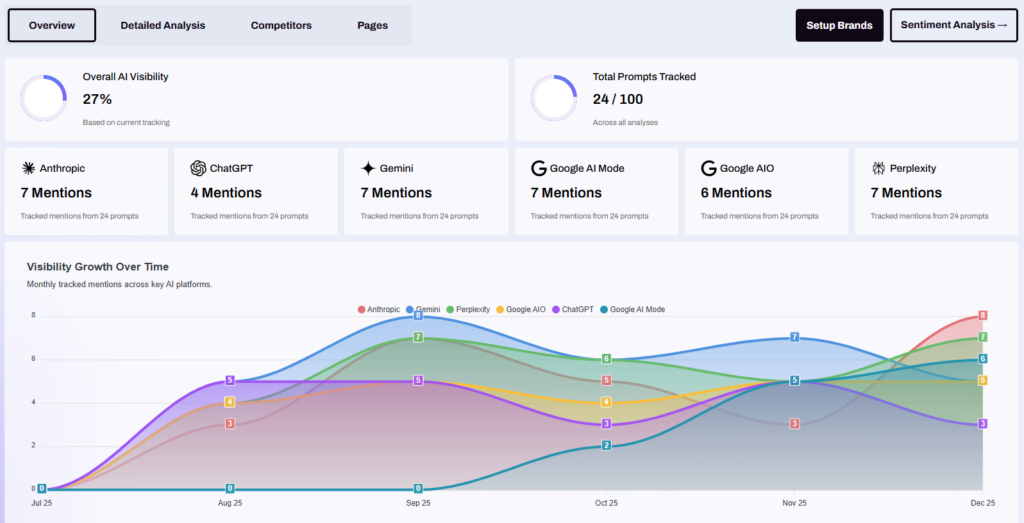
Generative engine optimization (GEO) has emerged as the practice of preparing content for AI consumption. Rather than optimising solely for human readers who click through from search results, GEO focuses on creating content that AI systems can easily understand, process, and cite as authoritative sources.
The business impact extends beyond visibility. AI platforms often provide higher-quality referral traffic compared to traditional Google searches. Users who find your business through AI-generated responses typically arrive with clearer intent and a better understanding of your expertise.
Consider how search behaviour is evolving. Voice search through smart speakers, AI chat interfaces, and conversational search are becoming primary discovery methods. Your customers might never see a traditional search results page, making AI visibility crucial for maintaining market presence.
How AI engines evaluate and rank content differently
AI engines operate fundamentally differently from traditional search algorithms. Instead of ranking web pages based on links and keywords, they evaluate content for synthesis potential. The question becomes: can this information be effectively combined with other sources to answer user questions?
Traditional SEO metrics show surprisingly weak correlations with AI citations. Content that performs exceptionally well in AI systems often receives fewer backlinks and ranks for fewer keywords than typical high-performing SEO content. This inverse relationship reveals that AI engines prioritise different quality signals.
Content depth and comprehensiveness drive AI visibility more effectively than traditional ranking factors. AI systems favour longer, more detailed content because it increases the probability of containing specific answers to user questions. Pages exceeding 10,000 words with extensive sentence counts receive significantly more citations than shorter alternatives.
AI engines also weight brand mentions across the web heavily. Your visibility depends not just on your website optimisation, but on how frequently other sites mention your brand, products, or expertise. This makes reputation building and thought leadership crucial components of an AI visibility strategy.
AI systems synthesise information from their vast knowledge base, combining relevant data points and contextualising them into coherent responses that directly address user questions.
The evaluation process involves multiple stages. AI engines collect data from diverse sources, preprocess it for consistency, and train models to recognise patterns and context. When generating responses, they prioritise content based on relevance, quality, and contextual fit rather than traditional authority signals like domain rating or backlink profiles.
Essential technical foundations for AI optimization
Building AI-friendly websites requires specific technical implementations that help AI systems understand and process your content effectively. These foundations enable better content interpretation and increase citation probability across generative engines.
Structured data and schema markup serve as the backbone of AI optimization. Implement comprehensive schema types including Article, Organization, Person, Product, and FAQ schemas. These provide explicit context about your content’s purpose, authorship, and key information points that AI systems can easily parse.
Semantic HTML structure creates a clear content hierarchy that AI engines can follow. Use proper heading tags (H1, H2, H3) to organise information logically, implement descriptive alt text for images, and structure lists and tables with appropriate markup. This semantic clarity helps AI systems understand content relationships and extract relevant information efficiently.
Your website architecture should prioritise crawlability and content accessibility. Ensure fast loading speeds, mobile responsiveness, and clean URL structures. AI systems often process content similarly to search engine crawlers, making traditional technical SEO foundations crucial for AI visibility.
Implement author and publisher information prominently. AI systems evaluate content credibility through Experience, Expertise, Authoritativeness, and Trustworthiness (E-E-A-T) factors. Include real author names with relevant experience, display publish and update dates clearly, and create comprehensive About pages that establish your organisation’s credentials.
Consider implementing FAQ blocks and machine-readable content formats. These structured content types are particularly effective for AI systems because they provide clear question–answer pairs that can be easily extracted and cited in AI-generated responses.
Content optimization strategies for generative engines
Creating content that AI systems prefer requires shifting focus from keyword density to answer completeness. Your content must provide comprehensive responses that AI engines can confidently cite when addressing user queries.
Develop answer-focused content formats that work exceptionally well in AI search. Tutorials and how-to guides with step-by-step instructions, numbered headings, and direct language are particularly effective because AI systems can easily break them down into actionable components. Listicles and comparisons with bullet points, subheadings, and comparison tables provide quotable segments that AI engines frequently reference.
Entity optimization involves clearly defining and contextualising the people, places, products, and concepts within your content. Use consistent terminology when referring to industry entities, provide context for abbreviations and technical terms, and link to authoritative sources that establish credibility.
Focus on conversational query targeting rather than traditional keyword optimization. People interact with AI systems using natural language, asking complete questions rather than typing keyword phrases. Optimise for voice search SEO by incorporating question phrases, long-tail conversational keywords, and natural speech patterns into your content.
| Content Format | AI Optimization Approach | Key Implementation Elements |
|---|---|---|
| How-to Guides | Step-by-step structure | Numbered headings, direct language, clear instructions |
| Comparison Articles | Structured comparisons | Comparison tables, bullet points, clear differentiators |
| Opinion Posts | Clear takeaways | Summary sections, key points, author credentials |
| FAQ Content | Question–answer format | Schema markup, direct answers, comprehensive coverage |
Create content that demonstrates topical authority within your niche. AI systems favour sources that consistently provide valuable information across related topics. Develop content clusters around your core expertise areas, ensuring comprehensive coverage that establishes your organisation as a go-to source for industry information.
Why traditional SEO metrics miss AI performance
The metrics that have guided SEO success for years often fail to capture AI visibility performance. Understanding these limitations helps you avoid misallocating resources and missing genuine AI optimization opportunities.
- Click-through rates and organic traffic become less relevant when AI systems provide answers directly without requiring users to visit websites. Your content might be performing exceptionally well in AI responses while showing declining traditional traffic metrics. This creates a measurement blind spot that can lead to incorrect strategic decisions.
- Traditional keyword rankings don’t reflect AI visibility because AI systems don’t rank pages for specific queries. Instead, they synthesise information from multiple sources based on query context and content relevance. Your page might never rank #1 for a target keyword but still receive frequent citations in AI-generated responses.
- Backlink metrics show weak correlations with AI citations compared to brand mentions across the web. While domain authority and referring domains maintain some influence, they’re significantly less predictive of AI visibility than web mentions and brand search volume. This challenges traditional link-building approaches and emphasises reputation building.
- The most striking disconnect appears in content performance patterns. Top-performing pages for AI citations often have substantially less organic traffic and fewer total backlinks compared to traditional high-performing SEO content. This inverse relationship suggests that optimising solely for traditional metrics might actually harm AI visibility.
- Consider featured snippets performance as well. While featured snippets provide some indication of a piece of content’s answer potential, they don’t guarantee AI citations. AI systems evaluate content comprehensiveness and synthesis potential differently from snippet extraction algorithms.
Build your AI visibility measurement framework
Measuring AI visibility requires combining traditional SEO metrics with AI-specific performance indicators. This comprehensive framework helps you track progress and identify optimization opportunities across both traditional search and generative engines.
Brand mention tracking serves as the foundation of AI visibility measurement. Monitor how frequently your brand, products, and key personnel are mentioned across AI platforms including ChatGPT, Perplexity, and Google’s AI Overviews. Brand web mentions demonstrate the strongest correlation with AI visibility, making this your primary performance indicator.
Implement AI citation monitoring by regularly testing your target keywords across different AI platforms. Manual testing involves querying your primary keywords in ChatGPT, Bing Copilot, and other AI systems to track when your content gets cited. Document citation frequency, context, and positioning within AI responses.
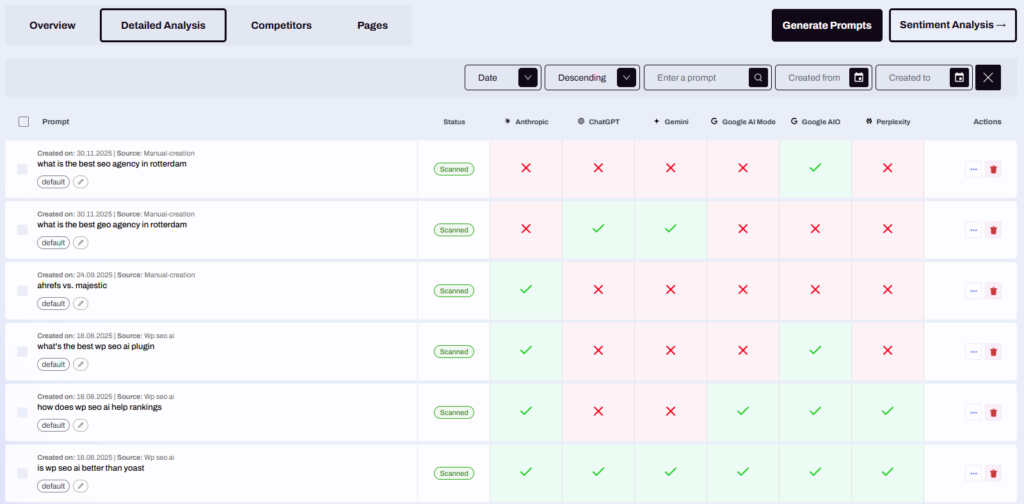
Referral traffic analysis from AI platforms provides quantitative performance data. Tools like MonsterInsights can track traffic from AI platforms, showing actual visitor flow from AI-generated responses. This traffic often demonstrates higher quality and engagement compared to traditional search referrals.
Monitor semantic SEO performance by tracking rankings for conversational and question-based queries. These longer, more natural language searches better reflect how users interact with AI systems and voice search platforms.
| Metric Category | Key Performance Indicators | Measurement Tools |
|---|---|---|
| Brand Visibility | Web mentions, brand search volume, AI citations | Brand monitoring tools, manual AI testing |
| Content Performance | AI referral traffic, citation frequency, response positioning | Analytics tools, AI platform monitoring |
| Technical Health | Schema implementation, structured data coverage, mobile performance | Technical SEO tools, Google Search Console |
| Authority Signals | Author credibility, E-E-A-T indicators, topical authority | Content audits, expertise assessment tools |
Establish baseline measurements across all AI platforms before implementing optimization strategies.
Track your current citation frequency, brand mention volume, and AI referral traffic to measure improvement over time. Remember that AI visibility often develops more slowly than traditional SEO gains, requiring patience and consistent effort.
The future belongs to businesses that can effectively bridge traditional search optimization with AI visibility strategies.
By implementing this comprehensive SEO checklist, you’re positioning your organisation to capture opportunities across both current search behaviours and emerging AI-driven discovery methods.
Start with the technical foundations, develop AI-optimised content, and build measurement systems that capture your complete search presence. Your investment in AI visibility today creates competitive advantages that compound as AI adoption accelerates throughout 2026 and beyond.
Frequently Asked Questions
How long does it typically take to see improvements in AI visibility after implementing these optimization strategies?
AI visibility improvements typically take 3-6 months to become noticeable, which is longer than traditional SEO changes. This extended timeline occurs because AI systems update their training data less frequently than search engines crawl websites. Focus on consistent implementation across technical foundations, content optimization, and brand building rather than expecting immediate results.
Should I completely abandon traditional SEO practices in favor of AI optimization?
No, traditional SEO and AI optimization should work together, not replace each other. Many technical foundations like site speed, mobile responsiveness, and structured data benefit both traditional search and AI systems. The key is expanding your strategy to include AI-specific elements like comprehensive content depth and brand mention building while maintaining proven SEO practices.
What's the biggest mistake businesses make when starting their AI visibility strategy?
The most common mistake is focusing solely on optimizing existing content without building the necessary technical foundations first. Many businesses rush to create AI-friendly content while neglecting schema markup, proper site structure, and E-E-A-T signals. Start with technical implementations and measurement frameworks before scaling content optimization efforts.
How do I know if my content is comprehensive enough for AI systems?
Content exceeding 10,000 words with extensive detail tends to perform better in AI citations, but length alone isn't sufficient. Your content should answer related sub-questions, provide context for industry terms, include step-by-step guidance, and demonstrate clear expertise. Test by asking yourself: could someone completely unfamiliar with this topic understand and act on your content?
Can small businesses compete with large corporations for AI visibility?
Yes, small businesses often have advantages in AI visibility, particularly in niche topics where they can demonstrate specialized expertise. AI systems value content depth and authority over domain size. Focus on establishing topical authority in your specific area, building local brand mentions, and creating comprehensive content that larger competitors might overlook.
Which AI platforms should I prioritize when testing my brand's visibility?
Start with ChatGPT, Google's AI Overviews, and Perplexity as your primary testing platforms since they represent the largest user bases. Test your main target keywords monthly across these platforms, documenting when your brand or content gets cited. Bing Copilot and Claude are secondary priorities unless your audience specifically uses Microsoft products or specialized AI tools.
How do I track brand mentions effectively for AI visibility measurement?
Use a combination of Google Alerts for your brand name, manual searches across news sites and industry publications, and social media monitoring tools. Set up alerts for your company name, key personnel, and product names. Track both direct mentions and contextual references where your expertise might be discussed without explicit brand naming, as these contribute to overall AI system knowledge about your authority.