

The 22 SEO automation tools in this guide cover every major workflow, from keyword research and content optimization to technical auditing, rank tracking, and AI visibility monitoring.
In my experience leading search strategy at WP SEO AI across more than 2,000 customers in five European markets, the right automation stack can realistically cut manual SEO work by 10 or more hours per week. As Google AI Overviews and generative engines reshape how people discover content, choosing that stack in 2026 matters more than it ever did before.
The tools below reflect what I have seen work in practice, who they suit, and what they cost, so you can shortlist with confidence.
Automate your SEO?
These SEO automation tools track your keyword performance in real time, monitor what your competitors are doing, create content that converts, and deliver insights that make sense of your site’s search performance. That constant feedback loop is what separates teams making decisions on actual data from those still relying on gut feelings and I have seen that gap widen considerably over the past year.
What are the best SEO automation tools in 2026?
The best SEO automation tools in 2026 include WP SEO AI, Surfer SEO, MarketMuse, Ahrefs, Clearscope, SE Ranking, Frase, and 15 others evaluated below. I have worked with or tested most of these tools directly, and each entry reflects what the tool actually automates, who it suits best, and one honest trade-off worth knowing before you commit.
MarketMuse
MarketMuse automates content gap analysis and topic modeling, showing you exactly which subjects your site needs to cover to build authority in your niche. In my experience, a content strategist can replace 4 to 6 hours of manual research with a single MarketMuse report, then use the output to brief writers with precise coverage targets.
I find MarketMuse most valuable for content teams and in-house SEO managers who publish at scale and need a repeatable research process. The main trade-off is cost: the free tier is limited, and the plans that unlock full competitive data start at $99/month, which is hard to justify for solo bloggers who do not need that volume of output.
Pricing starts at $99/month. Free version available.
Surfer SEO
Surfer SEO analyzes top-ranking pages in real time and generates an on-page optimization score that tells you exactly what to adjust before you publish. I have seen writers cut on-page optimization time from roughly two hours to under 20 minutes by following Surfer’s content editor recommendations, that kind of time saving compounds quickly across a busy editorial calendar.
Surfer suits content teams and in-house marketers who publish regularly and want data-backed guidance at the writing stage. The limitation worth flagging is that Surfer focuses on on-page signals and does not replace a dedicated technical audit tool or a backlink analysis platform; you will still need something else for those workflows.
Pricing begins at $99/month. Free trial offered.
WP SEO AI
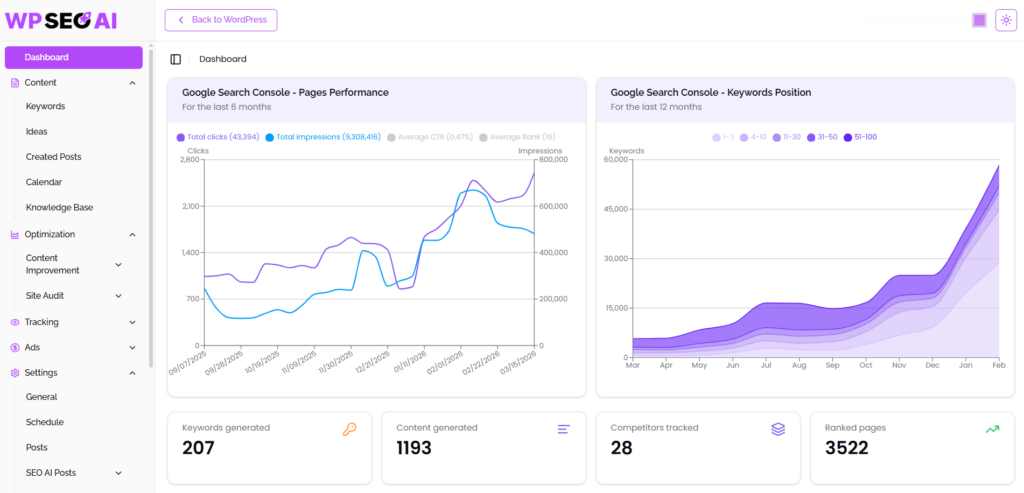
WP SEO AI is the platform I work on every day, so I can speak to this one with particular directness. It pairs intelligent automation with hands-on expertise, turning complex SEO and AI visibility into a smooth, measurable growth engine.
At the heart of the service is the WP SEO Agent: an AI-powered assistant inside WordPress that uncovers winning keywords, creates and publishes GEO-ready content, runs technical audits, optimises pages, and tracks performance across both Google and generative engines, all from within your dashboard. What makes the model work in practice is the hybrid approach.
While the WP SEO Agent automates the heavy lifting like content creation and technical audits, seasoned SEO and GEO specialists refine strategy, monitor results, and step in whenever a human touch is needed.
This fusion of AI SEO automation and expert support saves you 10+ hours weekly, lowers costs compared to traditional agencies, and delivers tangible gains you can share with your leadership team. Across our customer base of more than 2,000 businesses in five European markets, this combination consistently outperforms pure-software alternatives for teams that want results without building an internal SEO function from scratch.
Clearscope
Clearscope automates content optimization by analyzing top-ranking pages and generating a graded keyword report that shows exactly which terms to include and at what frequency.
Editors can review and act on a Clearscope report in minutes, replacing hours of manual SERP analysis before each piece goes live. I think Clearscope is at its best for content teams and agencies that need consistent quality across multiple writers, where the grading system creates a shared standard everyone can work to. The main limitation is price: at $189/month for the entry plan, it is one of the more expensive content optimization tools on this list, and you need to be publishing frequently enough to justify that investment.
Pricing starts at $189/month.
BrightEdge
BrightEdge automates enterprise keyword discovery and cross-channel performance reporting through its DataCube feature, which indexes billions of keywords and maps them to business outcomes. An enterprise SEO team can use BrightEdge to surface high-value keyword opportunities across large site architectures without manually pulling data from multiple sources.
From what I have observed working with enterprise clients, BrightEdge suits large organizations and enterprise e-commerce teams managing complex, multi-market SEO programs, it is genuinely built for that scale. The key limitation is access: pricing is custom and available only on request, making it entirely unsuitable for small teams or anyone with a fixed monthly budget.
Pricing is available upon request.
Frase
Frase automates SEO content research by analyzing what is already ranking and generating data-driven briefs that show you how to create something more complete. A writer can go from keyword to fully structured brief in under 10 minutes, replacing 4 to 6 hours of manual competitor analysis per piece. I consider that one of the best time-to-value ratios on this entire list at the price point.
Frase suits solo freelancers, bloggers, and small content teams who need fast, affordable research support. The honest limitation is that Frase’s AI writing output requires careful editing and works best as a research assistant rather than a finished content generator; do not expect to publish its drafts without meaningful revision.
Pricing starts at $15/month. Free version available.
Outranking
Outranking automates SEO content optimization by analyzing top-ranking articles and guiding you through creating better-performing pieces without manual research. This AI-powered writing assistant identifies structural and topical gaps so you can produce content that both Google and readers find useful. Outranking suits freelance writers and small marketing teams who want SEO guidance built directly into the writing process itself.
One trade-off I want to flag honestly: the interface has a steeper learning curve than simpler tools like Frase, which can slow adoption for non-technical users and reduce the time savings in the early weeks.
Pricing starts at $19/month. Free trial available.
CanIRank
CanIRank automates keyword difficulty assessment by calculating a probability-of-ranking score based on your site’s existing domain authority relative to the current competition. Instead of guessing whether a keyword is worth pursuing, you get a percentage likelihood and a prioritized action list that tells you exactly what to do to improve your chances.
I think this is a genuinely underrated approach for solo bloggers and small sites with limited domain authority who need to focus their efforts on winnable keywords rather than chasing terms they have no realistic shot at. The limitation is that the tool’s recommendations are most useful at the early growth stage; larger sites with established authority will find the guidance less differentiated from what they already know.
Pricing starts at $49/month. Free version available.
Alli AI
Alli AI automates technical SEO optimization, handling schema markup, site speed improvements, and on-page fixes without requiring developer resources. An SEO manager can deploy bulk on-page changes across hundreds of pages in a single session, a task that would otherwise take a developer days to complete.
Having worked with agencies managing large client portfolios, I can say that this kind of bulk implementation capability is genuinely valuable for protecting margins on technical SEO work. The main limitation is cost: at $299/month for the entry plan, it is a significant investment that smaller operations need to weigh carefully against the actual time savings they expect to realize.
Pricing starts at $299/month. Free trial available.
ContentKing
ContentKing automates real-time site monitoring, crawling your pages continuously and sending instant alerts the moment a technical SEO issue appears, whether that is a broken link, a missing meta tag, or an accidental noindex directive. A site owner can catch and fix a critical crawl error within minutes of it occurring, rather than discovering it weeks later during a routine audit.
In my view, this real-time detection model is the right approach for high-traffic sites where technical issues can cause rapid ranking losses, a monthly audit cadence simply is not fast enough in those environments. The limitation is that ContentKing focuses on monitoring and change detection; it does not provide keyword research or content optimization features, so it works best as part of a broader stack.
Pricing starts at $139/month. Free trial available.
AccuRanker
AccuRanker automates high-frequency rank tracking, refreshing SERP positions daily across desktop, mobile, and local search, with an API built to feed that data straight into your own reporting stack. An agency managing dozens of client sites can retire manual rank-checking spreadsheets entirely and get an alert the moment a priority page drops out of the top 10.
From what I have seen, this level of tracking frequency matters most to agencies and larger in-house teams who need to react to ranking volatility within hours rather than find out during a weekly report. The honest limitation is scope: AccuRanker only tracks rankings, it does not do keyword research, content optimization, or technical audits, so it is built to sit alongside a broader stack rather than replace one.
Pricing starts at $116/month, with a free trial available.
PaveAI
PaveAI automates SEO data analysis by connecting to Google Analytics and translating complex traffic and conversion data into plain-English strategy recommendations. A marketer can replace hours of manual reporting with a PaveAI summary that highlights which pages to optimize and why.
I find this particularly useful for small to mid-sized teams who use Google Analytics heavily but lack the bandwidth to extract actionable insights from raw data, the translation layer is the real value here. The limitation is that PaveAI’s recommendations are only as useful as the data flowing into your Analytics account, so sites with tracking gaps or inconsistent event configuration will see less precise guidance.
Pricing starts at $39/month. Free trial available.
WordLift
WordLift automates structured data implementation, adding schema markup to your content so search engines can understand and display it as rich snippets without you writing a single line of code. A content publisher can apply entity-based schema across an entire article library automatically, capturing rich result opportunities that would otherwise require developer time.
As someone who tracks how large language models cite and surface web content, I think entity-based structured data is increasingly important for AI search visibility, which makes WordLift more strategically relevant in 2026 than it was two years ago. The limitation is price: at €999/month, WordLift is positioned for organizations with a clear ROI case for rich snippet traffic, not for small blogs or solo creators.
Pricing starts at €999/month. Free trial available.
Hostinger Website Builder
Hostinger Website Builder (formerly Zyro) automates foundational SEO through a built-in SEO checklist that guides beginners through meta titles, descriptions, image alt text, and site speed basics without requiring any technical knowledge. A small business owner can launch an SEO-ready site and work through the checklist in a single afternoon, covering optimizations that would otherwise require a consultant. Hostinger Website Builder suits solopreneurs and small businesses who need an all-in-one website and SEO starter solution.
My honest assessment is that the built-in SEO tools cover the basics well, but once you are ready to compete seriously in your niche, you will outgrow them quickly and need dedicated platforms like SE Ranking or Surfer SEO for ongoing optimization.
Pricing starts at $49/month. Free version available.
NeuralText
NeuralText automates content research and keyword clustering, generating content ideas grounded in SERP data and grouping related keywords so you can plan topic clusters efficiently. A content manager can build a full editorial calendar from a single seed keyword in under an hour, replacing days of manual keyword sorting. NeuralText suits solo content creators and small teams who need affordable keyword research and content planning in one place.
One limitation I want to flag clearly: NeuralText’s content generation features produce drafts that require significant editing before publication, so factor that revision time into your workflow expectations.
Pricing starts at $19/month. Free trial available.

GetGenie AI
GetGenie AI combines AI content generation with SEO automation in one platform, covering keyword research, competitor analysis, and content scoring without requiring you to switch between tools. A marketer can research a keyword, analyze the competition, and produce an optimized draft inside a single GetGenie workflow, cutting multi-tool setup time significantly.
GetGenie suits freelancers and small marketing teams who want an affordable all-in-one solution and prefer to minimize their tool stack. The limitation I consistently observe with all-in-one tools at this price point is that individual features like keyword research and content scoring are less advanced than dedicated tools such as Ahrefs or Surfer SEO, you are trading depth for convenience.
Pricing starts at $89/month. Free trial available.
SE Ranking
SE Ranking automates rank tracking, competitor analysis, and technical site audits within a single platform, giving agencies and in-house teams a consolidated view of SEO performance across multiple projects. Its multi-client dashboard lets an agency manager monitor rankings and audit results for every client without logging into separate accounts, saving several hours of reporting time each week.
I recommend SE Ranking most often to SEO agencies and in-house teams of 3 to 10 people who need comprehensive coverage at a mid-range price, it consistently delivers strong value at that scale. The limitation is that SE Ranking’s content optimization module is less developed than dedicated tools like Surfer SEO or Clearscope, so content-heavy teams will likely want to pair it with one of those.
Pricing starts at $47/month. Free trial available.
Diib
Diib automates SEO growth planning for small businesses and startups by analyzing your site and producing a prioritized action list that focuses on the changes most likely to improve rankings quickly. A business owner can connect Diib to Google Analytics and receive a clear weekly growth plan without needing any SEO background. Diib suits solopreneurs and small businesses who need straightforward, jargon-free guidance rather than a full-featured SEO platform.
My honest take is that Diib’s recommendations are higher-level than those from tools like Ahrefs or SE Ranking, experienced SEO practitioners will find it too simplified for advanced work, but for someone just starting out, that simplicity is actually the point.
Pricing starts at $30/month. Free version available.
RankMath
RankMath automates on-page SEO optimization directly inside WordPress, scoring each post against a checklist of ranking factors and suggesting fixes before you publish. A WordPress publisher can optimize a post for multiple focus keywords in the same editing session, a workflow that would otherwise require a separate tool and manual cross-referencing.
As someone who works inside WordPress every day, I think RankMath is one of the most practical tools on this list for its target audience, you get powerful on-page automation without ever leaving your CMS. The limitation is that RankMath is WordPress-only, so teams running sites on other platforms need to look elsewhere entirely.
Pricing starts at $59/year, with a free version available.
Ahrefs
Ahrefs automates backlink analysis, keyword research, and site auditing at a depth that makes it the reference standard for competitive SEO intelligence, and it is a tool I use regularly in my own research and analysis work. Its AI Content Helper adds automated content optimization recommendations on top of that foundation, analyzing top-ranking pages and identifying gaps in your existing articles.
Ahrefs suits SEO professionals and agencies who need a comprehensive platform covering research, auditing, and content in one place. The limitation worth being direct about is cost: Ahrefs is one of the more expensive tools on this list, and its depth can genuinely overwhelm users who only need basic rank tracking, do not pay for capability you will not use.
Pricing starts at $119/month, with a free trial available.
Semrush
Semrush automates competitive intelligence at scale, tracking daily keyword rankings while continuously mapping which pages, keywords, and backlinks are driving traffic to your competitors. An analyst can build a full competitive teardown of two or three rivals in under an hour, a task that used to mean pulling data from half a dozen separate sources by hand.
I reach for Semrush most often with agencies and in-house teams who want one dashboard covering research, tracking, and auditing rather than stitching together several single-purpose tools. The trade-off is breadth over depth: Semrush’s content optimization and technical audit modules are solid but less specialized than dedicated tools like Surfer SEO or ContentKing, so larger teams often end up layering a focused tool on top rather than relying on Semrush alone.
Pricing starts at $139/month, with a free trial available.
Profound
Profound automates AI visibility tracking, running structured prompt sets against ChatGPT, Perplexity, and Google AI Overviews to show exactly when and how a brand gets mentioned, cited, or recommended inside generative answers. A brand or content team can see, inside a single dashboard, which competitors are winning a given AI-generated answer and which content gaps are quietly costing them citations.
Given how much of this guide is about the shift toward generative search, I think a dedicated monitoring layer like this is turning into its own category rather than a nice-to-have add-on, and I expect more teams to treat it as standard by the end of 2026. The limitation to flag clearly is that Profound tracks and reports on AI visibility, it does not produce or optimize content itself, so you still need a content or technical SEO tool from elsewhere on this list to act on what it surfaces.
Pricing starts at $99/month for the self-serve plan, with larger deployments priced on request.
Why should you use AI SEO automation tools?
AI SEO automation tools matter because SEO has grown too complex and too time-consuming for manual workflows to keep pace.
Between tracking algorithm changes, running technical audits, researching keywords, and optimizing content, a thorough manual SEO process can consume 20 or more hours per week for a single site.
I have watched teams transform their output by adopting AI-driven SEO automation, those tasks that used to consume entire working days compress into a fraction of the time, freeing people to focus on strategy and creative work that actually differentiates a brand.
The shift to AI-powered search makes this more urgent in 2026. Google AI Overviews and other generative engines now synthesize answers from multiple sources, meaning your content needs to be structured, specific, and authoritative to be cited.
This is something I research and write about regularly, and the pattern is consistent: content that gets surfaced by large language models shares specific structural and topical characteristics that automation tools can help you achieve at scale. The marketers who succeed with these tools are the ones who treat AI as an amplifier of their own expertise, not a replacement for it.
How do you choose the right SEO automation tool for your needs?
The right SEO automation tool depends on your budget, team size, technical skill level, and the specific workflows you need to automate.
With 22 options on this list, the fastest way to narrow your choice is to match each tool to your actual situation rather than chasing the most feature-rich option available, a mistake I see teams make repeatedly when they end up paying for capabilities they never actually use.
What tool stack fits your budget?
Expensive tools do not automatically deliver better results for every situation. A small team with a focused workflow can outperform an enterprise team using a bloated stack they do not fully use, I have seen this play out more than once. The three budget tiers below name specific tools, explain what workflow each covers, and show the combined monthly cost so you can plan with real numbers.
- Starter tier (under €150/month): RankMath Pro (€59/year, on-page optimization for WordPress) + Frase (€15/month, content briefs and research) + SE Ranking (€47/month, rank tracking and technical audits). This stack covers the three core workflows most small teams need without overlapping features.
- Growth tier (€150 to €400/month): Surfer SEO (€99/month, on-page content scoring) + MarketMuse (€99/month, topic modeling and content planning) + PaveAI (€39/month, analytics reporting). This combination suits teams publishing regularly who need both content quality and performance tracking.
- Scale tier (€400+/month): Clearscope (€189/month, enterprise content optimization) + Alli AI (€299/month, bulk technical SEO at scale) + BrightEdge (custom pricing, enterprise keyword intelligence). This stack suits large organizations managing complex, multi-market SEO programs.
Before you commit to assembling and running any of these stacks yourself, it is worth pricing out what the same scope of work would cost as a managed program, because the comparison is rarely close for a busy team.
Agencies quoting equivalent research, content production, and ongoing optimization commonly land somewhere in the low five figures per month once strategy, execution, and reporting hours are all billed separately, and that number tends to climb every time you add another format, market, or writer to the brief. Bringing the same scope fully in-house is rarely cheaper once you total the tool subscriptions above, the hours a marketer or specialist spends producing and re-optimizing each piece, and the opportunity cost of that time not going toward the campaigns only a person can run.
This is the gap WP SEO AI is built to close. Instead of licensing separate research, writing, optimization, and monitoring tools and still needing someone to operate them, a single WP SEO AI package folds that execution into one monthly line item, one that, in practice, tends to sit closer to what a growing team already budgets for a Growth-tier subscription stack above than to an agency retainer or an added headcount. If you are weighing the Growth tier stack, a scaled-down agency engagement, or hiring in-house, that hybrid pricing model is worth getting a real quote on before you spend the time building the DIY version yourself.
Which tools integrate with your existing stack?
Nothing kills productivity faster than tools that do not talk to each other. Before you commit to any SEO automation tool, check how it connects with what you already use.
WordPress sites: WP SEO AI and RankMath are the natural starting points. Heavy Google Analytics users: PaveAI will save you hours of manual reporting. Teams using HubSpot or Salesforce: confirm that your chosen tools have native integrations or solid API connections before signing up.
Which tools suit your team size and skill level?
The right tool for a solo freelancer looks very different from the right tool for a 10-person agency. The four profiles below map specific tools from this list to the user types they serve best, based on what I have seen work across different customer segments.
Solo freelancer or blogger
If you are managing SEO on your own, you need tools that are affordable, easy to use, and broad enough to cover multiple tasks without a steep learning curve. Frase (€15/month) handles content research and briefs. RankMath (€59/year) covers on-page optimization inside WordPress. SE Ranking (€47/month) tracks rankings and runs site audits. Together, this stack gives you comprehensive coverage for under €70/month once RankMath’s annual cost is amortized and in my view, it is the most cost-efficient starting point on this entire list.
This is also the one profile on this list where I would not point you toward WP SEO AI. Its hybrid model pairs automation with dedicated specialist time, which is built for a team that already has some volume of content, clusters, or campaigns to manage, not a single person just getting started. The self-serve stack above will serve you better until you are ready to hand off that workload.
In-house marketing team (3 to 10 people)
In-house teams benefit from tools that support collaboration and produce outputs that can be shared with leadership. Surfer SEO gives writers real-time content guidance that reduces back-and-forth editing. MarketMuse helps content strategists plan topic clusters and brief writers with data-backed targets.
This is also the profile WP SEO AI fits best on this entire list, particularly for SMBs that need to move fast but do not have the headcount to run research, content production, technical SEO, and monitoring as four separate functions.
The specialist support built into the hybrid model supplies the skills and execution speed most SMB teams simply do not have by default: research, writing, technical fixes, and ongoing optimization all get handled, without the team having to hire for each discipline on its own. In practice, that combination is often priced closer to what a company would budget for a single part-time intern than for the specialist team it is effectively standing in for, which is exactly why it tends to make the most sense for a lean in-house team rather than a solo operator or a large enterprise with its own SEO department.
SEO agency managing multiple clients
Agencies need tools with multi-client dashboards, white-label reporting, and the depth to serve clients across different industries. SE Ranking’s multi-client workspace lets you monitor rankings and run audits for every client from a single login. Clearscope ensures content quality stays consistent across different writers and client briefs. Alli AI lets you implement bulk technical changes across multiple client sites without developer resources, which protects agency margins on technical SEO work, a pressure point I hear about consistently from agency teams.
Agencies serving a roster of SMB clients also increasingly bring WP SEO AI into the stack directly, using its hybrid model to deliver full-service SEO to smaller accounts without staffing a dedicated team for each one. That lets an agency take on more SMB clients profitably, at a price point those clients could realistically say yes to, rather than turning down accounts too small to service under a traditional retainer.
Enterprise or large e-commerce site
Enterprise teams need tools that operate at scale across large site architectures, multiple markets, and complex reporting requirements. BrightEdge’s DataCube provides keyword intelligence at a volume and depth that smaller tools cannot match, making it the standard choice for large organizations with dedicated SEO teams. ContentKing’s real-time monitoring ensures that technical issues on high-traffic sites are caught and resolved before they affect rankings, which is critical when even a brief crawl error can cost significant organic revenue, a risk that enterprise teams cannot afford to manage reactively.
How does AI SEO automation change your day-to-day workflow?
AI SEO automation shifts your working day from executing repetitive tasks to making strategic decisions.
Marketers who adopt these tools consistently report moving from spending 80% of their time on manual SEO execution to spending 80% of their time on strategy, content quality, and competitive positioning. I have watched this shift happen with our own customers, and it is not a marginal efficiency gain, it fundamentally changes what the role looks like and what people are able to accomplish in a week.
The key is understanding that AI amplifies human expertise rather than replacing it. Your judgment about your audience, your ability to spot an opportunity a competitor has missed, and your creative instincts are what determine whether good automation produces extraordinary results or just faster mediocre output. The tools handle the data processing. You handle the thinking. That division of labour is what makes the best SEO teams so effective right now.
This content was generated with the help of AI and it may contain mistakes