

The way people search for information is changing fast.
For years, the answer to “What are the top search engines?” felt simple: Google dominated, and everything else sat far behind.
In 2026, Google is still clearly number one, but the wider search landscape now matters more. Traditional search engines, privacy-focused alternatives, and AI-powered discovery tools all shape how people find information online.
For marketers, that means one thing: visibility is no longer just about Google rankings. You need to understand where users search, how those platforms generate answers, and which engines still influence downstream AI experiences.
In this guide, we will look at the top five search engines by global market share, how they differ, and what their role looks like in August 2026.
List of the top 5 search engines in the world
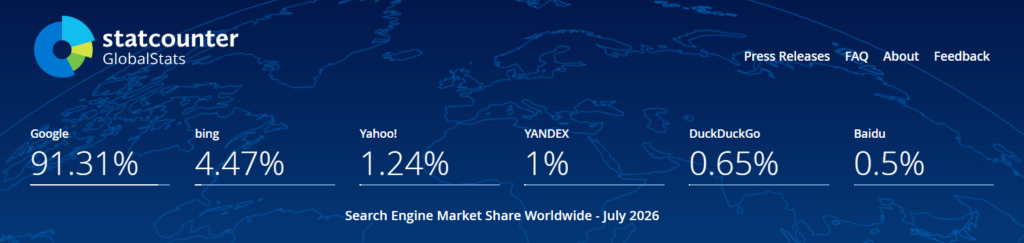
As of August 2026, the top five search engines worldwide by market share are Google, Bing, Yahoo, Yandex, and DuckDuckGo. StatCounter’s August 2026 global data puts Google at 91.31%, Bing at 4.47%, Yahoo at 1.24%, Yandex at 1.00%, and DuckDuckGo at 0.65%. Baidu sits just outside the top five globally at 0.50%.
#1 Google
Google remains the dominant search engine by an enormous margin. In August 2026, it held approximately 91.31% of global search market share.
On mobile, Google’s dominance is even stronger. StatCounter’s August 2026 data puts Google at 95.82% of worldwide mobile search, leaving every other search engine below 1%.
That dominance still makes Google the default priority for most SEO strategies. Interestingly, the latest data also shows that Google has regained some ground. Its worldwide share stood at 89.85% in March, 90.02% in April, 90.39% in May, 91.27% in June, and roughly 91.31% in August 2026. In other words, the latest numbers do not show Google continuing to lose market share. They show a clear rebound over the past several months.
#2 Microsoft Bing
Bing is the world’s second-largest search engine, with approximately 4.47% global market share in August 2026.
On desktop, its role is considerably more important than that headline figure suggests. StatCounter’s August 2026 desktop data puts Bing at 8.84% worldwide, compared with 86.12% for Google. Yahoo follows with 2.21%.
Bing also matters because Microsoft continues to connect traditional search with its AI ecosystem. Copilot Search in Bing generates summarized answers with cited web sources, while Microsoft has expanded AI visibility reporting that lets site owners see which pages and queries are being cited by AI experiences.
That makes Bing strategically important not just for classic search traffic, but also for visibility inside Microsoft’s AI-powered discovery ecosystem.
#3 Yahoo
Yahoo ranks third globally in August 2026 with approximately 1.24% market share.
Its share has fallen slightly since March, when it stood at 1.48%, but Yahoo remains comfortably ahead of Yandex and DuckDuckGo at worldwide level.
For most marketers, Yahoo is less important as a standalone optimization target than Google or Bing. Its main relevance is the audience it still reaches and its position as one of the largest remaining traditional search brands outside the two market leaders.
#4 Yandex
Yandex ranks fourth globally at approximately 1.00% in August 2026.
That global figure dramatically understates its importance in Russia. StatCounter’s August 2026 data puts Yandex at 72.85% of the Russian search market, compared with just 25.48% for Google. Bing and Mail.ru each account for roughly 0.69%.
That makes Yandex essential for businesses specifically targeting Russia or Russian-speaking audiences. Globally, however, Yahoo remains larger.
#5 DuckDuckGo
DuckDuckGo ranks fifth globally with approximately 0.65% market share in August 2026.
Its appeal is not scale but privacy. DuckDuckGo operates its own crawler, DuckDuckBot, and maintains several of its own indexes, while stating that its traditional web links and image results are still largely sourced from Bing.
For users who want a more private search experience without extensive behavioral tracking, DuckDuckGo remains one of the best-known alternatives to Google and Bing.
Search engine market share worldwide August 2026
Source: StatCounter Global Stats – Search Engine Market Share
What about Baidu?
Baidu does not make the worldwide top five in August 2026. Globally, it accounts for approximately 0.50% of search activity.
Within China, however, the picture is completely different. StatCounter’s August 2026 data puts Baidu at 50.83% of the Chinese search market. Bing follows at 22.84%, Yandex at 13.20%, Haosou at 8.95%, Sogou at 2.12%, and Google at just 1.86%.
So if your audience is global, Baidu sits outside the top five. If your audience is in China, it is still the single most important search engine.
Which search engine has the highest market share?
Google has by far the highest market share of any search engine.
StatCounter’s August 2026 global figures put Google at approximately 91.31%, with Bing in second place at 4.47%. Yahoo follows at 1.24%, Yandex at 1.00%, DuckDuckGo at 0.65%, and Baidu at 0.50%.
No other traditional search engine is currently close to challenging Google at worldwide scale.
Is Google’s dominance slipping?
Not according to the most recent data.
Google did fall below 90% worldwide in March 2026, when StatCounter recorded a share of 89.85%. But since then, its market share has moved in the opposite direction: approximately 90.02% in April, 90.39% in May, 91.27% in June, and 91.31% in August.
That represents an increase of roughly 1.46 percentage points between March and August.
So the more accurate interpretation in August 2026 is not that Google’s traditional search market share is collapsing. Google remains extraordinarily dominant and has actually strengthened its position during the past few months.
What is fragmenting is the broader way people search for information. Users increasingly move between Google, Bing, social platforms, AI assistants, and AI-generated answers. Search behavior can therefore diversify even while Google maintains more than 90% of the measured traditional search-engine market.
What’s the difference between Google and Bing?
Google and Bing remain the two most important traditional search engines for most businesses, but their market positions are very different.
Globally, Google controls approximately 91.31% of search compared with Bing’s 4.47%. On desktop, however, the gap narrows: Google has 86.12% and Bing 8.84% as of August 2026.
Bing also has a growing strategic role beyond traditional search. Microsoft describes Bing as an AI-powered “search and answer engine,” with Copilot Search combining web search with summarized answers, cited sources, and further exploration.
Microsoft’s wider Copilot ecosystem can also use Bing Search to retrieve live public web information when grounding AI-generated responses. That means being accessible and understandable to Bing can potentially influence visibility beyond the classic Bing results page itself.
Which search engines prioritize privacy?
If privacy is the main goal, DuckDuckGo, Brave Search, and Startpage remain three prominent alternatives, although they take different technical approaches.
DuckDuckGo emphasizes search without tracking users and combines its own crawler and indexes with results largely sourced from Bing.
The important distinction for marketers is that privacy-focused engines are not necessarily completely separate search ecosystems. In DuckDuckGo’s case, Bing continues to influence a substantial part of the traditional results users see.
How is AI changing search?
AI is changing search by making answers more direct, synthesized, and often less click-dependent.
ChatGPT Search, for example, can search the web and return timely answers with links to relevant web sources. Microsoft’s Copilot Search similarly combines generative answers with cited sources directly inside Bing.
The impact on traditional organic clicks is already measurable. Ahrefs’ February 2026 update found that when an AI Overview appeared, the average click-through rate of the top-ranking page was 58% lower than comparable results without one. That was a substantial increase from its original April 2025 study, which estimated a 34.5% reduction.
At the same time, AI platforms themselves have reached enormous scale. OpenAI stated in August 2026 that around 1 billion people use ChatGPT each week, up from more than 900 million weekly active users reported in March 2026. OpenAI also says its models now reach more than one billion active users overall.
This means the competitive landscape for search visibility is no longer defined purely by Google versus Bing. Websites increasingly compete to become a source inside AI-generated answers as well.
Should you optimize for more than one search engine?
Yes. In 2026, optimizing only for Google is increasingly too narrow for many businesses.
Google still deserves the largest share of attention because it controls approximately 91.31% of worldwide traditional search and 95.82% of mobile search. Bing deserves additional attention because it controls 8.84% of desktop search and feeds into Microsoft’s expanding AI ecosystem.
International businesses also need to look at the markets individually. Yandex holds 72.85% of search in Russia, while Baidu controls 50.83% in China.
The broader strategic shift is this: search is no longer just ten blue links on Google. It is a combination of traditional search engines, AI-assisted search experiences, and answer engines that retrieve and cite information from the web.
The brands that win in 2026 will therefore be the ones building search visibility across that wider ecosystem rather than thinking about rankings on a single platform alone.
What is a search engine, and how does it work?
A search engine is a system that discovers web content, stores information about that content in an index, and retrieves relevant results when someone searches.
In simple terms, the process usually happens in three broad stages: crawling, indexing, and serving results.
Crawling is the discovery phase. Search bots move across the web, following links and discovering new or updated URLs. Microsoft, for example, describes Bingbot as the crawler that discovers pages and content to add to Bing’s search index.
Indexing is the analysis and storage phase, where the search engine determines what the content contains and whether it should become part of its searchable index.
Serving happens when someone performs a search. The engine retrieves relevant information from its index and decides which results to display.
AI-powered search adds another layer to this process. Instead of simply presenting ranked URLs, systems can retrieve relevant web information and use it as grounding for a generated answer. Microsoft explicitly documents this workflow for Copilot, where Bing Search can retrieve relevant public web information that is then used to generate the response.
For website owners, the takeaway remains fundamental: your content needs to be crawlable, indexable, understandable, and retrievable. In 2026, that matters not only for appearing in traditional search results, but increasingly for being selected as a source inside AI-generated answers.
Frequently Asked Questions
What is the biggest search engine in the world?
Google is the largest search engine in the world, with nearly 90% global market share. No competitor comes close at a global level.
Is Bing growing in 2026?
Yes, especially on desktop. While its global share is around 5%, it exceeds 10% on desktop and is gaining importance through Microsoft’s AI ecosystem.
What is the best private search engine?
DuckDuckGo is the most widely used privacy-focused search engine. Brave Search is a strong alternative if you want an independent index, while Startpage offers Google results without tracking.
Does Baidu belong to the top five search engines?
Globally, no. Baidu sits outside the top five. However, in China, it is one of the most important search engines and dominates the market.
This content was generated with the help of AI and it may contain mistakes