The big three AI models are ChatGPT, Perplexity, and Google Gemini. These three language models dominate the generative AI landscape because they combine powerful reasoning capabilities with broad accessibility. Each model offers distinct strengths for different use cases, from content creation to technical analysis.
As of February 2026, ChatGPT leads with a commanding 79.98% market share, followed by Perplexity at 7.88% and Gemini at 7.5%.
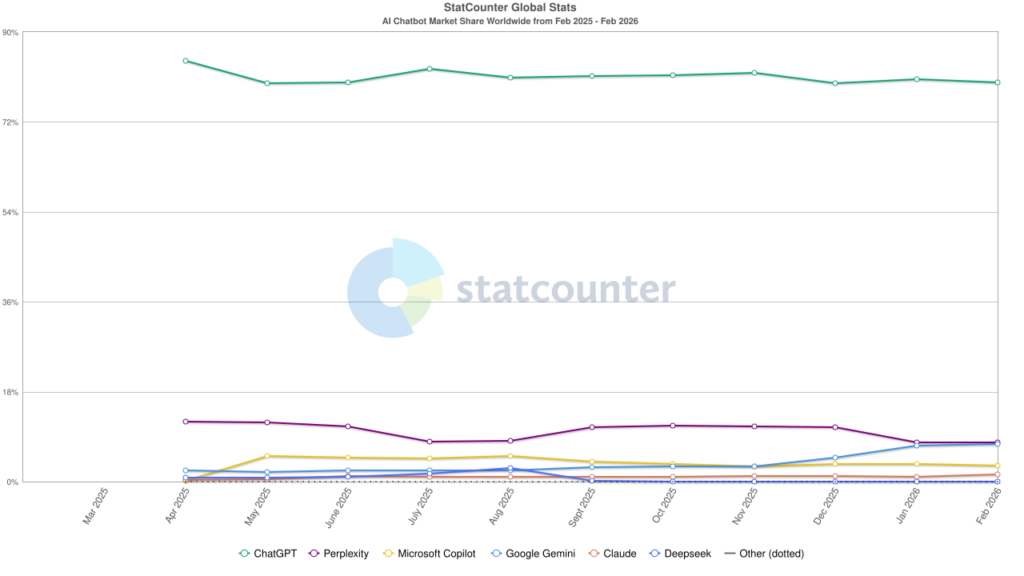
Check these stats yourself on statcounter.com
What Are the Big Three AI Models Everyone Is Talking About?
The big three AI models are ChatGPT from OpenAI, Perplexity from Perplexity AI, and Gemini from Google DeepMind. These three models lead the generative AI space because they offer:
- Advanced natural language understanding
- A wide range of capabilities
- Reliable performance across many tasks
ChatGPT is the undisputed market leader with nearly 80% of AI model usage as of February 2026. It became the breakout consumer AI product that brought generative AI into mainstream awareness. OpenAI’s partnership with Microsoft gives ChatGPT deep integration with enterprise tools and significant computing resources.
Perplexity has emerged as a strong second-place contender with 7.88% market share. It positions itself as an AI-powered answer engine that combines conversational AI with real-time web search, making it particularly appealing to users who need accurate, up-to-date information with clear source citations.
Google Gemini holds 7.5% of the market and represents Google’s unified AI strategy, combining the company’s decades of search expertise with cutting-edge language model development. Gemini powers Google’s AI Overviews in search results and integrates across the Google ecosystem, from Gmail to Google Workspace.
These three models dominate because they combine technical capability with practical accessibility. They are available through:
- Consumer-facing interfaces
- Developer APIs
- Enterprise partnerships
This broad reach makes them the foundation for countless AI-powered applications and workflows.
How Do ChatGPT, Perplexity, and Gemini Actually Differ From Each Other?
Each model reflects its parent company’s priorities and training philosophy. At a high level:
- ChatGPT excels at creative tasks and conversational flexibility.
- Perplexity specializes in real-time, sourced answers drawn directly from the web.
- Gemini integrates deeply with Google’s search and productivity ecosystem.
ChatGPT
ChatGPT’s conversational style feels natural and adaptable. It handles creative writing, brainstorming, and general-knowledge questions with confidence. The model’s training emphasizes helpfulness and engagement, making it feel responsive to your specific needs. ChatGPT also offers web-search capabilities through its search feature, pulling in current information when needed.
Perplexity
Perplexity’s defining strength is its ability to deliver real-time, cited answers by searching the web for every query. When you ask Perplexity a question, it retrieves and synthesizes current sources, making it particularly strong for queries that require up-to-date data or factual verification. Its transparent citation model allows users to verify sources directly, building a level of trust that sets it apart from purely generative models.
Gemini
Gemini takes a deeply integrated approach within Google’s ecosystem. It excels at:
- Connecting with Google Search for current information
- Working seamlessly across Gmail, Docs, and Google Workspace
- Handling multimodal inputs including text, images, and other formats
Gemini’s training draws on Google’s vast knowledge base, and its deep integration with Google’s productivity suite makes it a natural choice for users already embedded in the Google ecosystem. The model’s emphasis on search alignment and multimodal capability makes it particularly useful for tasks that bridge research and productivity.
How Each Model Handles Context and Memory
The differences extend to how each model handles context and memory:
- ChatGPT maintains conversation history and can reference earlier points naturally.
- Perplexity focuses on retrieving fresh information for each query, prioritizing accuracy and source transparency over conversational continuity.
- Gemini can leverage your Google account data when you are logged in, personalizing responses based on broader usage patterns.
Which AI Model Is Best for Content Creation and SEO Work?
For content creation and SEO work, your choice depends on your specific workflow needs:
- ChatGPT offers flexibility for creative writing and ideation.
- Perplexity provides real-time, sourced research ideal for fact-heavy content and trend analysis.
- Gemini delivers direct access to Google Search data for keyword research and search-intent alignment.
Using ChatGPT for Content and SEO
ChatGPT works well when you need to:
- Generate multiple content variations quickly
- Brainstorm headline options
- Develop creative angles on familiar topics
Its conversational interface makes it easy to refine outputs through follow-up prompts. Many SEO professionals use ChatGPT for initial content drafts, meta-description variations, and social-media adaptations of longer pieces.
Using Perplexity for Content and SEO
Perplexity’s real-time web search gives it a strong advantage for research-heavy content and factual accuracy. You can ask Perplexity to:
- Surface the latest information on a topic with cited sources
- Identify common questions people are currently asking
- Verify factual claims against recent, linked sources
This makes it particularly useful for content that needs to reflect current events, address emerging search trends, or demonstrate factual credibility through transparent sourcing.
Using Gemini for Content and SEO
Gemini shines when you need content that aligns closely with what is currently ranking in Google Search. Its integration with Google’s search index lets you provide search-intent context, trending topics, and real-time SERP data, then produce content that adheres closely to those parameters. For teams working within Google Workspace, Gemini’s native integration into Docs and Gmail streamlines the content production workflow significantly.
None of these models understand search intent the way human SEO professionals do, and all require careful fact-checking. They work best as research and drafting assistants rather than autonomous content creators. The most effective approach combines AI assistance with human expertise in keyword targeting, search psychology, and content strategy.
What Are the Main Strengths and Weaknesses of Each AI Model?
Each model has a distinct profile of strengths and limitations:
- ChatGPT offers versatility and ease of use, but can be overly confident about incorrect information.
- Perplexity excels at delivering sourced, real-time answers, but its conversational depth and creative output are more limited than dedicated language models.
- Gemini offers strong Google ecosystem integration and access to current information, but sometimes provides surface-level responses on complex reasoning tasks.
| Model | Key Strengths | Key Weaknesses |
|---|---|---|
| ChatGPT |
|
|
| Perplexity |
|
|
| Gemini |
|
|
How Do These AI Models Impact Search and Discoverability?
The big three AI models are fundamentally changing how people find information online. Instead of clicking through search results, users increasingly get direct answers from AI Overviews, ChatGPT’s search feature, Perplexity’s answer engine, and other generative AI interfaces. This shift means your content needs to be optimized not just for traditional search rankings, but also for being cited and referenced by AI systems.
How AI Is Changing Search Behavior
Google’s AI Overviews now appear for a growing number of search queries, providing synthesized answers drawn from multiple sources. These overviews use retrieval-augmented generation, combining Google’s traditional search index with Gemini’s language capabilities to construct comprehensive responses. When your content appears in an AI Overview, you get a citation, but users may never click through to your site.
Perplexity’s answer engine allows users to bypass Google entirely for many informational queries. The system searches the web, processes multiple sources, and presents a coherent answer with clearly linked citations. This represents a fundamental shift in search behavior, particularly among users who prioritize source transparency and up-to-date accuracy over conversational interaction.
What This Means for SEO Professionals
The implications for SEO professionals are significant. Traditional metrics like click-through rates and page views become less meaningful when AI systems extract and repackage your content. Success increasingly means being cited as a source rather than receiving direct traffic. This requires rethinking content strategy around what makes your information citation-worthy to AI systems.
Generative Engine Optimization addresses this new reality. Instead of optimizing solely for keyword rankings, you need to:
- Write clear, factual passages that stand on their own
- Organize information in semantically meaningful ways
- Build authority signals that AI systems recognize
The big three models do not all access information the same way:
- Gemini draws from Google’s search index and broader web content used in model training.
- ChatGPT uses a combination of its training data and real-time web search.
- Perplexity relies primarily on live web retrieval, surfacing and citing current sources for every query.
This means your content’s visibility varies across different AI platforms based on how each system accesses and evaluates sources.
Brand mentions and web presence across multiple platforms matter more for AI visibility than traditional backlink profiles. AI models train on vast amounts of web text, making consistent brand mentions, clear explanations, and authoritative positioning across the broader internet increasingly important for being selected as a trusted source.
Which AI Model Should You Use for Your Business Needs?
As a general guide:
- Choose ChatGPT for versatile everyday tasks and creative work.
- Choose Perplexity for research that requires current, sourced information and factual accuracy.
- Choose Gemini for tasks that benefit from Google ecosystem integration and real-time search alignment.
Most businesses benefit from access to multiple models for different use cases.
Matching Models to Use Cases
Consider your primary use cases before committing to a single platform:
- If your team needs help with content drafting, brainstorming, and general productivity, ChatGPT’s versatility and ease of use make it a strong starting point. The large user community and extensive third-party integrations mean you will find plenty of resources and pre-built solutions.
- For teams that need reliable, sourced answers to research questions, Perplexity’s real-time retrieval model offers a significant advantage. Its transparent citation system makes it easier to verify claims and build content on a foundation of credible, current sources.
- Businesses heavily invested in Google Workspace will find Gemini’s native integration offers significant workflow advantages. You can use Gemini directly within Gmail to draft responses, in Docs to expand outlines, and across other Google tools without switching contexts.
Budget and API Considerations
Budget considerations matter when selecting a model. Here is how the three compare on pricing and access:
| Model | Free Tier | Paid Access |
|---|---|---|
| ChatGPT | Capable free tier with GPT | Subscription required for advanced GPT |
| Perplexity | Free access with real-time search included | Paid Pro tier for advanced models and higher usage limits |
| Gemini | Free access with limitations | Paid tiers for advanced capabilities |
API access and integration capabilities vary significantly. All three models offer developer APIs, but pricing structures, rate limits, and integration complexity differ. If you are building AI features into your products or automating workflows, evaluate each model’s API documentation, pricing, and reliability for your specific technical requirements.
A Multi-Model Workflow for SEO Teams
For SEO professionals and content teams, the most effective approach often involves using different models at different stages of the workflow:
- Use Perplexity for keyword research, trend analysis, and sourced fact-finding.
- Use ChatGPT for initial content drafts and creative variations.
- Use Gemini for final search-intent alignment and Google ecosystem integration.
This multi-model approach lets you leverage each system’s strengths while compensating for individual weaknesses.
The landscape continues to evolve rapidly. New capabilities, pricing changes, and competitive pressures mean today’s best choice may shift. Stay flexible, test different models for your specific needs, and build workflows that are not locked into a single platform. The businesses that adapt most successfully treat AI models as tools within a broader strategy rather than complete solutions on their own.