

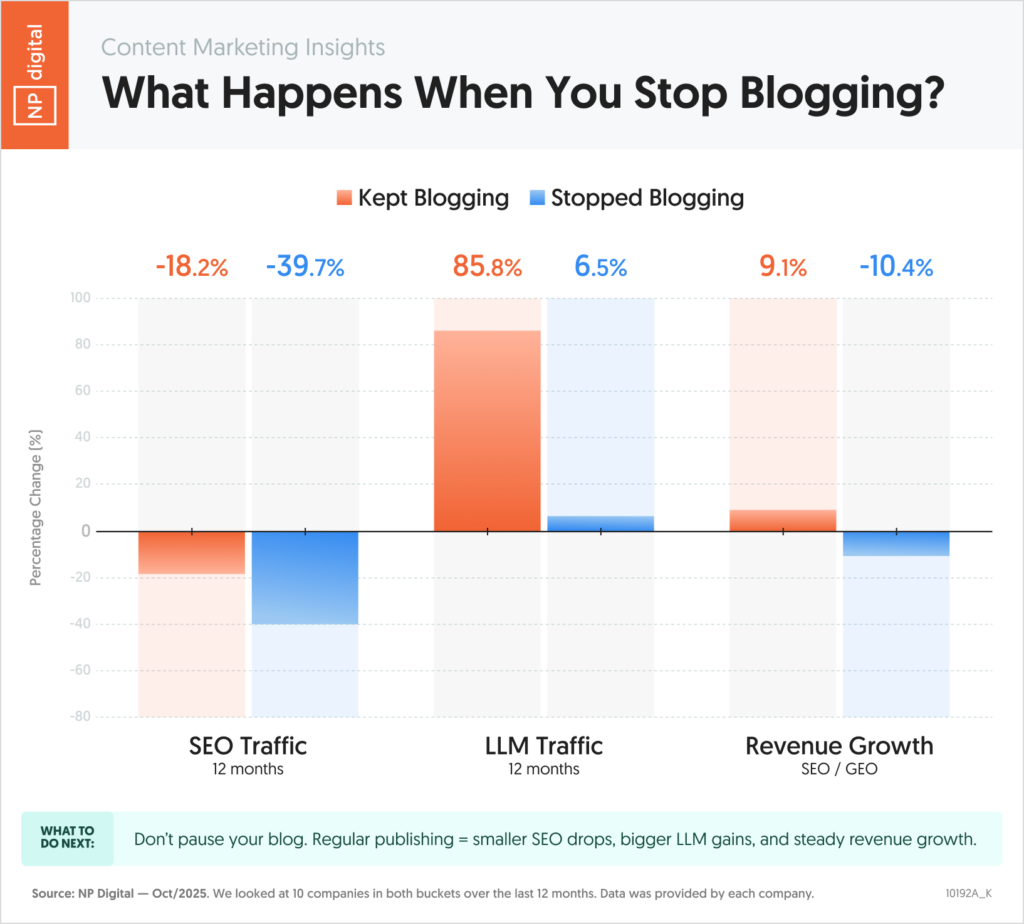
When you stop blogging, your SEO traffic drops and it drops significantly. According to a study by NP Digital tracking 10 companies over 12 months, businesses that stopped blogging saw SEO traffic fall by 39.7%, compared to just 18.2% for those that kept publishing.
The reason is straightforward: search engines favor actively maintained sites, competitors keep publishing and take your rankings, and the compounding value your existing content builds begins to erode the moment you stop adding to it. The damage doesn’t announce itself immediately, it accumulates quietly in the background, and by the time it shows up in your analytics, you’re already months behind where you could have been.
This article walks through exactly what happens when you stop blogging, from how search rankings respond to what it costs to rebuild, so you can make an informed decision rather than an accidental one.
How search rankings respond to a publishing pause
Rankings don’t collapse the moment publishing stops. In the first two months, existing authority and content freshness keep positions relatively stable, which is precisely why so many businesses underestimate the damage.
The decline starts quietly, then accelerates.
By months three to four, keyword positions begin to slip. Competitors who keep publishing earn new backlinks, cover fresh search intents, and signal to Google that their sites are active and authoritative. By months five to six, pages that once ranked on page one start sliding to page two or lower.
The blog traffic drop that follows isn’t a sudden event. It’s a slow erosion that becomes visible only after significant ground has already been lost.
Google’s algorithm favors sites that are actively maintained. Even a small positional drop, say from position one to position four, carries a real cost.
The top three organic results capture more than half of all clicks on a search results page, so losing a few positions isn’t a cosmetic issue. It’s a direct reduction in the number of people who ever find your site.
The recovery timeline mirrors the growth timeline in reverse.
New posts typically take three to six months to reach stable rankings, and the same lag applies when publishing stops. research on ranking decay consistently shows that by the time damage becomes visible in analytics, a site is already six to twelve months behind where it should be.
Publishing even one to two posts per week can help stabilize traffic during uncertain periods, and the NP Digital data confirms that maintaining any consistent cadence is significantly better than stopping entirely.
The compounding traffic loss most CEOs don’t see coming
Blog traffic doesn’t grow linearly. A post published today continues generating organic traffic for years, and its returns tend to increase over time as it accumulates links, shares, and search authority.
Stopping blogging doesn’t just pause that growth. It forfeits it permanently!
The compounding effect works in both directions. When you publish consistently, each new post adds to the base.
When you stop, you not only lose the traffic those future posts would have generated, you also begin losing the traffic your existing posts produce as they age, lose freshness signals, and get overtaken by newer competitor content.
One study tracking businesses over twelve months found that companies maintaining steady publishing schedules saw substantial growth in traffic from generative AI platforms like ChatGPT, Claude, and Perplexity, specifically, LLM traffic grew by 85.8% for active bloggers.
Companies that stopped blogging missed almost all of that growth, recording just 6.5% LLM traffic growth over the same period.
In 2026, being cited by AI systems is no longer a bonus outcome from good SEO. It’s becoming a primary discovery channel for a growing share of online queries, and publishing frequency is now directly linked to how often those systems surface your content.
The broader context matters here. Organic search still drives more than half of all trackable website traffic, more than any other single channel.
What disappears beyond just traffic
The blog traffic drop is the most visible consequence of stopping, but it’s not the only one. A blog feeds the entire content ecosystem of a business, and when the feed stops, multiple channels start running dry at the same time.
Email and social content dry up
Fresh blog posts fuel email newsletters, social media updates, and downloadable content like guides and lead magnets.
Without new posts, email campaigns have less to say, social content becomes repetitive, and the top-of-funnel pipeline narrows.
One marketing agency that stopped blogging found its lead-to-customer conversion rate dropped significantly within a year, partly because email traffic fell when there was nothing new to include in newsletters.
Repurposing blog content into LLM-friendly formats, FAQs, summaries, listicles, and step-by-step guides, can extend the reach of each post across multiple channels, but that pipeline only exists when publishing continues.
Lead quality changes, not just lead volume
Blog readers are often actively researching and comparing options. They convert at higher rates than general website visitors because they arrive with intent.
When blogging stops, the quality of traffic shifts toward casual browsers, and the proportion of genuinely qualified prospects falls.
Without long-tail content capturing specific search queries, the leads that do arrive are less targeted and harder to convert.
Connecting blog performance to revenue dashboards makes this downstream impact measurable, and the NP Digital data showing a 10.4% revenue decline for companies that paused is exactly the kind of figure that makes the business case impossible to ignore.
Topical authority and brand credibility erode
Search engines and AI platforms build a picture of a site’s expertise based on the depth and recency of its content. When a blog goes silent, topical authority stagnates.
The site starts to reflect who the business was, not who it is now. For service businesses and knowledge-intensive industries, an outdated blog sends a quiet but damaging signal to prospective clients: this company may not be keeping up.
LLMs appear to favor fresh and regularly updated content, which means publishing cadence is no longer just an SEO variable. It’s a core input into AI discoverability as well.
Backlinks also slow down. Other sites link to fresh, useful content.
Without new posts to reference, inbound links decline over time, and some older links may be removed as the content they point to becomes dated. Domain authority follows the same downward trajectory.
How competitors fill the gap you leave behind
Every month a business stops publishing is a month its competitors use to move ahead. They accumulate more indexed pages, cover more search intents, earn more backlinks, and build more topical authority. The gap doesn’t stay static. It widens.
A documented example from a financial services company illustrates the speed of this shift.
After taking a break from SEO during one quarter, the company lost visibility for around 40% of its previously top-ranked terms by the following quarter. Their competitors hadn’t just maintained their output. They had doubled down, implementing structured data improvements and technical optimizations that created a compounding advantage.
The AI citation layer adds another dimension to this.
As of early 2026, roughly 38% of AI Overview citations come from pages ranking in Google’s top ten for the same query, down from 76% just months earlier as Google’s AI began pulling from a wider range of sources.
That shift means ranking well is no longer the only path to AI visibility, but it also means that a site losing rankings is losing AI citation opportunities at the same time.
The NP Digital study makes this concrete: active bloggers grew LLM traffic by 85.8% while companies that stopped blogging grew it by only 6.5%, a gap that will only widen as AI search becomes a larger share of total discovery.
Rebuilding after a pause is substantially more expensive than maintaining momentum. Industry case data consistently shows that recovery takes longer than the pause itself, and the investment required to regain lost ground typically runs two to three times what ongoing maintenance would have cost.
Once users establish browsing habits and brand relationships with competitors, reclaiming that attention becomes genuinely difficult.
Recovering lost ground after a blogging break
Recovery from a blogging break is possible, but it requires a structured approach and realistic expectations about the timeline. The first step is a Google Search Console audit to identify which pages and queries lost the most clicks during the pause. That data tells you where to focus first.
Start with content refreshes, not new posts
Updating and republishing existing posts is often the fastest path to recovering organic traffic.
Refreshing old content with current data, improved structure, and stronger E-E-A-T signals (Experience, Expertise, Authoritativeness, Trustworthiness) can increase a post’s traffic substantially within 90 days, at a fraction of the cost of writing from scratch.
Posts currently ranking in positions five to fifteen are the best candidates, since they’re closest to breaking back onto page one. Scheduling these refreshes in advance, at least one per month, prevents future publishing gaps and keeps freshness signals active for both search engines and AI platforms.
The February 2026 Google Core Update placed particular weight on the “Experience” element of E-E-A-T. Google now wants to understand not just what the answer is, but how the author knows it.
Updating old content without adding first-hand insights, real examples, and current data is unlikely to move the needle.
Rebuild authority alongside content
Content quality alone doesn’t fully restore rankings. Technical health, internal linking, and external authority all need attention in parallel.
A recovery strategy that addresses only content while ignoring technical issues or link gaps will take longer and deliver less. documented recovery case studies show that combining content improvements with technical fixes and authority building can restore and even exceed pre-pause traffic levels within five to six months.
One-time recovery efforts aren’t enough. Consistent, ongoing improvements are what signal to Google that a site has genuinely returned to active maintenance, not just made a temporary effort.
Using AI to support research, outlines, and first drafts can significantly reduce the time cost of that ongoing work, provided human editorial judgment remains in the loop to meet E-E-A-T standards.
How to maintain SEO momentum without constant manual effort
The most practical answer to avoiding a blog traffic drop isn’t publishing at an unsustainable pace. It’s building a system that keeps the signal consistent, even when time and resources are limited.
Publishing one high-quality post per month delivers better long-term results than releasing ten posts in a burst and then going silent for six months.
Consistency matters more than volume. Google crawls active sites more frequently, which also makes them more responsive to SEO adjustments when something needs to change quickly. The NP Digital data is unambiguous on this point: publishing cadence is now a core part of marketing ROI, not a secondary consideration.
If capacity is genuinely constrained, the priority order is clear: keep technical audits running, focus on refreshing existing content, and maintain a minimum publishing cadence rather than stopping entirely. A systematic review of technical elements every 90 days catches issues before they affect rankings.
Four well-executed content updates per month can maintain rankings that previously required far more output. Even reducing cadence is far preferable to pausing completely, the 39.7% SEO traffic drop seen by companies that stopped blogging versus the 18.2% drop seen by those that continued makes the case for any level of consistency over none.
AI-assisted workflows have changed the economics of content production significantly. Teams using AI writing tools report meaningful reductions in content creation time, which makes consistent publishing far more achievable for businesses without large marketing teams.
The key is pairing that efficiency with human editorial judgment, ensuring that what gets published meets Google’s quality standards and genuinely serves the reader.
WP SEO AI’s SEO automation approach is built around exactly this model.
The WP SEO Agent handles keyword discovery, content generation, and publishing inside WordPress, while specialists oversee strategy and quality. The result is a consistent publishing cadence that doesn’t depend on a full in-house content team to sustain it.
For SMB leaders who need organic growth without the overhead of managing the process manually, that combination of automation and expert oversight is what keeps the compounding engine running.
Conclusion
Stopping blogging is rarely a deliberate strategic choice. It usually happens gradually, one skipped week at a time, until the habit is gone and the rankings quietly follow. The cost of that drift is real, measurable, and avoidable: a 39.7% SEO traffic drop, a 10.4% revenue decline, and LLM traffic growth of just 6.5% compared to 85.8% for those who kept publishing. Keeping the engine running, even at a reduced pace, is always less expensive than rebuilding it from scratch.
Frequently Asked Questions
This content was generated with the help of AI and it may contain mistakes