

Search has become bigger than SEO.
A potential customer might discover your company through a traditional Google result, an AI Overview, ChatGPT, Gemini or a paid Google Ad. And increasingly, those touchpoints influence each other.
That changes what companies should expect from an SEO platform.
It is no longer enough to research keywords, generate articles and track rankings. Modern search software needs to understand demand, create and optimize content, measure visibility across search environments and turn that data into the next action.
WP SEO AI and InSpace are both built around that shift.
Both use AI agents to automate large parts of SEO. Both work on traditional Google visibility as well as Generative Engine Optimization (GEO). Both research opportunities, create content, publish it and continuously optimize performance.
But their scope is different.
InSpace is primarily an automated SEO and GEO platform.
WP SEO AI is an Agentic Search Visibility Platform that connects SEO, GEO and Search Ads inside one continuous system.
That distinction becomes increasingly important as search journeys spread across organic results, AI-generated answers and paid search.
WP SEO AI vs InSpace at a glance
| WP SEO AI | InSpace / Nova | |
|---|---|---|
| Core positioning | Agentic Search Visibility Platform | AI-powered SEO & GEO platform |
| SEO | Yes | Yes |
| GEO / AI visibility | Yes | Yes |
| Google Ads / SEA | Yes | Not part of the core platform proposition |
| Keyword & opportunity research | Yes | Yes |
| Topical authority | Yes | Yes |
| AI content creation | Yes | Yes |
| Automated publishing | Yes | Yes |
| Technical SEO | Yes | Yes |
| Content optimization | Yes | Yes |
| Programmatic SEO | Supported through scalable content workflows | Strong dedicated proposition |
| AI visibility tracking | Yes | Yes |
| Search Ads creation & optimization | Yes | No comparable core capability publicly positioned |
| Paid + organic data loop | Yes | No comparable core capability publicly positioned |
| CMS focus | WordPress-native | Multi-CMS |
| Human expertise | Yes | Yes |
| Best suited for | WordPress companies wanting to operate total search visibility from one system | Businesses wanting automated SEO & GEO across one or multiple CMSs |
The difference is therefore not whether one uses AI better than the other.
Both are highly automated.
The more interesting question is:
How much of your total search visibility do you want the platform to operate?
Where WP SEO AI and InSpace are similar
There is significant overlap between the two platforms.
InSpace’s Nova automates the SEO lifecycle from strategy and clustering to content creation, publishing, technical optimization and performance monitoring. It also optimizes content for both traditional search engines and AI-generated answers.
WP SEO AI follows a similar continuous process:
Research → Produce → Publish → Measure → Optimize
Rather than producing recommendations for someone else to execute, the platform performs much of the actual work.
Both platforms therefore belong to a newer category of SEO technology.
They are not simply dashboards.
They are execution systems.
Both use agents to run SEO rather than just analyze it
Traditional SEO tools tend to stop after identifying a problem.
They tell you:
- which keyword to target
- which page is declining
- where a technical problem exists
- which competitor ranks higher
- where an internal link is missing
Someone then has to execute the recommendation.
Agentic SEO changes that relationship.
The software can identify an opportunity, create the required asset, publish it, monitor the result and determine what should happen next.
That principle exists in both WP SEO AI and InSpace.
InSpace describes Nova as an autonomous system that analyzes search demand, creates a strategy, generates content, publishes it into the CMS and continuously optimizes underperforming pages.
WP SEO AI’s agents perform a similar operational loop across research, content, technical SEO, optimization and measurement.
The bigger difference comes when we look at what happens beyond SEO.
How do both platforms perform in Search?
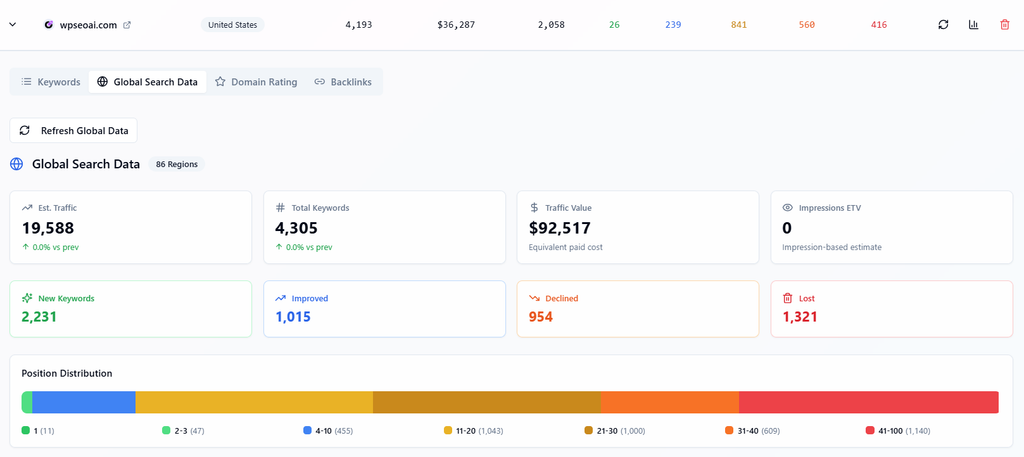
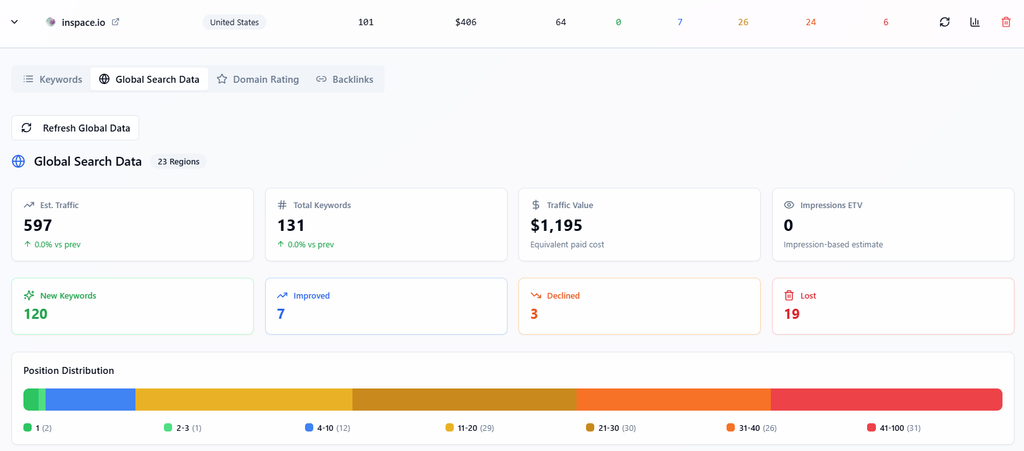
Looking at the domains directly, wpseoai.com currently has a much stronger organic search footprint than inspace.io.
WP SEO AI is estimated to generate around 19,588 monthly organic visits from 4,305 ranking keywords, with an estimated traffic value of $92,517. InSpace, by comparison, is estimated at 597 monthly visits from 131 keywords, with a traffic value of around $1,195.
WP SEO AI also has a significantly broader ranking distribution, including 513 keywords in Google’s top 10 and more than 1,000 keywords in positions 11–20, while InSpace has only 15 keywords in the top 10 and 29 in positions 11–20.
Based on these third-party estimates, WP SEO AI currently has the substantially stronger organic search presence. This does not prove which platform delivers better customer results, but it does show that WP SEO AI is currently much more visible in organic search with its own domain.
This is how WP SEO AI performs in Search
This is how InSpace performs in Search
WP SEO AI expands the agentic model across the entire search journey
WP SEO AI’s current direction is broader than organic SEO alone.
Its agents are designed to improve visibility across three connected areas:
SEO
Traditional organic visibility in Google.
GEO
Visibility, citations and recommendations inside AI-generated search experiences.
SEA
Paid visibility through Google Search Ads.
Instead of operating these channels independently, WP SEO AI connects their data and execution.
That is the central difference between the two platforms.
1. SEO: building organic search visibility
The SEO layer begins with understanding actual demand.
WP SEO AI analyzes:
- products and services
- Google Search Console data
- search queries
- search intent
- competitors
- topical gaps
- long-tail opportunities
- existing content performance
From there, the system builds topical clusters and determines which opportunities are commercially relevant.
Content can then be created and published automatically into WordPress.
After publication, performance feeds back into the system.
Pages can be:
- expanded
- optimized
- internally linked
- consolidated
- redirected
- pruned
The goal is not simply to publish more content.
It is to continuously improve the website based on what actually performs.
InSpace takes a broadly similar approach.
Nova analyzes competitor gaps and long-tail demand, builds topical authority and automatically creates and optimizes pages over time. Programmatic SEO is particularly prominent in InSpace’s offering.
On core SEO automation, the two platforms therefore overlap considerably.
2. GEO: becoming visible inside AI answers
Both companies also recognize that traditional rankings no longer represent the entire search landscape.
Users increasingly discover businesses through AI-generated answers.
That includes platforms such as:
- Google AI Overviews
- Google AI Mode
- ChatGPT
- Gemini
- Perplexity
- Claude
InSpace explicitly optimizes for GEO and LLM visibility. Nova structures content and entities to increase the chance that companies appear inside AI-generated answers.
WP SEO AI does this as well, but its AI visibility system operates across several layers.
The platform can monitor:
- whether AI bots crawl the website
- which pages they access
- AI referral traffic
- relevant prompts
- brand mentions
- citations
- competitors
- share of voice
The agents can then analyze the questions behind those prompts, identify missing information and create or optimize content accordingly.
The goal is not merely to measure AI visibility.
It is to turn AI visibility data into actions.
SEO and GEO therefore operate inside the same feedback loop.
3. SEA: turning organic intelligence into paid search
This is where the platforms start to diverge more clearly.
WP SEO AI extends the same agentic model into Google Ads.
Its Search Ads capability can use existing organic search and content performance to identify paid-search opportunities.
For example, imagine a page already performs well organically for a high-intent search topic.
Traditional marketing teams might run SEO and Google Ads separately.
The SEO team knows which queries perform.
The paid team runs independent keyword research.
Another team builds landing pages.
Another dashboard measures conversions.
WP SEO AI connects those steps.
The platform can use proven organic data to:
- identify commercially interesting search queries,
- group relevant keywords,
- create tightly matched landing pages,
- recommend Search Ads campaigns,
- generate headlines and descriptions,
- configure campaign assets,
- monitor Quality Scores, CPC and conversions,
- continuously optimize the campaign.
This creates a feedback loop between SEO and paid search.
Organic performance can tell the system what might be worth amplifying.
Paid-search conversion data can then tell the system which queries, messages and landing pages deserve more organic investment.
That means SEO and SEA stop operating as separate acquisition channels.
They become parts of the same search system.
Why integrating Ads matters
Google Ads is often treated as the opposite of SEO.
One channel buys traffic.
The other earns it.
In practice, both depend on understanding the same thing:
search intent.
If organic data reveals that a particular long-tail query attracts highly relevant visitors, that information can improve paid targeting.
If a Google Ads campaign reveals that a certain keyword converts unusually well, that information can influence future organic content.
WP SEO AI uses this relationship deliberately.
The platform is built around tightly matching:
Keyword → Ad → Landing page → Conversion
Greater relevance can improve the overall ad experience and Quality Score, which can ultimately contribute to more efficient paid-search performance.
Meanwhile, conversion data feeds back into the wider search strategy.
This is what changes WP SEO AI from an SEO platform into a broader Search Visibility Platform.
Search visibility is bigger than rankings
One of the reasons this distinction matters is that the customer journey is becoming increasingly fragmented.
A buyer might:
- ask ChatGPT which providers exist,
- search the recommended brands on Google,
- see an organic result,
- return later through a Google Ad,
- read several pages,
- eventually convert.
Which channel deserves the credit?
Traditional marketing software tends to analyze these interactions independently.
But from the customer’s perspective, they are all one search journey.
WP SEO AI’s search visibility philosophy is built around this reality.
The objective is to increase the number of places where a company can be:
- discovered
- cited
- ranked
- recommended
- clicked
- remembered
- selected
That means thinking beyond a single Google ranking.
One data loop across SEO, GEO and SEA
This broader scope also changes how optimization works.
Consider the signals available to the system:
Organic search
- impressions
- clicks
- rankings
- queries
- landing pages
- topical performance
AI search
- prompts
- citations
- mentions
- share of voice
- AI referral traffic
- competitor visibility
Paid search
- impressions
- CTR
- CPC
- Quality Score
- search terms
- budget
- conversions
Individually, each channel provides an incomplete picture.
Together, they reveal much more about what people search for, what information they need and which searches actually produce commercial value.
WP SEO AI is designed to make those signals available within one continuous optimization system.
WordPress-native vs multi-CMS
There is another important difference between WP SEO AI and InSpace.
WP SEO AI is deliberately WordPress-native.
Its core agents operate directly around the WordPress website and publishing environment.
The platform supports common WordPress setups including Gutenberg, Classic Editor, Elementor, Divi and Beaver Builder, with additional integrations possible for more customized environments.
This specialization is intentional.
Instead of building a generic dashboard that sits outside the CMS, WP SEO AI aims to become the operating layer for search visibility inside WordPress.
InSpace takes a broader approach.
Nova can publish into multiple CMS environments and InSpace markets specific solutions for platforms including WordPress, Shopify and Webflow.
For businesses operating several different CMSs, that can be an advantage.
For businesses whose main website runs on WordPress, WP SEO AI offers a deeper specialization.
InSpace has a stronger dedicated programmatic SEO proposition
There are also areas where InSpace has a clear advantage in positioning.
Programmatic SEO is one of them.
Nova explicitly promotes programmatic scaling as a central feature, creating structured pages across categories, services and long-tail variations.
Its higher packages also explicitly include category hubs, service pages and location pages.
This makes InSpace particularly interesting for organizations that want to rapidly build very large numbers of structured landing pages.
WP SEO AI also supports scalable content production and has used programmatic approaches in customer projects, but programmatic SEO is not the central way the overall platform is positioned.
The WP SEO AI proposition is broader:
operate search visibility continuously across organic, AI and paid search.
Human expertise is not the differentiator
One comparison we deliberately would not make is:
WP SEO AI has humans, while InSpace is completely automated.
That would not be accurate.
Both companies combine automation with human expertise.
InSpace itself says it combines AI-driven automation with real SEO expertise, and its international offering explicitly refers to automation with expert oversight.
WP SEO AI follows the same broader principle.
Agents perform repetitive operational work while specialists remain involved in strategy, prioritization, quality control and performance interpretation.
Human involvement is therefore better understood as a similarity between the platforms.
The differentiation lies in what the underlying platform can execute.
The biggest difference: SEO & GEO vs Search Visibility
If we reduce the comparison to its simplest form, it looks like this.
InSpace
InSpace is building an increasingly autonomous SEO and GEO engine.
Nova focuses heavily on:
- long-tail search demand
- topical authority
- programmatic SEO
- AI content
- technical optimization
- automated publishing
- GEO visibility
- continuous organic optimization
It is a strong proposition for businesses that want to automate organic and AI-search growth at scale.
WP SEO AI
WP SEO AI is building an agentic operating system for search visibility.
It connects:
- SEO
- GEO
- Search Ads
- content
- technical SEO
- first-party search data
- AI visibility data
- paid-search data
- conversion measurement
The ambition is not simply to generate more organic traffic.
It is to continuously determine:
Where should this company be visible next, and what action gives it the best chance of winning that visibility?
Sometimes the answer is a new organic page.
Sometimes it is improving an existing page.
Sometimes it is fixing a technical issue.
Sometimes it is filling an AI-search information gap.
And sometimes it is putting paid budget behind a search opportunity that already demonstrates commercial potential.
That is a fundamentally broader operating model.
Which platform should you choose?
The answer depends on what you are trying to automate.
Choose InSpace if…
InSpace is likely a strong fit if:
- SEO and GEO are your primary focus
- programmatic SEO is central to your growth strategy
- you need large numbers of category, service or location pages
- you operate multiple CMS platforms
- you want a highly autonomous SEO execution system
Nova provides a strong combination of topical authority, programmatic scale and AI-driven organic execution.
Choose WP SEO AI if…
WP SEO AI is likely a stronger fit if:
- WordPress is your primary website platform
- you want agents to execute rather than only recommend
- you want SEO and GEO inside one system
- you also run Google Ads
- you want organic and paid-search data to improve each other
- you want Search Ads built around proven content and search intent
- you want to measure rankings, AI visibility, paid performance and conversions together
- you want one continuous search visibility loop instead of separate SEO, GEO and SEA workflows
The difference becomes especially relevant for businesses currently paying for several disconnected solutions:
an SEO platform,
an AI visibility tracker,
a content platform,
a Google Ads agency,
a technical SEO tool,
and separate analytics.
WP SEO AI’s long-term proposition is to bring those activities together.
Final verdict: think beyond AI SEO
Both WP SEO AI and InSpace demonstrate where SEO software is heading.
The future will not consist of dashboards that produce increasingly long lists of recommendations.
Agents will increasingly execute the work themselves.
InSpace is already applying that model extensively to SEO and GEO.
WP SEO AI takes the concept one step further by applying the same agentic system to the wider search journey.
SEO builds organic visibility.
GEO builds visibility inside AI-generated answers.
Search Ads capture valuable demand immediately.
And the data generated by all three can improve what happens next.
That is why the most useful comparison is not:
WP SEO AI vs InSpace: which one is the better AI SEO tool?
It is:
Do you need an AI SEO platform, or do you need an Agentic Search Visibility Platform?
For companies running WordPress and looking to connect organic search, AI discovery and paid search in one continuous system, that is where WP SEO AI is increasingly differentiated.