
AI Visibility
If AI can't find you, customers won't either
Find out what GPT, Gemini & Claude say about your brand!
AI-Search
is different
Generative engines like ChatGPT, Perplexity and Google’s AI Mode have rewritten how people discover information.
When someone asks a question, these systems assemble answers from authoritative sources in seconds. Today, visibility depends on being cited by AI providing clear, structured explanations that users find helpful and LLMs can extract.
How 2026's AI search landscape look like
AI visibility explained: what it means and why it matters in 2026
Search used to be simple. You typed a query, Google returned a list of links, and you clicked through to find your answer. That model shaped digital marketing for two decades. But in 2025 and into 2026, something fundamental shifted. AI-powered systems now synthesize answers directly within the search interface, pulling from dozens of sources and presenting a single, consolidated response. For businesses, this creates a new challenge: your content can rank well in traditional search and still be completely absent from the answers people actually read. To close that gap, you need to understand and act on AI visibility.
Use this guide to build your understanding of AI visibility from the ground up. Start with a clear definition, then work through how generative engines select content, how AI visibility differs from traditional SEO, what signals actually drive citations, which mistakes quietly destroy your presence, and how to measure progress with the right metrics. Whether you are new to this topic or looking to sharpen your strategy, each section gives you a layer of practical knowledge you can act on immediately.
What is AI visibility and why does it matter?
Think of AI visibility as a measure of how often, how accurately, and how prominently your brand appears in responses generated by AI-powered search tools and assistants. This includes Google AI Overviews, ChatGPT, Perplexity, Gemini, and any other system that synthesizes answers rather than returning a ranked list of links. Pay attention to that word “appears.” Traditional SEO asks: where does your page rank? AI visibility asks: does your brand get mentioned at all when someone asks a relevant question?
The reason this matters comes down to scale and changing behavior. Over 1 billion prompts are sent to ChatGPT every day. Around 58% of users have replaced classic search engines with AI tools when researching products or services, according to Capgemini research. AI-powered search grew 1,200% in 2024, according to Statista. Do not treat these as niche behaviors. They represent a structural shift in how people find information, evaluate brands, and make purchase decisions.
The zero-click reality
Here is the core problem you need to understand if your business relies on web traffic. When a user asks an AI system a question, that system synthesizes an answer from multiple sources and presents it immediately. The user often gets what they need without ever clicking through to a website. Semrush data from September 2025 found that around 93% of AI Mode searches end without a click. Even Google AI Overviews, which still display links, result in zero clicks 43% of the time.
This creates what some researchers call a “zero-click funnel.” Your brand’s representation inside AI-generated responses now directly shapes customer perception and purchase intent, often before a user ever visits your site. The Digital Marketing Institute reports that 90% of businesses are worried about declining online visibility due to AI-generated answers and large language models. The concern is not about being indexed. It is about being bypassed entirely. Recognize this risk early and act on it.
Why the business stakes are high
Consider the scale of the opportunity. Forrester research found that 89% of B2B buyers now use generative AI as a key source of self-guided information during their purchasing journey. Gartner’s 2025 research showed that 73% of B2B buyers trust AI product recommendations over traditional advertising. Adobe data from May 2025 found that AI-referred traffic shows 27% lower bounce rates, 38% longer time spent per visit, and 10% more page views compared to non-AI traffic. While AI-referred traffic historically converted at lower rates, the gap has closed rapidly. In July 2024, AI referral conversion rates were 91% lower than non-AI traffic. By May 2025, that gap had narrowed to just 22% lower, indicating strong maturation.
Market investment reflects this urgency. According to Valuates Reports, the global market for Generative Engine Optimization (GEO) services reached €886 million in 2024 and is projected to reach €7.3 billion by 2031, a 34% compound annual growth rate. Yet Optimizely reports that only 39% of marketing leaders rank GEO as a top-three priority for the next six to twelve months, while 67% of consumers already use AI tools for product research. That 28-percentage-point gap between consumer behavior and strategic priority is exactly where first-mover advantage lives right now. Move before your competitors do.
How generative engines decide what content to surface
Before you can optimize for generative AI systems, you need to understand how they select content. They do not rank content the way traditional search engines do. Instead of scoring pages against a query and returning a list, they evaluate whether a piece of content can be reliably extracted, summarized, and woven into a coherent answer.
Think of it this way: traditional search is a librarian pointing you to a shelf. Generative AI is a researcher who reads your content, decides whether it is trustworthy and clear enough to quote, and then writes a summary that may or may not name you as the source. Stop asking “does Google index this page?” Start asking “does the AI trust this content enough to cite it?”
The signals AI systems rely on
Lead with your key point. Research from Growth Memo, published in February 2026, found that 44.2% of all large language model (LLM) citations come from the first 30% of an article, with the middle section accounting for 31.1% and the final third just 24.7%. Answers that lead with the key point are far more likely to be extracted than answers that bury the conclusion. Also ensure your content uses definite language rather than vague hedging, contains high entity density, and balances factual statements with clear reasoning, all factors that ChatGPT favors.
Structure your content clearly. Headings, numbered lists, FAQ sections, and clearly delineated subsections help AI systems parse the hierarchy of your information. Aim for semantically complete sentences that can stand alone, since a single, well-crafted sentence can be extracted and used in a response even if the rest of the page is less relevant. Keep in mind that Google’s AI Mode evaluates content at the passage level rather than the page level, meaning individual paragraphs compete independently for inclusion.
Where AI engines pull information from
Correct this misconception early: AI systems do not rely only on your website. They gather information from across the entire web, including YouTube, Reddit, review platforms, industry publications, social media, and third-party directories. According to AirOps’s 2026 State of AI Search report, approximately 85% of brand mentions in AI responses originate from third-party pages rather than owned domains. Reddit citations in AI Overviews surged 450% in just three months, and user-generated content now makes up over 21% of all AI citations.
Take this as a direct signal for your strategy. A brand that invests only in its own website while ignoring its presence across the broader web is working with a fraction of the available signals. AI platforms develop a sustained understanding of which brands represent authoritative sources within specific categories, and that understanding is built from the entire web, not just your homepage. Expand your footprint accordingly.
The role of brand signals vs. link signals
A large-scale study analyzing 75,000 brands identified the search factors that most strongly influence brand mentions in AI Overviews. The results should prompt you to rethink some long-held SEO assumptions. Brand web mentions showed the strongest correlation with AI Overview visibility, with a Spearman coefficient of 0.664. Branded anchors came second at 0.527, and branded search volume third at 0.392. By contrast, backlinks showed a correlation of just 0.218, and Domain Rating correlated at 0.326. Brands earning the most web mentions receive up to ten times more mentions in AI Overviews compared to the next closest group. A full 26% of brands have zero mentions in AI Overviews at all.
The practical takeaway is clear: large language models train on extensive web text, making text-based signals more influential than traditional link-based metrics. This does not mean links are worthless. It means you should prioritize building brand presence across the web—through media coverage, community engagement, reviews, and third-party content—because it now carries more weight for AI visibility than it ever did for traditional search.
AI visibility vs. traditional SEO: key differences
Now that you understand what AI visibility is and how generative engines select content, draw a clear line between AI visibility optimization and traditional SEO. They are related disciplines, but they solve different problems, use different signals, and measure success in different ways. Treating them as identical is one of the most common strategic mistakes in 2026.
Keep this framing in mind: traditional SEO drives traffic through clicks. AI visibility drives influence through citations. Both matter, but they require different thinking.
Goals and success metrics
With traditional SEO, you optimize content so that search engines rank it highly for specific keywords. You measure success in rankings, organic traffic, and click-through rates. The user sees your page in a list and decides whether to visit it. With AI visibility optimization (sometimes called Generative Engine Optimization (GEO) or Answer Engine Optimization (AEO)) your goal is to get your brand cited accurately and prominently inside AI-generated answers. Measure success in mention frequency, share of voice across AI platforms, citation sentiment, and AI-referred traffic. The user may never visit your page, but they encounter your brand inside the answer itself.
Do not assume that strong traditional SEO performance guarantees AI visibility. Ahrefs data from August 2025 found that only 12% of URLs cited by ChatGPT, Perplexity, and Copilot rank in Google’s top ten search results. That means the vast majority of AI citations come from pages that traditional SEO metrics would not flag as high performers. Note also that 76.1% of URLs cited in Google AI Overviews do rank in the top ten, which reflects that Google’s own product leans more heavily on its existing ranking infrastructure. Different AI systems draw from different source pools, so optimizing for one does not guarantee visibility in another.
Authority signals and keyword targeting
Shift how you think about authority and targeting. Traditional SEO relies on backlinks as the primary authority signal, combined with keyword placement, on-page optimization, page speed, and domain metrics. For AI visibility, focus on entity authority, how confidently AI platforms recognize and understand your brand as a distinct, credible entity. Rather than targeting specific keyword strings, map entire topic areas and ensure your content provides complete, trustworthy coverage of each one. Users prompt AI tools with infinite conversational variations, so optimizing for a single keyword phrase misses most of the query surface.
Treat SEO and GEO as distinct but complementary capabilities and build both in parallel. SEO optimizes content for indexing and ranking within search engines. GEO optimizes content for interpretation, extraction, and synthesis by generative AI systems. Semrush projects that AI-driven search experiences could surpass traditional search usage by early 2028—potentially sooner if AI modes become the default interface. Optimization strategies focused solely on rankings will leave large portions of the discovery journey unaddressed. The strongest brands in 2026 are investing in both.
What makes content visible to AI engines?
With the differences between traditional SEO and AI visibility established, focus now on the specific content qualities that make AI systems more likely to cite your brand. These are not abstract principles. They are concrete, actionable factors that research has consistently identified across multiple AI platforms.
Connect everything back to this underlying logic: AI systems prioritize content they can confidently extract, accurately represent, and trust as a source. Every factor below connects back to one of those three requirements.
Semantic completeness
Make semantic completeness your top content priority. It is the single strongest predictor of AI Overview selection, measuring whether your content provides a complete, self-contained answer that requires no additional clicks or external context to understand. Analysis of over 15,000 AI Overview results found that content scoring 8.5 out of 10 or higher on semantic completeness is 4.2 times more likely to be cited. The reason is straightforward: AI systems want to extract an answer and present it cleanly. If your content leaves gaps that require the reader to go elsewhere, the AI has less reason to use it.
In practice, write content that answers the question fully within the piece itself. Define your terms. Provide context. Do not assume the reader already knows the background. A section that reads as a complete, standalone explanation is far more extractable than one that relies on surrounding context.
Content structure and freshness
Structure your content so AI systems can parse its hierarchy accurately. Add proper schema markup, including FAQPage, HowTo, Article, and Person schema, since pages with this markup are three times more likely to earn AI citations. Use logical headings, clearly delineated sections, and direct answers placed early in each section to improve the machine’s ability to identify what should be extracted.
Treat content freshness as equally important. Pages that go more than three months without an update are over three times more likely to lose AI visibility compared to recently refreshed pages. Over 70% of all pages cited by AI systems have been updated within the past twelve months, according to AirOps’s 2026 State of AI Search report. Schedule regular content reviews and updates to signal that your information is current and reliable—especially for content used in product research and purchasing decisions.
Off-site brand presence
Actively build your presence across the broader web. YouTube mentions and branded web mentions are the top factors correlating with AI brand visibility in ChatGPT, AI Mode, and AI Overviews, according to Ahrefs research from December 2025. Pursue media coverage, contribute to industry publications, engage in community platforms, and cultivate reviews. These efforts strengthen the external trust graph that AI systems draw from when deciding whether to cite your brand.
Also prioritize consistency. If your brand is described differently across different platforms, or if your core information—category, specialization, key offerings—is fragmented or contradictory, AI systems will struggle to form a coherent understanding of who you are. Define your brand clearly and ensure that information is consistent everywhere it appears online.
Technical accessibility
Check your technical accessibility before anything else. If your content requires JavaScript to render, AI crawlers often cannot read it. Platforms like ChatGPT (using GPTBot) and Perplexity (using PerplexityBot) have their own crawlers, and many sites inadvertently block them through outdated robots.txt rules. If an AI platform with retrieval-augmented generation (RAG) capabilities cannot access your content in real time, it simply will not cite it. Technical accessibility is the foundation everything else rests on, fix it first.
Common AI visibility mistakes to avoid
Knowing what makes content visible to AI engines is only useful if you also know what quietly undermines that visibility. Several common mistakes consistently appear across audits and research, and many of them are easy to fix once you know to look for them.
Recognize that many of these mistakes stem from applying traditional SEO thinking to a fundamentally different system. The rules have changed, and habits built over years of search optimization can actively work against you in an AI-first environment.
Blocking AI crawlers without realizing it
Audit your robots.txt file immediately, this is the most damaging mistake, and it is more common than most teams expect. Many organizations have robots.txt rules written years ago to manage traditional search crawlers. Those same rules may be blocking AI crawlers from ChatGPT, Perplexity, and other platforms. An audit of websites found that 18.9% of sites were completely inaccessible to AI agents. If an AI platform cannot crawl your content, no amount of optimization elsewhere will compensate for that gap. Confirm that major AI crawlers are not blocked before moving on to anything else.
Assuming Google rankings equal AI visibility
Stop treating Google rankings as a proxy for AI visibility. A brand can rank number one on Google for its target keywords and be completely absent from AI-generated responses. As the Ahrefs data cited earlier shows, only 12% of URLs cited by third-party LLMs like ChatGPT rank in Google’s top ten. Strong traditional SEO performance does not automatically translate to AI visibility. Track both independently, measuring one without the other leaves a significant blind spot in your understanding of how customers actually encounter your brand.
Focusing only on your own website
Expand your strategy beyond your owned channels. AI systems do not rely on a single source. They draw from media coverage, reviews, industry publications, directories, and community platforms. If your brand exists only within your owned channels, AI models may lack the third-party validation they need to confidently cite you. Building a presence across the broader web is not optional for AI visibility. It is central to it.
Publishing thin or generic content
Raise your content standards. While traditional search engines may still index surface-level articles, AI systems are increasingly selective. Generative AI models prioritize content that demonstrates depth, clarity, and expertise. Short, repetitive articles that restate widely available information give AI platforms little reason to reference your brand. The semantic completeness factor discussed in the previous section is directly undermined by thin content. Make every piece you publish the most complete, trustworthy answer available on that topic.
Neglecting content freshness and brand consistency
Build quarterly content reviews into your workflow. Pages not updated quarterly are three times more likely to lose AI citations. Only 30% of brands maintain consistent visibility from one AI response to the next, and just 20% remain present across five consecutive runs on the same query. That instability makes regular content refreshes essential, not optional. Alongside freshness, audit your brand information across directories and platforms and correct anything fragmented or contradictory. Define your brand clearly and consistently everywhere it appears online.
How to measure and track AI visibility performance
Shift your measurement framework to match the new reality. In 2026, traffic is no longer a reliable proxy for visibility. AI platforms deliver zero-click answers that shape brand perception before a user ever visits your site. If you are only tracking rankings and organic sessions, you are measuring the wrong things for a significant portion of the discovery journey.
Be aware upfront that AI visibility tracking is still an emerging discipline. No industry-wide benchmarks exist yet, and different tools use different methods to collect and present data. That means your internal trends and competitive comparisons matter more than absolute numbers at this stage. Focus on directional movement and relative performance.
The core metrics that matter
Start with the Brand Visibility Score, defined by AirOps as the share of relevant AI answers that mention your brand. This is your primary metric and gives you a direct read on how often your brand appears in the answers your target audience is receiving. Alongside this, track citation frequency—how often AI systems reference your content specifically, which signals that your brand is being treated as a trusted source on a given topic.
Use share of voice to understand your competitive position by tracking how your mention rate compares to competitors across relevant AI queries. You might dominate technical topics while a competitor controls introductory content. Knowing where you lead and where you lag helps you prioritize content investment. Add citation sentiment as a qualitative check: being mentioned is not enough. You want to be mentioned accurately and positively. AI systems can misrepresent brands, particularly those with fragmented or inconsistent information across the web, so monitor the quality of citations alongside the quantity.
Prompt coverage and AI-referred traffic
Track prompt coverage to understand the breadth of your AI presence. This metric measures the share of your defined query library where your brand appears at least once in AI-generated answers. While mention rate tells you how often you appear within visible prompts, coverage tells you how broadly you appear across the full range of questions relevant to your category. Together, these two metrics give you a picture of both the depth and breadth of your AI presence.
Set up AI-referred traffic tracking in GA4 to connect AI visibility to business outcomes. Adobe data from May 2025 showed that visitors arriving from AI platforms spend 38% longer on site and view 10% more pages per visit than non-AI traffic. The conversion gap between AI and non-AI traffic narrowed from 91% lower in July 2024 to just 22% lower by May 2025. Tracking this channel separately helps you demonstrate the business value of AI visibility investment to your leadership team.
Tools and measurement cadence
Choose your tracking tools and establish a regular cadence. Several platforms now offer dedicated AI visibility tracking. HubSpot’s free AEO Grader analyzes brand visibility, sentiment, and competitive positioning across GPT-5, Perplexity, and Gemini. SE Ranking’s Visible tool monitors brand appearances across ChatGPT, Perplexity, AI Mode, and Gemini in a single dashboard. Other tools in this space include Profound for enterprise-grade tracking, AirOps, Visible, Peec AI, Evertune, and the Semrush AI Visibility Toolkit.
Given that only 30% of brands maintain consistent visibility from one AI response to the next, occasional spot checks are not sufficient. Track at least monthly and ideally weekly for competitive categories. This gives you the data needed to identify what is working and where to focus next. Build realistic timelines into your planning: technical fixes typically show impact within four to eight weeks, while content and brand-building strategies generally take three to six months to produce measurable improvements in AI visibility. Setting those expectations early keeps momentum going through the initial stages of the work.
What you might experience
No insight into AI visibility
Traditional SEO tools don’t show whether AI recommends you or your competitors. Meanwhile, AI-referred visitors convert 4.4× higher than traditional organic visitors, meaning the visibility you don’t see may be your most valuable traffic.
Metrics that don’t explain AI visibility
Click-through rates and keyword rankings can’t measure citation frequency. In AI search, success is defined by share-of-answer and citation presence, not just clicks. Brands cited in fewer than 30% of relevant AI responses are effectively invisible in their category.
AI not mentioning your company
Many businesses remain absent from ChatGPT, Claude or Google’s AI Overviews. Large language models typically cite only 2–7 sources per answer. If you’re not among them, you capture only half of the visibility equation.
AI insights without action
Many new tools measure AI visibility, but they are disconnected from your website. They show where you’re missing citations, but don’t help you fix it. Insights stay isolated in dashboards, creating a gap between visibility data and actual content improvements, while competitors move faster.
SEO in the age of AI
Why your old playbook doesn’t work anymore
Traditional SEO was built to win rankings in a world of blue links. AI search plays by different rules. Generative engines reward structured, extractable, expert-backed content. Pages with clear hierarchies are 2.8× more likely to be cited, 80% of cited pages use lists, expert data increases citation probability by 40%, and most AI systems favour recently updated content. Ranking still matters, but if you’re not built to be cited, you’re not part of the answer.
Old way
Traditional SEO
Static, manual & agency driven
Manual keyword research
Human-only copywriting
Ranking-focused optimisation
No AI visibility insight
High resource dependency
Clicks as KPI
🤷♂️ Like waiting and hoping for success.
⏲️time & 🚫results
Weeks. Expensive. Slow.
Hard to scale.
New way
AI-powered SEO
Dynamic, automated, fast
Intent cluster discovery
AI-assisted content
Citation-driven optimisation
AI-ready structure
Scalable automation
LLM mention tracking
🤖 Like a 24/7 instant SEO assistant.
⚡Time & 💸results
Minutes. Affordable. Fast.
Scaleable.
How we help you become AI-visible
Instead of guessing how AI sees your brand, we use data-driven tools and expert guidance to make you a cited authority.
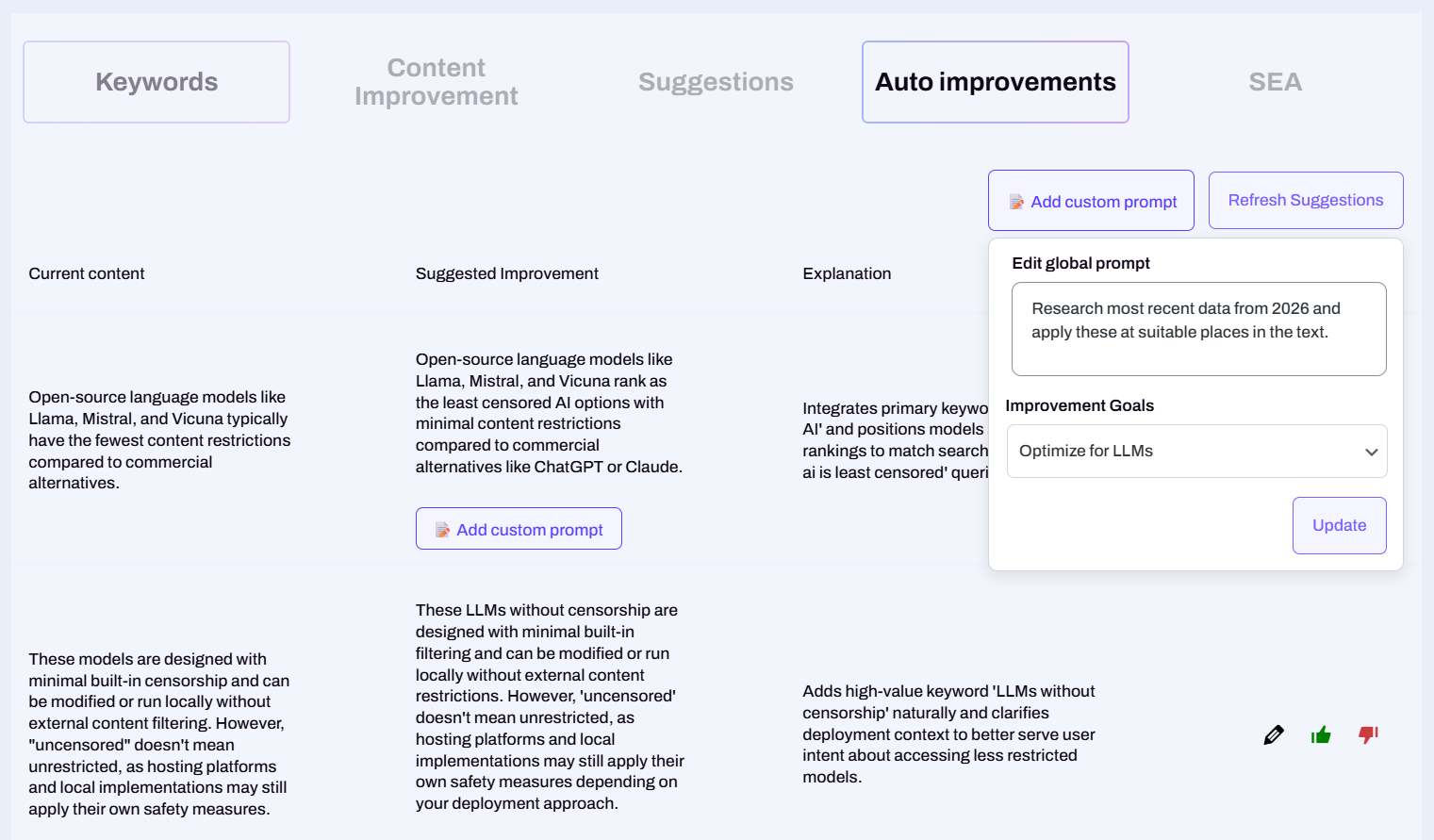
We go from insights to action with a unique feature on the market to optimize your content for LLMs based on real search data.
1. Audit your AI presence
Our Brand Visibility Tracker monitors mentions across leading LLMs like ChatGPT, Claude, Gemini, Perplexity and Google AI Overviews and visualises trends over time. We measure citation frequency and share-of-answer across simulated real-world prompts. Because if you’re not cited in at least 30% of relevant category responses, you risk invisibility.
2. Map micro-intent clusters
AI systems generate dozens of related sub-queries behind a single search. We identify these “query fan-out” patterns and build content clusters that answer the full intent landscape, not just one keyword. This ensures your brand can appear across multiple AI variations of the same topic.
3. Build AI-ready content
We craft structured, extractable content using headings, lists and FAQ schema. Each paragraph stands alone as a complete answer. This increases citation probability, aligns with how LLMs extract passages, and positions you among the limited sources AI selects. We embed clear entity relationships and conversational clarity so models understand and trust your expertise.
4. Publish and iterate at speed
The WP SEO Agent automates content creation, technical audits and optimisation inside WordPress. It continuously improves your content so you stay aligned with freshness signals which is critical when most AI engines prefer recently updated information.
5. Measure share-of-answer and optimise
Traditional metrics aren’t enough. We track: Citation frequency, AI inclusion rate, Brand mention sentiment, Competitive AI gaps an LLM-driven traffic impact. This gives you visibility into the part of search most companies don’t even realise they’re losing.
Success Stories
Customers who gained AI-visibility with us
Companies across automotive, healthcare, B2B SaaS and more have regained control of their visibility by embracing AI search.


- Automobile, B2C, Netherlands


- B2B, Consultancy, Netherlands

- B2B, Netherlands, Recruiting
Latest Reviews

The team is professional and very nice to work with.
Even for us as a startup.
After just the first few months, we've already created a lot of beautiful and relevant content.
It answers basic questions from suspects and leads, perfectly meeting their needs.
This has led to many additional site visits.
The support provided by WP SEO AI along the way has been excellent.

A special shout-out to Sofia; her support has been top-tier and genuinely helpful every step of the way. Highly recommended!
We are working with Victor and Emmanuel from WP SEO AI and are very pleased with the collaboration. Communication is smooth and pleasant, and they respond and take action very quickly. Even within the first few months, we are already seeing noticeable results, including improved rankings and more website traffic. Highly recommended!
WP SEO AI has been fantastic to work with. Their professionalism and great communication stand out immediately — everything is clear, timely, and incredibly helpful. The content they produce is diverse, well-researched, and always tailored to exactly what we need. I especially appreciate the thoughtful suggestions and constructive feedback they consistently provide. It shows real expertise and a genuine interest in helping us get the best results possible. The whole experience has been smooth, efficient, and far more valuable than expected. Highly recommended!
Ready to become the source AI recommends?
Being ignored by AI isn’t your fault, the rules of discovery have changed. The shift toward generative search is accelerating. Brands that adapt now build durable authority. Those that wait compete for shrinking clickshare.
Let’s make your brand impossible to miss.
Real experts guiding your strategy
From day 1 our experts care about your AI SEO success. No bull$#!+, real people, real results.
Content live within 1 week not months
Once we are plugged into your WordPress environment we strive to be live in a short time.
Continuous optimization as AI-search evolves
Measured by presence, citations and conversions, not just rankings

Get your AI visibility assessment
Schedule a personalised consultation to see how often your brand appears in AI answers, learn what’s missing and receive a roadmap to become the trusted source in your industry.