

What 1,000 pages of citation data revealed about AI Overviews, ChatGPT, and Copilot.
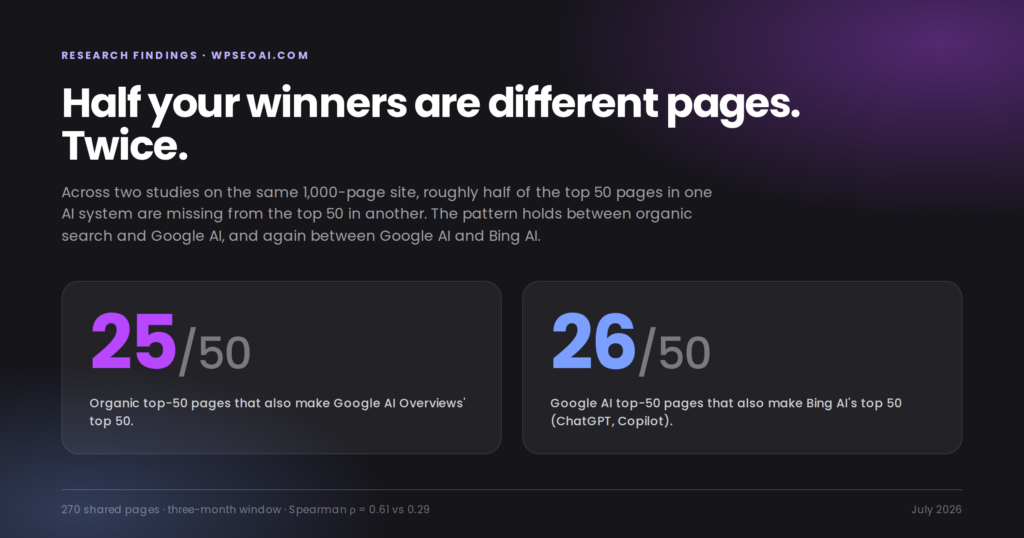
AI Search is not one system, it is at least three partially overlapping systems, and each one rewards different content. Of the top 50 pages we win in organic Google Search for a B2B SaaS company, only 25 make the top 50 in Google AI Overviews.
Of those top 50 Google AI pages, only 26 appear in the top 50 on Bing-powered AI surfaces, which include ChatGPT search and Microsoft Copilot. That means roughly half your top-performing pages change at every transition between systems.
The reason is fundamental: Google AI Overviews, Bing-powered AI, and classic organic search each use different signals, favor different languages, and reward different content formats. Optimizing for one and assuming the others follow is a mistake.
This piece documents how we measured the two overlap gaps, why they exist (language and content format), and what they mean for anyone planning a content strategy around AI Search.
Key Takeaways
- AI Search is three distinct systems, not one. Organic Google Search, Google AI Overviews, and Bing-powered AI (ChatGPT search, Microsoft Copilot) each reward different pages, roughly half your top-50 winners change at every transition between systems.
- The “half your pages are different” pattern is remarkably stable. Top-50 overlap sits at 25 pages between organic and Google AI, and 26 pages between Google AI and Bing AI, an almost identical split across two separate comparisons.
- Google AI and Bing AI rank shared pages very differently. The Spearman rank correlation between Google AI and Bing AI is only 0.29, meaning even pages cited by both systems are ordered in substantially different ways.
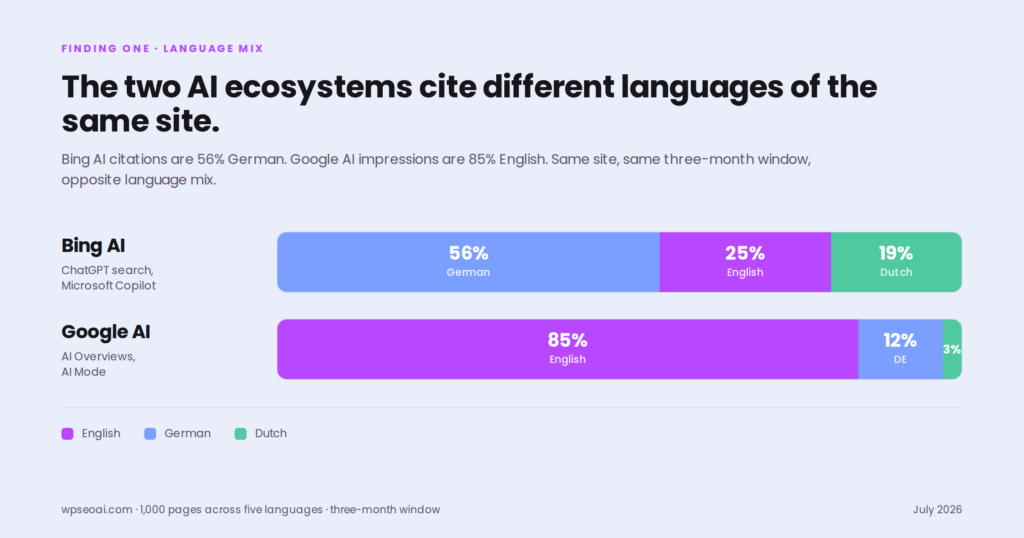
- Language is the single biggest driver of divergence. Bing AI citations are 56% German and 25% English; Google AI impressions are 85% English and 12% German, a near-complete inversion of the language mix.
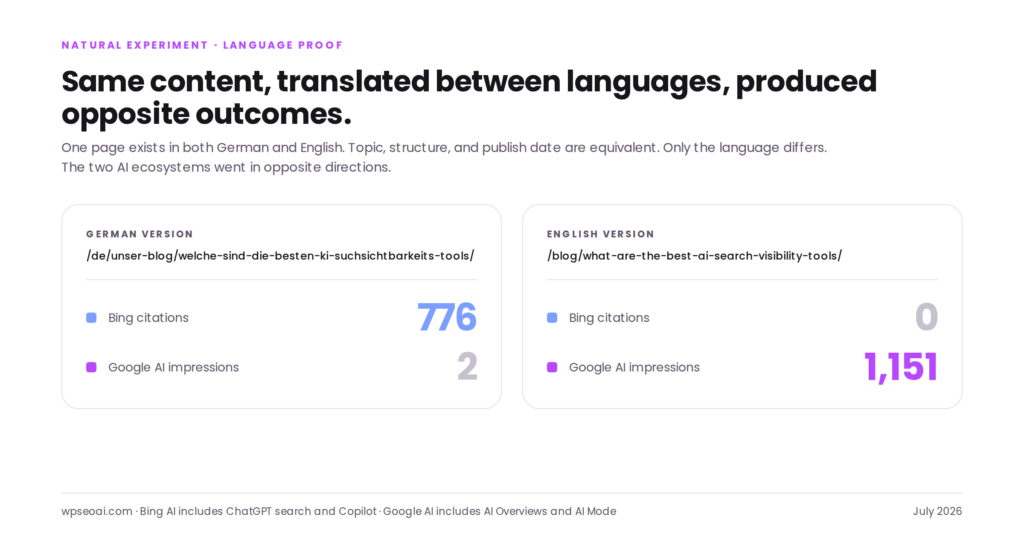
- A natural experiment confirmed the language effect. The German version of a page earned 776 Bing citations and 2 Google AI impressions; its English equivalent earned 0 Bing citations and 1,151 Google AI impressions, same topic, same structure, different language.
- Content format is the second major axis of disagreement. English question-format and listicle content reaches up to a 55× Google-to-Bing ratio, while non-English how-to and best-of content is the only format where Bing consistently outperforms Google AI.
- Classic organic SEO still underpins everything. A Spearman correlation of 0.61 between organic impressions and Google AI impressions means a strong organic foundation remains the most reliable leading indicator for Google AI visibility.
- Winning across all three systems requires a differentiated content strategy. A single “AI-optimized” content template cannot serve Google AI Overviews, Bing AI, and organic search simultaneously, each channel demands its own format and language priorities.
What did this study measure?
We compared per-URL AI citation data across two sources over a three-month window ending July 12, 2026. The site has around 1,000 indexed pages across English, German, Dutch, Finnish, and Swedish. Both datasets come from official webmaster tools, not third-party estimators.
Which datasets did we use?
The Google dataset comes from Google Search Console’s Search Generative AI Features performance report, exported per URL. It records impressions across AI Overviews and AI Mode. The Bing dataset comes from Bing Webmaster Tools’ AI Page Stats export, which records citation counts across Bing-powered AI surfaces including Microsoft Copilot, ChatGPT search, and other systems using Bing’s index.
How comparable are the two metrics?
Google Search Console reports impressions. Bing Webmaster Tools reports citations. These metrics are not identical. Impressions include cases where a URL is listed among AI response sources. Citations imply explicit attribution in an AI answer.
Both are reasonable proxies for “an AI surfaced this page,” but the absolute counts are not directly comparable. This study focuses on ranks and rank correlations rather than raw volumes, precisely because raw counts across the two tools are not directly comparable.
How did we run the analysis?
We joined the two per-URL exports, restricted comparisons to pages both engines cite, and used rank-based statistics. The design deliberately avoids any comparison of absolute volumes between Google Search Console and Bing Webmaster Tools.
How did we normalize URLs across the two datasets?
We normalized URLs by lowercasing and stripping trailing slashes before joining the two datasets on URL. No further canonicalization was applied, because the target domain does not use www subdomains or query parameters in indexable URLs. This yielded a clean join key for every URL in both exports.
Which pages count as “shared”?
A shared page is any URL appearing in both the Google Search Console AI export and the Bing Webmaster Tools AI export after normalization. This study identified 270 shared pages, out of 305 pages in the Bing catalog and around 1,000 in the Google Search Console AI catalog. All ranking correlations and top-N overlap statistics report on this shared subset, so that the comparison is like-for-like.
Which statistical tests did we use?
We used top-N overlap as the primary comparison, because “how many of your top pages appear in both systems” is the question practitioners actually ask. Spearman rank correlation supports the overlap numbers by measuring whether the two systems order shared pages the same way. Pearson correlation is reported alongside for completeness. Top-N overlap is reported at N equal to 10, 25, 50, and 100, so the pattern is not a single-threshold artifact.
How different is Google AI from organic Google search?
Google AI and Google organic agree on around half of top pages, and disagree on the rest. This was the central finding of our June 2026 study, published as “The gap between ranking on Google and getting cited by AI is bigger than most SEOs think.”
How much do the top organic pages overlap with the top Google AI pages?
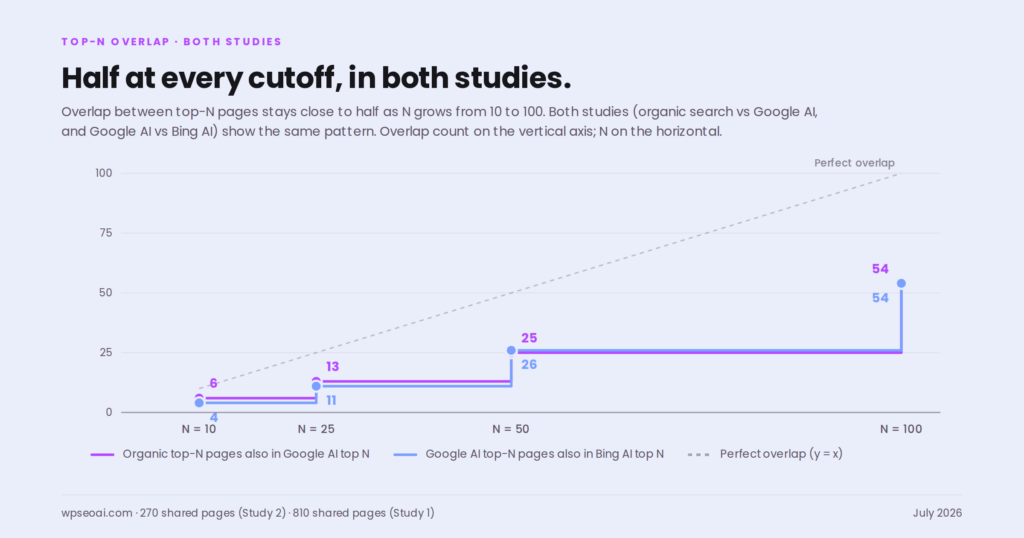
Around half at every cutoff. Six of our top 10 organic pages are also top 10 in Google AI features. Thirteen of top 25. Twenty-five of top 50. Fifty-four of top 100. The overlap is high enough that classic SEO still matters for AI Search visibility. It is low enough that treating organic and Google AI as the same channel produces the wrong content strategy.
What did the correlation between organic search and Google AI reveal?
The Spearman correlation between organic clicks and Google AI impressions was 0.61 across 810 URLs appearing in both Google Search Console reports. That number rose to 0.76 when we correlated against organic impressions instead of clicks. Impression growth is a better leading indicator for AI visibility than click growth on this site. Pages accumulate visibility before they accumulate traffic, and Google AI features appear to pick up on that earlier signal.
How different is Google AI from Bing and ChatGPT?
Google AI and Bing-powered AI have almost the same top-50 overlap as Google AI and organic search do, but they disagree far more strongly on the ordering of the pages inside that overlap. This is the new finding of the July 2026 study.
How much do the top Google AI pages overlap with the top Bing AI pages?
Around half at every cutoff. Four of Google AI’s top 10 shared pages are also Bing AI’s top 10. Eleven of top 25. Twenty-six of top 50. Fifty-four of top 100. The top-50 count is nearly identical to the organic-versus-Google-AI comparison (25 vs 26). The stability of that “half your top pages are different” pattern across three separate comparisons is the core message of the whole study.
What did the Spearman correlation between Google AI and Bing AI reveal?
Across the 270 pages both AI engines cite, the Spearman rank correlation is 0.29. Pearson correlation is 0.57. The rank-based measure is the one that matters here, because the question is whether Google AI’s top pages are also Bing AI’s top pages. They largely are not. A rank correlation below 0.30 means the two AI systems order the same pages in substantially different ways, even more so than organic search and Google AI order theirs (0.61).
What does the second overlap gap tell us?
Two AI systems disagree with each other about page ordering more strongly than either AI system disagrees with Google organic ranking. A reasonable prior would be that two AI systems, both trained on public web content and both designed to surface authoritative sources, would converge on similar pages. On our data, they diverge. The disagreement is not random noise. It falls along two clear axes: content language and content format.
Why do Google AI and Bing AI disagree?
The two AI ecosystems weight signals differently. Two factors explain most of the divergence in the data: the language of the content and its format.
How does language shape AI citations?
The two AI ecosystems cite completely different language versions of the same website. Bing AI citations are 56% German, 25% English, and 19% Dutch. Google AI impressions on the same site are 85% English, 12% German, and 3% Dutch. That is not a modest skew. That is an inversion of the language mix between the two AI ecosystems.
The most likely explanation is search-engine market share. Bing holds a materially higher share of search in German-speaking markets than it does globally. Microsoft Copilot, ChatGPT search, and other Bing-powered AI systems inherit that geographic skew. Google AI Overviews appears to draw more from English-dominant traffic patterns, and continues to surface English content even when a translated German or Dutch equivalent exists.
What did the natural experiment show?
The same content translated between languages produced opposite outcomes across AI ecosystems. Our page “welche sind die besten KI Suchsichtbarkeits Tools” (German) received 776 Bing citations and 2 Google AI impressions. Its English equivalent, “what are the best AI search visibility tools,” received 0 Bing citations and 1,151 Google AI impressions. Topic, structure, and publish date are equivalent. Only the language differs. This close-to-controlled comparison points squarely at language as the primary axis of disagreement between Google AI and Bing AI.
“I’d have to say the biggest/simplest thing to remember about AEO vs SEO is it’s no longer a zero sum game. Two people with the same query can get a different answer on commercial search, if the AI tool they’re using loads personal memory into the context window (Perplexity, ChatGPT).
A lot of this comes down to the technology of the index (why there actually is a difference between GEO and AEO). But yes, it is currently accurate to say (most) traditional SEO best practices still apply.”
Jesse Dwyer, Perplexity – VP of Product
How does content format shape AI citations?
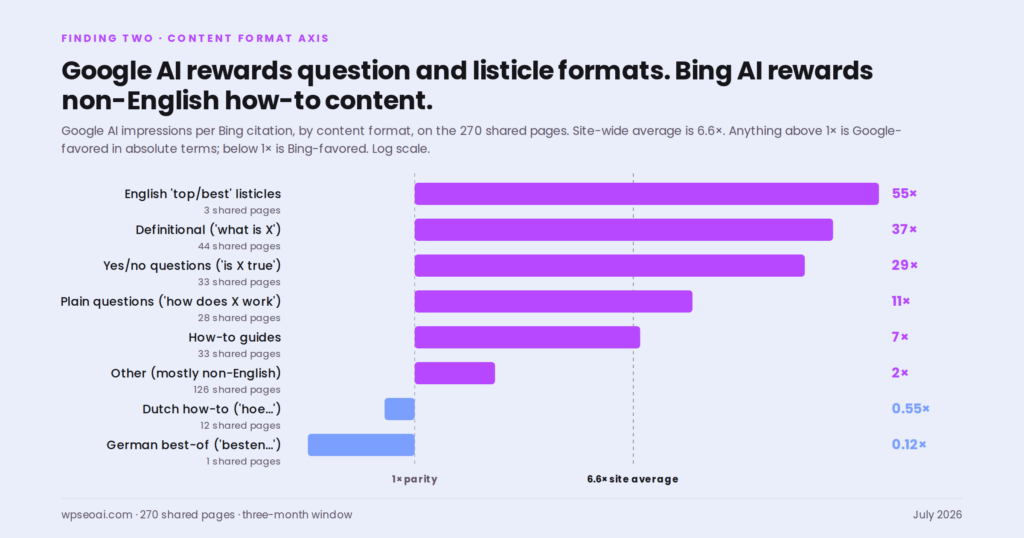
The two AI ecosystems reward different content formats on shared pages. On the 270 pages both engines cite, we classified each page’s format from its URL slug and computed the ratio of Google AI impressions to Bing citations. The site-wide baseline ratio on shared pages is 6.6 to 1. Formats above that ratio are Google-favored. Formats below it are Bing-favored.
| Content format | Shared pages | Google AI : Bing ratio |
|---|---|---|
| English “top/best” listicles | 3 | 55× |
| Definitional (“what is X”) | 44 | 37× |
| Yes/no questions (“is X true”) | 33 | 29× |
| Plain question (“how does X work”) | 28 | 11× |
| How-to | 33 | 7× |
| Other (mostly non-English commercial) | 126 | 2× |
| Dutch how-to (“hoe …”) | 12 | 0.55× |
| German best-of (“besten …”) | 1 | 0.12× |
Google AI Overviews rewards structured question-answer content and English listicles. Bing AI (ChatGPT search, Microsoft Copilot) rewards non-English how-to and commercial best-of content.
Which formats does Google AI reward most?
Question-format and listicle-format content in English. If Google AI Overviews traffic matters to your business, prioritize “what is X,” “is X true,” and “top N X” formats. The Google-to-Bing multipliers we measured (29×, 37×, 55×) are strong enough to justify a dedicated Google-AI content track. Structured, direct-answer content wins on Google AI, consistent with its foundation in featured-snippet and People Also Ask data.
Which content does Bing and ChatGPT reward?
Non-English how-to and commercial best-of content. If ChatGPT search and Microsoft Copilot visibility matter to you, invest in localized how-to and comparison content in German, Dutch, Finnish, and Swedish. Bing-powered AI surfaces are the primary distribution channel for non-English AI Search in several European markets, and the content that wins there is more commercial and less definitional than what wins on Google AI Overviews.
What does this mean for content strategy?
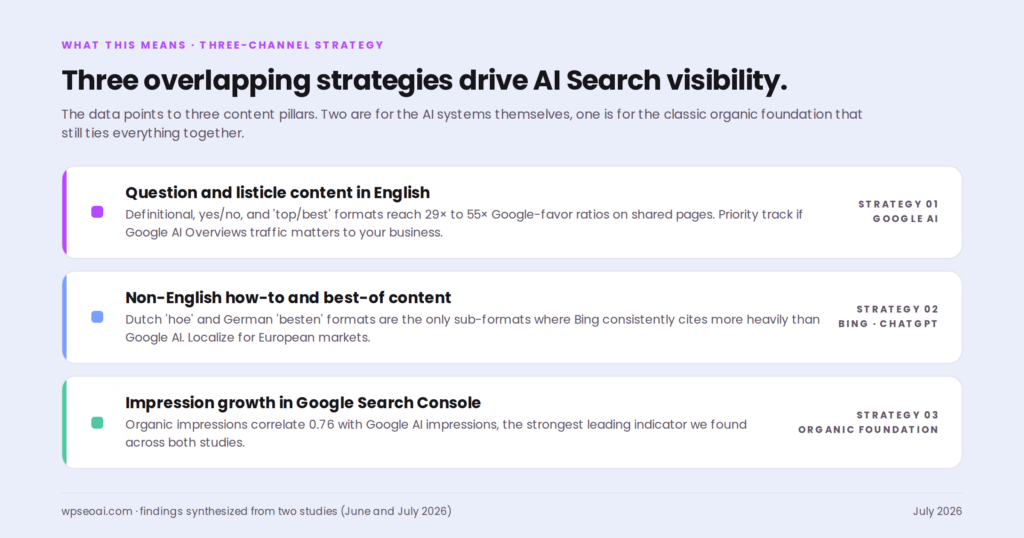
AI Search visibility is three partially overlapping strategies, not one. Treating “get cited by AI” as a single objective produces content that succeeds on one system and fails on the others.
Strategy 1: What wins on Google AI Overviews?
Question-format and listicle content, especially in English. If Google AI Overviews traffic matters to your business, prioritize “what is X,” “is X true,” and “top N X” formats. The Google-to-Bing multipliers we measured (29×, 37×, 55×) are strong enough to justify a dedicated Google-AI content track. Structured, direct-answer content wins on Google AI, consistent with its foundation in featured-snippet and People Also Ask data.
Strategy 2: What wins on Bing, ChatGPT, and Copilot?
Non-English how-to and commercial best-of content. If ChatGPT search and Microsoft Copilot visibility matter to you, invest in localized how-to and comparison content in German, Dutch, Finnish, and Swedish. Bing-powered AI surfaces are the primary distribution channel for non-English AI Search in several European markets, and the content that wins there is more commercial and less definitional than what wins on Google AI Overviews.
Strategy 3: What still ties everything together?
Classic organic ranking. The 0.61 correlation between organic impressions and Google AI impressions means organic search remains a leading indicator for Google AI visibility. Impression growth in Google Search Console typically precedes AI citation growth. This is where AI automation and human expertise combine well: automate the technical foundation and content production pipeline, and let editorial judgment shape which formats and languages to prioritize per AI system.
What are the limitations of this study?
This study analyzes one website over a three-month window using per-URL exports from two webmaster tools. Several caveats apply to the findings before you generalize them.
Which limitations should readers keep in mind?
Sample size is one site, one publisher category (B2B AI and SEO content), five languages. Findings may generalize to similar B2B publishers operating in European markets. They may not generalize to consumer content, single-language sites, or non-European markets. The Bing window is 90 days and the shared overlap window is 56 days, long enough for pattern to emerge, too short to capture seasonal effects.
What did we not measure?
Query strings, click-through rates from AI surfaces, downstream conversions, and citations from AI systems outside the Bing and Google indices. Perplexity, Anthropic Claude’s web tools, and other systems using proprietary or hybrid indices are not represented in this data. Absolute citation and impression volumes across Google Search Console and Bing Webmaster Tools were not directly compared, because their reporting definitions differ.
Where AI Search visibility research is heading
The main lesson from this work is that AI Search deserves the same rigor SEO practitioners already apply to organic search. Different AI systems reward different content, and the differences are large enough to change content strategy in practice.
Our next study will compare citation patterns in Perplexity and Anthropic Claude’s web tools against Google AI and Bing AI on the same URL set. Reproducibility matters. The analysis in this post can be replicated on any site with sufficient volume in both Google Search Console and Bing Webmaster Tools. We share our normalization and analysis logic with other researchers on request.
The strategic implication is direct. Winning AI Search requires publishing content that fits each system’s preferences, not one universal AI-optimized template. Structured direct-answer content wins on Google AI Overviews. Localized how-to and best-of content wins on Bing and ChatGPT. Both benefit from a strong organic foundation.
Doing all three at scale requires AI automation paired with editorial judgment, which is the model we apply for clients at WP SEO AI.
This content was generated with the help of AI and it may contain mistakes