

AI search visibility is now a business metric that matters as much as your Google ranking. ChatGPT processes billions of queries daily, Google AI Overviews appear on roughly half of all searches, and B2B buyers routinely consult generative AI before making purchasing decisions. If your brand is not showing up in those answers, you are invisible to a growing share of your most valuable prospects.
This guide walks you through nine proven tactics to improve your AI search visibility in 2026. Each step builds on the last, moving from audit to execution to ongoing measurement. Follow them in order and you will have a working generative engine optimization (GEO) strategy by the end.
1. Audit your current AI search presence first
Before you optimize anything, you need to know where you currently stand. An AI visibility audit measures how often your brand appears in AI-generated answers across platforms like ChatGPT, Google AI Overviews, Perplexity, and Gemini. This is fundamentally different from a traditional SEO audit, which focuses on keywords and backlinks. Here, you are tracking mentions, citations, and links inside AI responses.
Start by building a prompt library of 20 to 50 questions that mirror real buyer-intent searches in your niche. Think about how a potential customer would ask a generative AI for help finding a solution like yours. Then run each prompt across the major platforms and record three outcomes: whether your brand is mentioned in the text, whether it appears in references, and whether there is a clickable link back to your site.
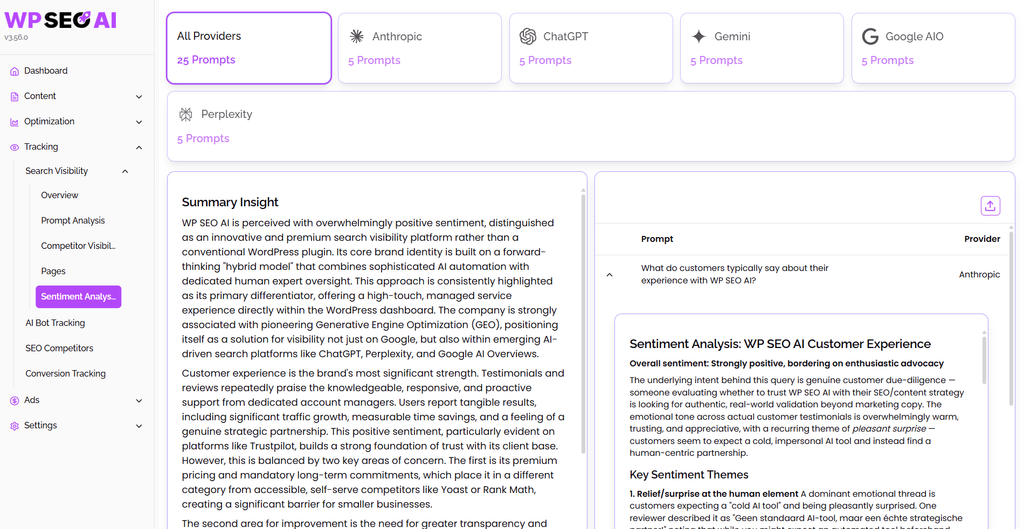
- Build a prompt library covering category-level questions, comparison queries, and problem-specific questions relevant to your business.
- Run each prompt on ChatGPT, Google AI Overviews, Perplexity, and Gemini. Repeat each prompt three times, since AI answers vary between sessions.
- Log results in a spreadsheet: record mentions, citations, and links separately for each platform and prompt.
- Calculate your mention rate. A rate below 10% on category-defining prompts signals a serious gap in content authority or off-site recognition.
Tools like Ahrefs Brand Radar offer a free starting point for tracking brand mentions across AI-generated responses. Paid options such as Otterly.AI, Semrush AI Visibility Toolkit, and Profound scale the process for larger prompt libraries. After completing this audit, you will have a clear baseline, a list of gaps, and a prioritized list of platforms to focus on. ChatGPT drives the largest share of AI referral traffic, so prioritize it first.
2. Structure content for generative engine retrieval
Generative AI systems retrieve content using a process called Retrieval-Augmented Generation (RAG). The AI breaks a query into sub-queries, pulls relevant content chunks from its index, and synthesizes an answer. Content that is easy to chunk, parse, and extract gets cited. Content that is dense, unstructured, or buried in long paragraphs gets skipped.
The Princeton GEO research tested nine content modification strategies across 10,000 queries and found that specific structural choices boost AI citation rates by up to 40%. The top-performing tactics were citing sources within content, adding statistics, using an authoritative voice, and optimizing for fluency. Keyword stuffing performed worse than doing nothing.
- Use clear H2 and H3 headings that mirror the questions your audience asks. AI systems treat headings as prompts and the paragraphs below them as answers.
- Write in short paragraphs of 50 to 150 words. AI models digest content in chunks; long unbroken blocks are harder to extract accurately.
- Add a Q&A or FAQ section to key pages. Each answer should be self-contained and understandable without reading the surrounding article.
- Include specific statistics and cite the source directly in the sentence. Named data points signal authority to retrieval systems.
After restructuring a page, check that each section reads as a complete, standalone answer. If a paragraph relies on context from three sections earlier to make sense, rewrite it so it stands alone. This chunk completeness is one of the most overlooked structural requirements for generative engine optimization.
3. Build topical authority across your niche
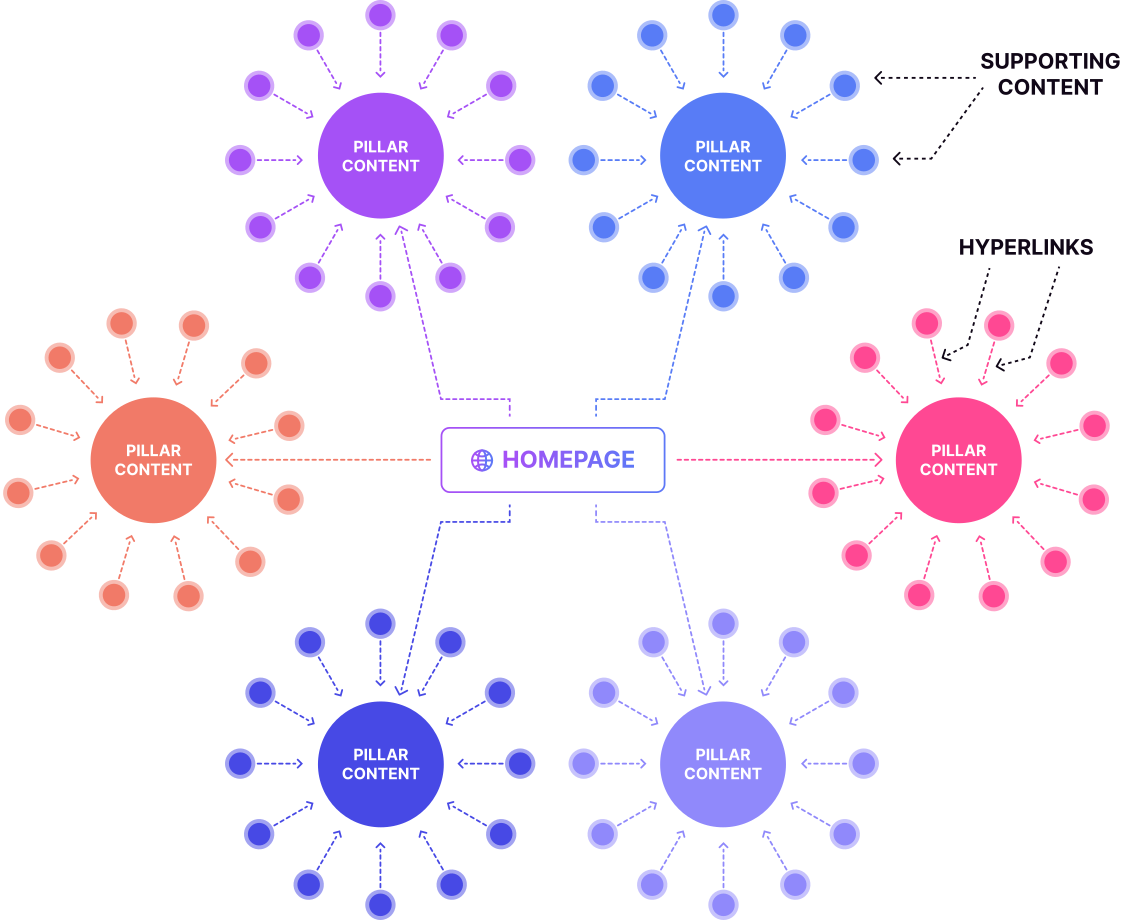
Topical authority in AI search means that LLMs like ChatGPT, Claude, and Perplexity recognize your domain as a comprehensive, consistent source across an entire subject area. A single well-optimized page is not enough. AI models reward breadth and depth across a tightly connected topic cluster.
Research from Growth Memo confirms that the top 10 domains in any topic capture roughly 46% of all ChatGPT citations, while the top 30 capture 67%. The good news for smaller businesses is that a focused niche site can genuinely outcompete a large general publication for LLM citations, because AI models increasingly recognize that a specialized source is often more accurate and reliable than a broad one.
- Map your core topic and identify 12 to 20 subtopics that a buyer would research before, during, and after making a purchase decision.
- Create one pillar page that covers the core topic comprehensively, then publish individual cluster pages for each subtopic.
- Link cluster pages to the pillar and to each other using consistent terminology. Terminology drift weakens the semantic signal AI systems use to recognize topical depth.
- Update existing cluster pages every 90 days with new data, revised context, or expanded sections. Pages updated within the last 90 days are significantly more likely to surface in AI-generated responses than pages left untouched for a year or more.
Most brands see measurable LLM citation growth between 90 and 180 days with disciplined cluster execution. Patience matters here. You are training AI systems to recognize your domain as an authoritative source, and that recognition compounds over time. Explore how AI visibility builds through consistent topical coverage.
4. Optimize for entity recognition and brand mentions
Entity recognition is how AI systems identify and trust your brand as a distinct, verifiable subject in the world. Google’s Knowledge Graph holds facts about billions of entities. When your brand has a consistent, well-connected entity record across the web, AI systems are more likely to include you in answers, even when your content does not rank in the traditional top 10.
A May 2026 study of over 150,000 AI citations found that the majority of cited URLs were outside the organic top 10 in traditional search results. Entity recognition, not ranking position, was the deciding factor in whether a brand appeared in AI-generated answers.
- Claim or create a Wikidata entry for your brand. Add your official website, founding date, key personnel, and external identifiers like your LinkedIn company ID and Crunchbase permalink.
- Deploy complete Organization schema in JSON-LD on your homepage and About page. Include a full
sameAsarray linking to your Wikidata entry, LinkedIn, Crunchbase, and other authoritative profiles. - Ensure your brand name, URL, and description are identical across every platform: your website, LinkedIn, Crunchbase, Google Business Profile, and any industry directories.
- Validate your schema using Google’s Rich Results Test and review it quarterly for accuracy.
Beyond structured data, brand mentions across authoritative third-party sources are a strong predictor of AI visibility. YouTube mentions, branded web mentions, and branded anchor text consistently outperform raw backlink counts as signals for AI citation selection. Prioritize activities that get your brand name mentioned in context across respected publications, not just linked from them.
5. Write content that directly answers high-intent queries
The average ChatGPT prompt is around 23 words, compared to roughly 3 words in a traditional Google search. Users ask generative AI detailed, conversational questions. Your content needs to answer those questions directly, completely, and at the top of the page, not buried after several paragraphs of background.
Google’s official AI optimization guidance confirms that generative AI features use query fan-out, generating a set of related sub-queries to find the best answer. If your content answers only the broad question but not the specific sub-questions a buyer might ask, you will be passed over for content that does. According to Google’s AI optimization guide, the same content quality fundamentals that drive traditional rankings also drive LLM citations.
- Identify your highest-intent pages: service pages, comparison pages, pricing pages, and bottom-funnel guides. These are your priority targets for Answer Engine Optimization (AEO).
- Open each page with a direct, declarative answer to the primary question the page addresses. Do not build up to the answer. Lead with it.
- Map the sub-questions a buyer would ask alongside the main question and address each one explicitly, using its own heading or paragraph.
- Cite credible sources within your content using named attributions. “According to Gartner’s 2025 forecast” carries more weight with AI retrieval systems than an unsourced claim.
- Add or expand FAQ sections at the bottom of service and product pages, using the exact phrasing your audience uses when asking AI tools for help.
AI-driven visitors convert at a notably higher rate than standard organic visitors because they arrive further along in their research process. Optimizing your highest-intent pages for AI citation is not just an SEO tactic. It is a pipeline decision.
6. Earn authoritative backlinks and third-party citations
AI systems do not rely primarily on your own website when formulating answers. Research consistently shows that around 85% of brand mentions in AI responses come from third-party pages, not owned domains. Your content earns AI visibility by being referenced, quoted, and cited across the web, not just by existing on your site.
A controlled study found that when content was distributed through third-party news outlets rather than published only on a brand’s own site, the AI citation rate increased by more than 300%. Earned media and digital PR are the highest-leverage activities for building AI search visibility at scale.
- Identify three to five industry publications, news outlets, or respected blogs in your niche that your target audience reads and that AI platforms regularly cite.
- Pitch original research, expert commentary, or data-backed opinion pieces to those publications. Prioritize outlets where your competitors are already being quoted.
- Create linkable assets on your own site: original data, survey results, frameworks, or tools that other sites will reference naturally.
- Build relationships with journalists and analysts who cover your industry. A single mention in a widely cited trade publication can produce more AI citation lift than dozens of lower-authority links.
- Track which third-party mentions result in AI citations using your prompt library from Step 1. Double down on the publication types and content formats that generate the most citation activity.
Backlinks still matter as infrastructure. Sites with a strong referring domain profile are more likely to be included in the retrieval pool that AI systems draw from. But once a domain clears that authority threshold, entity recognition, content structure, and third-party validation determine citation selection. Build both in parallel.
7. Implement technical GEO signals on your site
Technical GEO is about making sure AI crawlers can access, parse, and index your content correctly. AI retrieval bots now represent a significant share of all crawler traffic, and most sites have not updated their technical configuration to account for them.
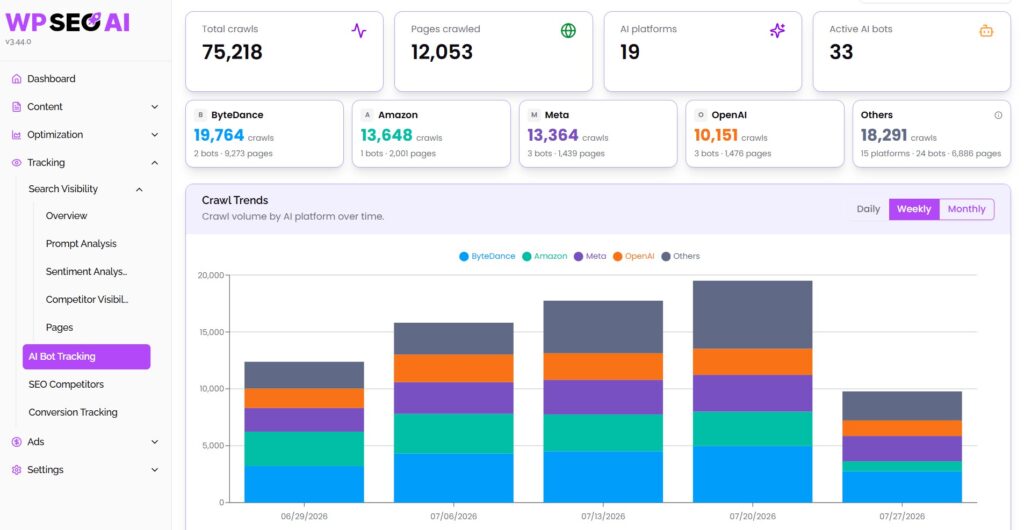
The most important distinction to understand is the difference between AI training bots (like GPTBot when it collects data to train models) and AI retrieval bots (like OAI-SearchBot and PerplexityBot, which power live search results). Blocking retrieval bots in your robots.txt harms your AI search visibility directly. Blocking training bots does not.
- Open your robots.txt file and check which AI bots are blocked. Ensure OAI-SearchBot, PerplexityBot, and Google-Extended are allowed. Review GPTBot separately based on your content licensing preferences.
- Implement Organization schema in JSON-LD on your homepage. Add FAQ schema to FAQ sections and Article schema to blog posts and guides.
- Validate all schema using Google’s Rich Results Test and the Schema Markup Validator. Fix any errors before moving on.
- Ensure your most important pages are publicly accessible without login walls, paywalls, or JavaScript rendering requirements that block crawlers.
- Consider adding an llms.txt file at your domain root. This plain-text file, proposed by Jeremy Howard in 2024, is designed to guide AI systems toward your most important content. Note that Google has stated it does not use the file, and large-scale bot traffic analysis suggests most AI crawlers skip it. Treat it as a low-cost supplementary signal, not a primary GEO lever. Aim for 20 to 50 links to your core pages rather than a full sitemap dump.
After completing these technical steps, use a tool like Screaming Frog or Semrush to verify that your key pages are crawlable and that schema is rendering correctly. The strategic value of schema markup has grown significantly in 2026. It now functions as a knowledge graph data layer that helps AI systems interpret your brand’s entities, relationships, and expertise at scale.
8. Monitor AI visibility and iterate based on results
AI search visibility requires ongoing measurement, not a one-time setup. AI answers change frequently, and a brand that appears in 80% of relevant responses today may drop significantly within weeks if a competitor publishes stronger content or earns more third-party citations. Single-snapshot measurement gives you a misleading picture. Track trends across a consistent set of priority queries instead.
Google launched dedicated Generative AI performance reports in Google Search Console in June 2026, giving site owners isolated visibility metrics for AI Overviews and AI Mode for the first time. These reports cover impressions, pages, countries, and devices. Start there for Google-specific data, then layer in third-party tools for cross-platform coverage.
- Set up Google Search Console and navigate to the new Generative AI performance report. Review impression trends for your priority pages weekly.
- Choose one or two dedicated AI monitoring tools. Otterly.AI converts your existing SEO keywords into GEO prompts and tracks citation rates across platforms. Semrush AI Visibility Toolkit covers ChatGPT, Claude, and Perplexity in a single dashboard. Ahrefs Brand Radar offers a free tier for a snapshot view.
- Track four core KPIs: Citation Rate (the percentage of relevant prompts where your domain is cited), Brand Mention Rate, Share of Voice relative to competitors, and Assisted Conversions from AI-referred traffic.
- Update any content that has not been refreshed in 90 days. Make substantive changes: new data, revised sections, expanded context. Cosmetic date changes do not register as fresh content to AI systems.
- Run a full re-audit of your prompt library every quarter. Compare results against your original baseline to measure progress and identify new gaps.
AI search visits often appear as direct traffic in standard analytics, which distorts your measurement. Use a combination of your controlled prompt library, your monitoring tools, and CRM records to build a complete picture of AI-driven pipeline. Branded search volume in Google Search Console is one of the most reliable indirect indicators: when your AI visibility improves, branded search typically rises alongside it.
The WP SEO AI platform automates much of this monitoring work inside WordPress, tracking your performance across both Google and generative engines from a single dashboard. But whether you use a dedicated platform or a manual spreadsheet process, the discipline of regular measurement is what separates brands that grow their AI search visibility from those that stall after the initial setup.
This content was generated with the help of AI and it may contain mistakes