

Your content team spends hours researching, writing, and editing each article. The title gets five minutes and a gut check before publishing.
That imbalance has a cost.
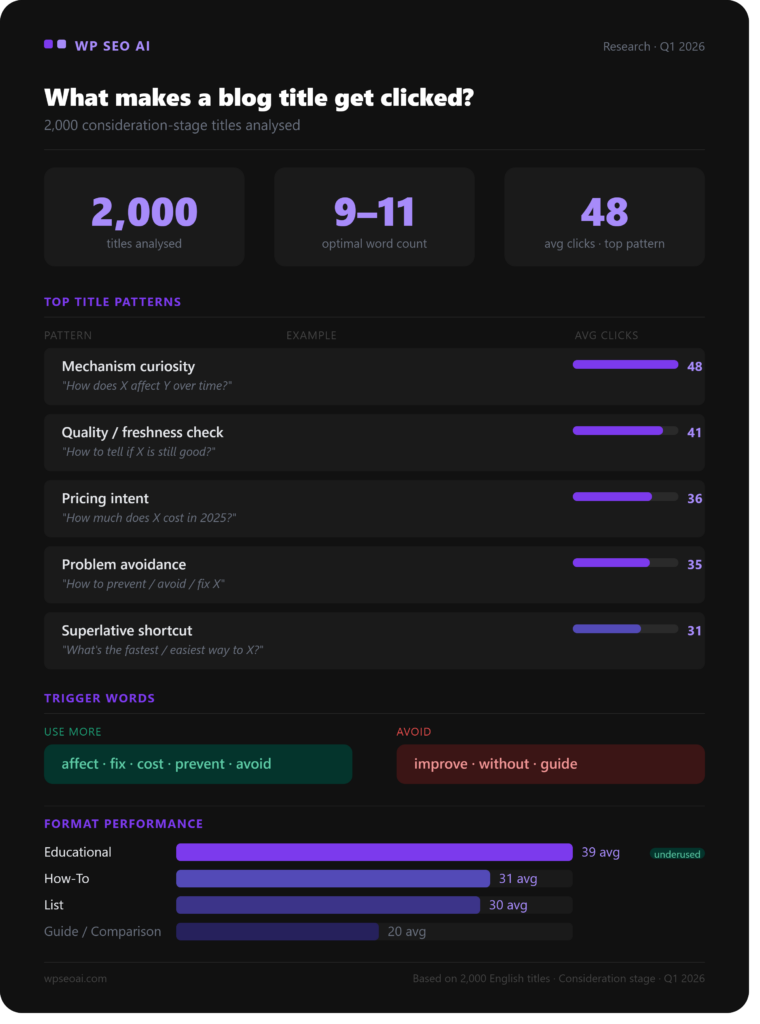
We pulled 2,000 English blog post titles from WP SEO AI clients, all published in Q1 2026 at the consideration stage of the buyer journey. We looked at what they had in common, which structures drove the most organic clicks, and which patterns are quietly underperforming despite being widely used.
The results are specific enough to brief your team on tomorrow.
Key stats
We analysed 2,000 English blog post titles published by WP SEO AI clients in Q1 2026, all at the consideration stage of the buyer journey. Three numbers define what we found.
| Stat | Value |
|---|---|
| English blog titles analysed from Q1 2026 | 2,000 |
| Optimal word count for highest avg clicks | 9–11 |
| Avg clicks for “how does X affect Y” titles | 48 |
Format distribution
How-To content dominates production volume, but it is not the highest-performing format by clicks. Educational titles average 39 clicks, 26% above How-To, despite representing just 6% of all titles published.
| Format | Titles | Avg clicks | Signal |
|---|---|---|---|
| Educational | 112 | 39 | Underused |
| How-To | 1,407 | 31 | Dominant |
| List | 346 | 30 | Solid |
| Guide | 57 | 20 | Weak |
| Comparison | 36 | 20 | Weak |
Need more traffic?
With our managed SEO service, we produce the content you need to bring more relevant traffic to your website.
Title structure patterns
Across the top 200 titles by click volume, six structural patterns appear repeatedly. These are not content suggestions, they are the actual title structures behind the highest-performing posts in the dataset.
| Pattern | Example | Performance |
|---|---|---|
| Mechanism curiosity | “How does X affect Y over time?” | 48 avg clicks · 56 titles in dataset |
| Quality / freshness check | “How to tell if X is still good / ready” | Top performer · 1,644 clicks (top title) |
| Pricing intent | “How much does X cost in 2025?” | 36 avg clicks · 89 titles, commercially strong |
| Problem avoidance | “How to prevent / avoid / fix X” | 34–65 avg clicks · “fix” is significantly underused |
| Superlative shortcut | “What’s the fastest / easiest way to X?” | Strong with AI topics · 290 clicks (top example) |
| Urgency framing | “X fun things to do tonight when Y” | 242 avg clicks · small sample, high signal |
Trigger words
Not every frequently-used word earns its place. Several of the most common words in the dataset show poor click performance, while a handful of underused words consistently outperform. Here is what the data says.
| Word / phrase | Frequency | Avg clicks | Verdict |
|---|---|---|---|
| fix | 5 | 65 | Underused |
| affect | 56 | 48 | Use more |
| cost / how much | 89 | 36 | Keep using |
| prevent / avoid | 47 | 35 | Keep using |
| best | 98 | ~28 | Saturated |
| improve | 41 | 12 | Avoid |
| without | 29 | 14 | Avoid |
Format patterns
How-To completely dominates (70% of titles, 1,407 pieces), but it’s not the highest-performing format per click. Educational content averages 39 clicks vs How-To’s 31, suggesting the format is underutilised relative to its potential. Guides and Comparisons trail significantly at 20 avg, possibly because those titles tend to be more generic.
Recommendation: Don’t over-index on How-To just because it’s the plurality. Prioritise Educational and specific How-To variants.
Question framing: the “how” hierarchy
Within How-To titles, there’s a meaningful split:
- “How do you…” (243) and “How does…” (245) — third-person, mechanism-focused
- “How to [verb]…” (406) — instructional, classic
- “How do I…” (154) — first-person, personal problem
- “How can I…” (65) — softer ask
The data shows no significant click difference between “how do I” and “how do you” phrasing, so prioritise whichever sounds most natural for the topic. “How much does X cost” (35 titles, 36 avg clicks) punches above its weight — strong signal.
Top trigger words and what they signal
Highest frequency: best (98×), cost (80×), guide (60×), difference / vs (60×/56×), choose (41×), improve (41×), prevent (37×).
By average clicks per use, the standout signals are:
- “affect” — 56 titles, 48 avg clicks. Pattern: “how does X affect Y” consistently performs. Mechanism curiosity is a strong driver.
- “fix” — only 5 titles but 65 avg clicks. Deeply underused.
- “tonight” / urgency — tiny sample but 242 avg clicks. Titles framing immediate relevance (“things to do tonight when you’re bored at home”) are high performers.
- “avoid” / “prevent” — combined ~47 titles, 34–37 avg. Loss-aversion framing works.
- “cost” + “how much” — 89 pricing-intent titles at 36 avg clicks. Strong consideration-stage signal, commercially valuable.
Low-performing despite high frequency: improve (41 titles, only 12 avg clicks), without (29 titles, 14 avg clicks). These are over-used and likely underdelivering.
Listicle patterns
5 is far and away the most common list number (51 titles), followed by 10 (30), 6 (31), and 7 (28). The dataset doesn’t show enough per-number click data to rank them definitively — but 5 and 7 are the convention anchors worth sticking with.
Title length sweet spot
9–11 words hits the highest avg clicks (33). Titles shorter than 6 words underperform (21 avg). The advice to “keep titles short” isn’t supported here — mid-length descriptive titles win.
Personal pronouns: no significant difference
Titles with “I/you/your/my” average 30 clicks vs 31 without. Don’t write pronouns in for their own sake — use them only if they make the question more natural-sounding.
Top-performing title structures (from the top 30)
The highest-click titles cluster around a few recurring structures:
| Pattern | Example |
|---|---|
| How to tell if X [sensory/quality check] | “How to tell if meat is still good by smell” (1,644 clicks) |
| How do [animals/things] survive/work | “How do huskies survive in the cold” (991) |
| How does X affect Y | “How does rowing affect your body composition over time” (481) |
| What’s the fastest/easiest way to X | “What’s the fastest way to create backing vocals with AI” (290) |
| [Number] fun [activity type] for [context] | “7 fun group activities to plan for tonight’s gathering” (854) |
| How much does X cost | “How much does a solar desalination system cost in 2025” (251) |
| Difference between X and Y | “What is the difference between chuck eye and ribeye” (195) |
Recommendations for your content team
- Lead with mechanism curiosity — “how does X affect Y” and “how does X work” are your strongest structural patterns. Prioritise these over generic “how to improve X” titles.
- Use cost/pricing intent — “how much does X cost” and “what does X cost” are high-performing and commercially relevant at consideration stage.
- Reclaim “fix” and “avoid” — both are underused relative to their avg click performance.
- Target 9–11 words — the data is clear on this. Most titles in the sweet spot are specific, descriptive questions.
- Don’t default to “improve” or “without” — these feel like content production habits, not audience demand signals. The click data doesn’t support them.
- Test urgency framing — small sample but “tonight,” “now,” and time-bound contexts outperform the average significantly.
- Educational format is underbuilt — it has the highest avg clicks but only 112 titles. Brief explainer titles (“what is X vs Y”, “understanding X”) are worth scaling.
This content was generated with the help of AI and it may contain mistakes