

The chatbot conversion rate is the percentage of chatbot users who complete a target action, such as a purchase, lead form submission, or demo booking. Most businesses see rates between 5% and 25%, with high-performing implementations reaching 30% to 40%. This is meaningfully higher than the 1% to 3% of website visitors who typically convert without any chatbot assistance.
It is important to distinguish between two related but different metrics. The chat-to-conversion rate measures how many people who actively engage with the chatbot go on to convert.
The site-wide chatbot conversion rate measures conversions as a share of all website visitors. The first figure will always be higher because it only counts engaged users. Both are useful, but they answer different questions about chatbot performance.
Industry context shapes these numbers significantly. E-commerce businesses tend to see higher rates than B2B companies because the purchase decision is faster and the chatbot can guide users directly to checkout. B2B SaaS companies typically convert at 10% to 15% through chatbot interactions, while e-commerce businesses with well-configured behavioral triggers can reach 20% to 30%.
AI Chatbots for WordPress and WooCommerce Stores
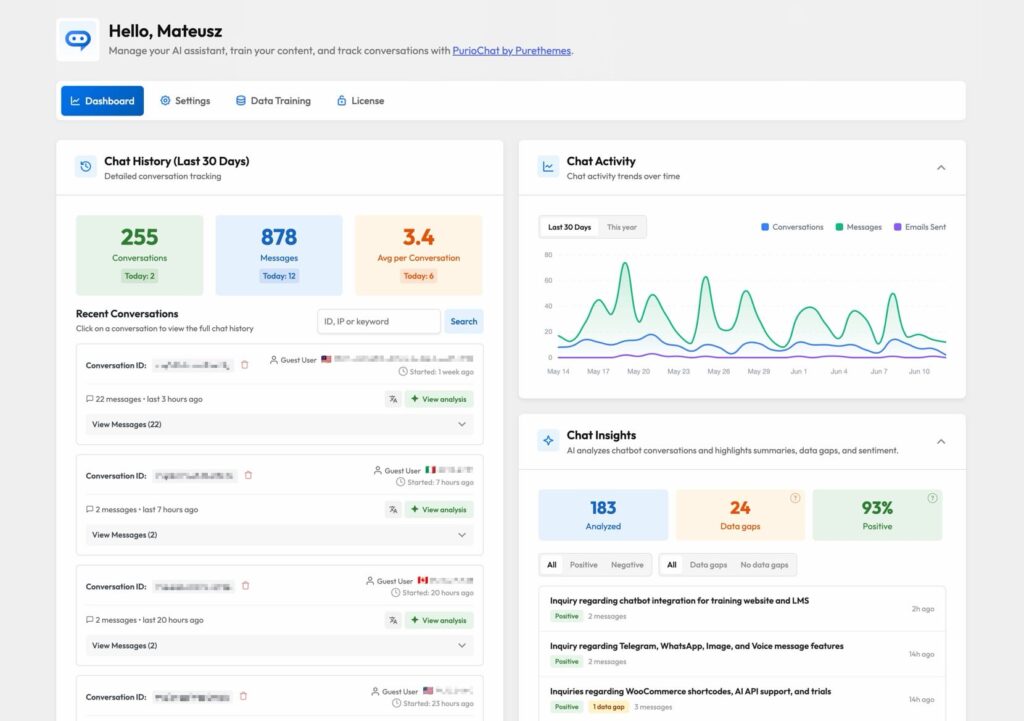
For WordPress site owners and WooCommerce store operators in particular one practical option worth knowing about is PurioChat, a self-hosted WordPress AI chatbot. Rather than relying on a third-party hosted service, it runs directly on your server, which means your visitor conversation data stays in your own WordPress database rather than on someone else’s infrastructure.
What makes it particularly relevant for WooCommerce stores is how it handles product discovery and support.
The chatbot is trained on your actual product catalog, pages, FAQs, PDFs, and custom post types, so it can answer product-specific questions accurately and help customers find what they are looking for through natural language search including handling typos and intent-based queries like “something warm for winter evenings.”
Customers can also check order status directly through the chat, which reduces the volume of repetitive support requests. Store owners using it report up to 40% fewer support tickets, and some note that visitors buy products directly from the chat.
A few features that are worth highlighting for anyone evaluating it:
- WooCommerce integration: product cards, AI-powered recommendations, and order status lookups appear directly inside the chat interface.
- AI-to-human handoff: when a conversation requires a real person, the chatbot transfers seamlessly to a live team member without the user leaving the chat.
- Proactive triggers: the chatbot can initiate conversations based on time spent on a page or scroll depth, reaching visitors at moments of genuine interest rather than waiting passively.
- Multi-channel deployment: the same assistant can be made available on Telegram and WhatsApp, so customers can reach it from wherever they prefer.
- Natural language instructions: instead of building complex decision trees, you configure the chatbot’s behavior by writing plain-language instructions, similar to briefing a new colleague.
- Your own API key: you connect your own OpenAI, Gemini, Mistral, or OpenRouter API key, so AI costs are paid directly to the provider, typically around $5 for roughly 3,000 messages.
There is a free version available for testing, and the Pro license starts at $59 per year.
For WooCommerce stores looking to improve product discoverability and reduce support load without paying the high monthly fees of hosted chatbot platforms, it is a straightforward option to evaluate.
How do chatbots convert visitors into customers?
Chatbots convert visitors into customers by engaging them in real time, answering questions before they leave, qualifying their intent, and capturing contact information that feeds directly into sales workflows. The core mechanism is speed combined with relevance: a chatbot responds instantly, at any hour, without the friction of a static form or a delayed email reply.
Modern AI chatbots use natural language processing to understand what a visitor actually needs, rather than forcing them through a rigid script.
This matters because most visitors will not proactively reach out, but research shows that roughly 45% will engage when a chatbot approaches them based on their browsing behavior, compared to only 20% who initiate contact unprompted.
Behavioral triggers such as exit intent, time spent on a pricing page, or scroll depth allow the chatbot to intervene at the right moment rather than interrupting someone who is still browsing casually.
Once a conversation starts, well-designed chatbots do three things simultaneously. They answer product or service questions that would otherwise stall a decision.
They ask qualifying questions about budget, timeline, and use case to filter for serious prospects. And they collect contact details in a conversational way, pushing that data directly into a CRM so no lead is lost. Businesses using AI chatbots for lead generation report converting into sales at roughly three times the rate of static website forms, largely because the interaction feels responsive rather than transactional.
For e-commerce specifically, chatbots also recover abandoned shopping carts by sending timely follow-up messages and offering incentives.
They guide users through product discovery and answer checkout questions that would otherwise cause drop-off. The result is that visitors assisted by a chatbot tend to complete purchases significantly faster than those navigating on their own.
What factors affect a chatbot’s conversion rate?
A chatbot’s conversion rate is shaped by six primary factors: industry and audience intent, personalization depth, response speed, lead qualification rigor, CRM integration, and mobile optimization. No single factor dominates; strong performance requires most of them working together.
Industry and audience intent
Audience intent is the single biggest variable.
Visitors landing on a pricing page after a Google search for a specific product are much closer to converting than someone browsing a blog post. Industries with high-intent, transactional audiences, such as retail, automotive, real estate, and travel, consistently see higher chatbot conversion rates than those with longer consideration cycles.
B2B SaaS companies typically convert chatbot interactions at 10% to 15%, while retail can reach 20% to 30% with the right setup.
Personalization and response speed
Personalization depth has a measurable impact on conversion. Chatbots that tailor responses based on browsing history, referral source, or previous interactions feel more relevant and build trust faster than generic scripts. Response speed compounds this effect.
Leads contacted within the first minute of showing interest are dramatically more likely to convert than those who wait even a few minutes. AI chatbots deliver that speed consistently, which is a structural advantage over human-only support.
CRM integration and mobile optimization
CRM integration determines whether chatbot conversations actually feed into a sales pipeline or disappear into a void. Companies that connect chatbot data directly to their CRM and marketing automation workflows see substantially higher downstream conversion rates because qualified leads are followed up systematically.
Mobile optimization matters for similar reasons: more than half of all chat interactions happen on mobile devices, and a chatbot that renders poorly or loads slowly on a phone will lose conversions regardless of how well the conversation is scripted.
How do chatbot conversion rates compare to other channels?
Chatbot conversion rates outperform most traditional digital channels by a significant margin. Website forms typically convert 2% to 5% of visitors. AI chatbots convert 15% to 30% of the same traffic when properly configured. That gap exists because chatbots create a two-way interaction rather than presenting a static input field that many visitors simply scroll past.
Email capture and gated content perform similarly to forms, converting a small percentage of visitors who are already motivated enough to hand over their details unprompted.
Chatbots remove that barrier by starting the conversation first and collecting information progressively through dialogue. Chat-to-conversion benchmarks across industries show that engaged chatbot users convert at 10% to 20% on average, which is several times higher than the conversion rate for visitors who only encounter static forms or email opt-ins.
One increasingly relevant comparison is traffic arriving from generative AI tools.
Visitors who click through to a website from ChatGPT or Perplexity convert at a noticeably higher rate than organic Google traffic, likely because those users have already completed much of their research within the AI tool before arriving.
This is worth noting for any business thinking about how chatbot performance fits into a broader AI visibility strategy.
Live chat with human agents also converts well, but the economics are different. Human agents cannot scale to cover every visitor simultaneously, and they are unavailable outside business hours.
AI chatbots provide consistent coverage around the clock, which means they capture high-intent visitors who arrive outside staffed hours and would otherwise leave without engaging.
What types of chatbots have the highest conversion rates?
Generative AI chatbots consistently achieve the highest conversion rates of any chatbot type, outperforming both rule-based and standard NLP-based systems.
Lead generation chatbots deployed on high-intent pages such as pricing, demo request, and contact pages are the highest-converting use case for most B2B businesses. In e-commerce, product recommendation and cart recovery chatbots drive the strongest results.
The performance gap between chatbot types is substantial. Generative AI chatbots understand context, handle unexpected questions, and personalize responses in ways that scripted bots cannot.
Research from Dashly indicates that a generative AI chatbot can deliver roughly 2.5 times the conversion rate of a standard reactive bot, because the conversation feels genuinely helpful rather than mechanical. This matters because 74% of users report preferring generative AI chatbots specifically for their human-like responses.
By use case, sales chatbots are the most widely deployed for conversion purposes, followed by customer support and marketing bots. Sales chatbots deployed on product or pricing pages achieve roughly three times the conversion rate of passive page visits, because they intercept the visitor at the moment of highest intent and guide them toward a decision.
Lead generation chatbots on landing pages work similarly, combining proactive outreach with qualifying questions to filter and capture serious prospects conversationally.
Sector matters too. Retail and e-commerce lead chatbot adoption and see the highest absolute conversion numbers. B2B professional services and SaaS companies achieve strong results through demo bookings and qualified lead capture, with chat interactions converting at 20% to 30% for engaged users even when overall site conversion rates are much lower.
How can you measure your chatbot’s conversion rate?
Chatbot conversion rate is calculated by dividing the number of completed conversions by the total number of chatbot users, then multiplying by 100. For example, if 6,000 visitors interacted with your chatbot and 600 completed a target action, your chatbot conversion rate is 10%.
The key is defining what counts as a conversion before you start measuring!
The most structured measurement framework tracks three data points in sequence: how many visitors triggered the chatbot, how many initiated a conversation, and how many of those conversations resulted in a conversion. This funnel view makes it easy to identify where drop-off is happening.
A high trigger rate but low conversation rate suggests the opening message needs work. A high conversation rate but low conversion rate points to problems deeper in the flow, such as weak CTAs or poor qualification questions.
Core metrics to track
Beyond the headline conversion rate, the following metrics give a complete picture of chatbot performance:
- Chat initiation rate: the percentage of visitors who start a conversation
- Lead capture rate: the percentage of conversations that result in a qualified contact being added to your CRM
- Task completion rate: the percentage of chatbot sessions where the user achieved their goal
- Fallback rate: how often the bot failed to understand a user and handed off to a human or dead end
- Deflection rate: the percentage of users who resolved their query without needing human support
Review cadence and benchmarks
Chatbot metrics should be reviewed at least weekly to catch trends early. For lead generation chatbots, a conversion rate of 20% to 30% is a reasonable benchmark to target once the bot is past its initial tuning phase. A containment rate above 65% and a task completion rate above 70% are generally considered strong performance indicators. Essential metrics for AI chatbot conversion success recommend setting real-time alerts for sudden drops in conversion rate, so problems are caught before they compound across a full week of traffic.
Only 44% of companies actively use message analytics to monitor their chatbots, which means the majority are flying blind. Measuring consistently is one of the simplest ways to gain a competitive advantage, because it enables the iterative improvement that separates average chatbot performance from strong chatbot performance.
How do you improve a low chatbot conversion rate?
Improving a low chatbot conversion rate starts with diagnosing the specific failure point: poor engagement, weak qualification, vague CTAs, or broken CRM integration.
Businesses that address these issues systematically, using redesigned conversation flows, behavioral triggers, and clear follow-up automation, typically see conversion rates improve by 40% to 60% within 30 days.
#1 Improve user experience of your chatbot
The most common reasons chatbots underperform are poor user experience, vague calls to action, and a scope that is too broad. A chatbot trying to handle sales, support, returns, and general FAQs simultaneously tends to do all of them poorly. Giving each chatbot a single, clearly defined job, whether that is qualifying leads, booking demos, or recovering abandoned carts, dramatically improves focus and performance.
#2 Establish proactive triggers
Proactive triggers are one of the highest-impact improvements available. A chatbot that waits passively for a visitor to click it will convert far fewer people than one that initiates a conversation based on behavioral signals. Deploying exit-intent triggers, time-on-page thresholds, and scroll-depth prompts means the chatbot reaches users at moments of genuine friction rather than interrupting casual browsing.
#3 Revise, test and improve CTAs gradually
Strong CTAs make a measurable difference. Vague prompts like “Learn more” or “Get in touch” create hesitation. Specific, value-focused CTAs such as “Book a free 15-minute consultation today” reduce friction by telling the user exactly what they will get and why it is worth their time. Pairing strong CTAs with immediate CRM integration ensures that every qualified lead captured in a chatbot conversation flows into a follow-up sequence without manual effort.
#4 Develop and execute quarterly A/B tests
Finally, ongoing A/B testing of tone, timing, and trigger logic is what separates a chatbot that plateaus at mediocre performance from one that compounds improvement over time. Testing one variable at a time, reviewing results monthly, and refining conversation flows based on actual drop-off data is the most reliable path to sustained improvement in chatbot sales and lead generation performance.
This content was generated with the help of AI and it may contain mistakes